If you spend any meaningful amount of time in Kampala traffic, you quickly develop a clear sense of what a city car needs to be. It needs to be nimble enough to thread through gaps that would make a larger vehicle’s driver break into a cold sweat. It needs to be fuel-efficient enough that the daily grind from Ntinda to town and back does not consume a disproportionate share of your salary. It needs to be reliable — because a breakdown at the Clock Tower roundabout during rush hour is nobody’s idea of a good afternoon. And ideally, it needs to look good doing all of the above.
The Nissan Note checks those boxes with quiet confidence. It is not a flashy car. It does not demand attention the way some vehicles do. But in the Ugandan urban context — where practicality, economy, and durability are the real currency — the Note has consistently proven itself to be one of the smartest choices a city driver can make.
This 2026 review takes a close look at the Nissan Note as it exists on Ugandan roads today: what it gets right, where its limitations lie, how it performs against local conditions, and whether it represents good value for money in the current market.
A Quick Background on the Nissan Note
The Nissan Note is a subcompact hatchback that has been sold in various forms since 2004. The model most commonly found on Uganda’s used import market is the second generation (E12), which was produced from 2012 onwards and received several updates through to 2020. A third-generation Note — featuring a hybrid e-POWER drivetrain — was introduced in Japan in 2020 and is beginning to appear on the Ugandan market as used imports from Japan filter through.
The E12 generation is the car most Ugandan buyers are likely to encounter, and it is the one this review focuses on primarily. It is available in both standard and e-POWER hybrid variants, with the hybrid commanding a premium that is increasingly justified by fuel savings.
Design and Dimensions: Small But Smartly Packaged
The Nissan Note is a compact car by any measure — but Nissan’s designers have done an impressive job of maximising the usable space within modest external dimensions. At roughly 4,100 mm in length, 1,695 mm in width, and 1,525 mm in height, the Note is easy to park in Kampala’s chaotic parking situations, squeezes through narrow streets with confidence, and fits into spaces that larger hatchbacks cannot.
Despite its compact footprint, the interior feels genuinely spacious. The seating position is relatively upright — which improves visibility in traffic and reduces fatigue on longer drives — and rear passengers have more legroom than the car’s exterior suggests. Boot space is practical for a city car: adequate for weekly shopping, a set of luggage, or the kind of cargo that comes with family errands.
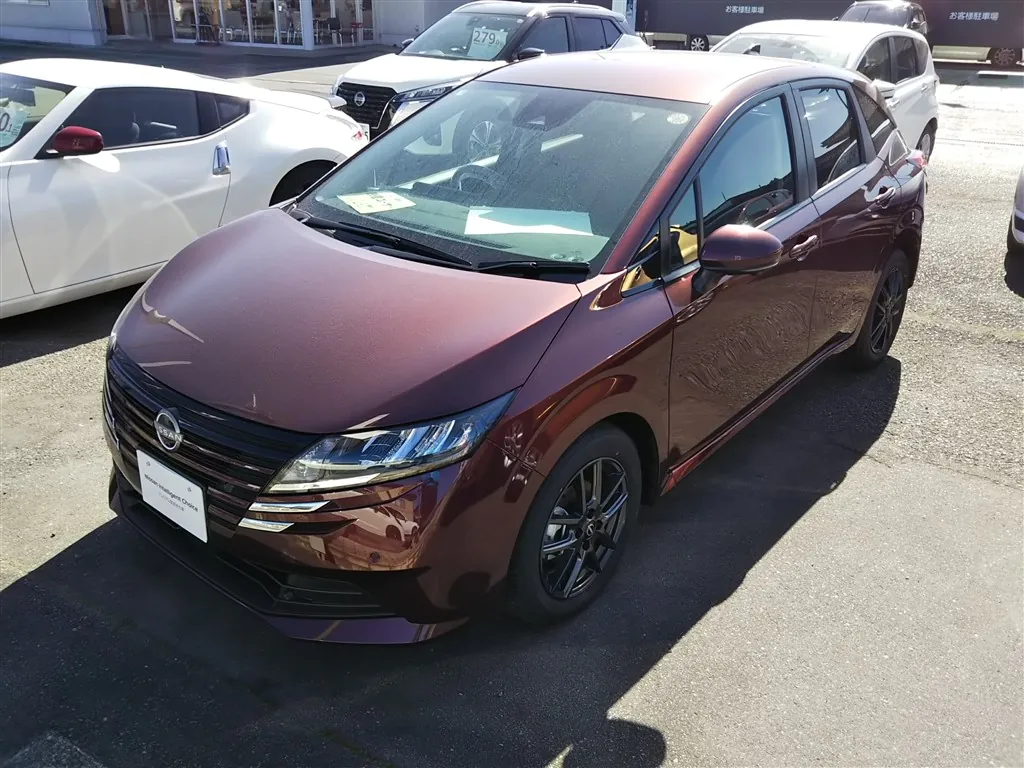
The styling of the E12 Note is clean and modern without being aggressive. Ugandan buyers tend to appreciate a car that looks presentable in a business or family context, and the Note’s understated design serves that preference well. The third-generation model, for those who can access it, represents a more contemporary aesthetic with sharper lines and a bolder front fascia.
Engine and Performance: Efficiency as a Feature
Standard Petrol (HR12DE / HR15DE):
Most E12 Notes on the Ugandan market are equipped with either the 1.2-litre HR12DE three-cylinder engine or the 1.5-litre HR15DE four-cylinder. Both are characteristically Japanese in their approach: they prioritise reliability and economy over outright performance.
The HR12DE produces around 79 horsepower — modest by any sporting standard, but more than adequate for city driving where the speed limit rarely exceeds 50 km/h and the real challenge is responsive low-speed manoeuvring rather than acceleration. The HR15DE offers slightly more pull, which is useful when the car is loaded with passengers.
Neither engine will excite drivers who enjoy a spirited driving experience, but that is not what the Note is designed for. On Uganda’s city roads — where sudden stops, speed bumps, and slow-moving traffic dominate — an engine that responds well at low speeds and sips fuel is infinitely more valuable than one optimised for open-road performance.
Fuel consumption (standard petrol): Approximately 16–19 km/litre in mixed driving — among the best in its class.
e-POWER Hybrid (HR12DE + Electric Motor):
The e-POWER variant is the more technically interesting version of the Note. Rather than functioning as a conventional parallel hybrid (where both the engine and motor drive the wheels), the e-POWER system uses the petrol engine exclusively as a generator to charge a battery, while the wheels are driven entirely by an electric motor.
The practical effect of this system is twofold. First, the driving feel is smoother and more responsive than a conventional petrol car — the electric motor delivers its torque instantly and seamlessly. Second, fuel consumption improves substantially, with real-world figures in Ugandan city conditions typically around 20–24 km/litre. For a driver covering 60–80 km per day in Kampala, this translates to meaningful monthly savings.
The e-POWER system also enables one-pedal driving — the car decelerates firmly when you lift off the accelerator, recovering energy through regenerative braking. It takes a day or two to adapt to but quickly becomes second nature, and it reduces brake wear significantly.
Fuel consumption (e-POWER): Approximately 20–24 km/litre in urban conditions.
Ride and Handling: A City Car in Its Element
The Nissan Note’s suspension is tuned for comfort and stability on imperfect roads — a priority that happens to align well with Uganda’s urban road conditions. The ride quality absorbs the typical city road surface — speed bumps, patched tarmac, shallow potholes — with composure. It is not the most cosseting ride in its class, but it is genuinely comfortable for daily use.
Ground clearance is modest at around 150–155 mm, which means the Note is primarily a tarmac car. It handles Kampala’s central roads and most suburban streets without issue, but it is not suited to deeply rutted murram roads or the kinds of terrain that upcountry travel regularly demands. For city use, this is entirely acceptable — the Note was designed for urban environments and it is honest about that.
Steering is light and direct — a genuine asset in stop-and-go traffic. Parking, U-turns, and tight manoeuvres that would require careful calculation in a larger car are handled with minimal effort in the Note. Drivers transitioning from larger vehicles consistently remark on how much less stressful city driving becomes in a car this size and this responsive.
Interior: Practical, Comfortable, and Driver-Friendly
Step inside the Nissan Note and you are immediately aware that Nissan’s designers made sensible decisions about the use of space. The dashboard layout is logical and uncluttered. Controls are where you expect them to be. The infotainment system on higher-trim variants includes a touchscreen with Bluetooth connectivity, reversing camera, and — on Japanese domestic market (JDM) imports — a detailed navigation system.
Seat comfort is good for a car in this class. The front seats offer adequate support for daily commutes and reasonable comfort on highway drives, though they lack the adjustability of more premium vehicles. The rear bench accommodates two adults in comfort or three at a squeeze — generous for a subcompact.
Climate control is effective, which matters more in Uganda’s equatorial heat than it might in the car’s native Japanese market. The air conditioning system cools the cabin quickly and maintains comfortable temperatures without placing excessive load on the engine.
Storage solutions throughout the cabin are plentiful: door pockets deep enough to hold a water bottle, a usable glovebox, a practical centre console area, and cup holders in sensible positions. Nissan understands that city drivers carry things — phones, charging cables, receipts, hand sanitiser — and the Note accommodates this reality well.
Safety Features
The Nissan Note’s safety specification varies by trim level and model year, but most E12-generation units available as used imports include:
- Dual front airbags (standard across the range)
- ABS (anti-lock braking system) with EBD (electronic brake-force distribution)
- Vehicle Dynamic Control (VDC) — electronic stability control — on higher trims
- Traction Control System (TCS)
- Reversing camera (on mid to high trims)
The third-generation Note adds more advanced driver assistance systems including automatic emergency braking and lane departure warning — features that are increasingly relevant even in the Ugandan market as driver safety awareness grows.
For a budget city car, the Note’s safety package is solid. It may not match the comprehensive ADAS suites found on premium European cars, but for the price point and the use case, it covers the essentials competently.
Fuel Economy in the Ugandan Context: The Real-World Numbers
Fuel economy is one area where the Nissan Note genuinely earns its reputation. Based on real-world feedback from Ugandan Note owners, here are the figures you can expect:
| Variant | Urban (Kampala traffic) | Highway | Mixed |
| HR12DE (1.2 petrol) | 14–16 km/litre | 18–20 km/litre | 16–19 km/litre |
| HR15DE (1.5 petrol) | 13–15 km/litre | 17–19 km/litre | 15–17 km/litre |
| e-POWER hybrid | 20–24 km/litre | 18–21 km/litre | 20–23 km/litre |
To put these numbers in context: a driver covering 1,500 km per month in Kampala with a standard 1.2-litre Note will consume roughly 90–100 litres of fuel. At current pump prices, that represents a notably lower fuel bill than most equivalent-sized competitors.
The e-POWER variant’s urban economy is particularly impressive — it benefits from the stop-and-go rhythm of Kampala traffic in exactly the same way that full battery electric vehicles do, recovering energy from each deceleration rather than wasting it as heat.
Spare Parts and Maintenance in Uganda
One of the most practically important questions for any car buyer in Uganda is not how good the car is — it is how easy and affordable it is to maintain once you own it.
The Nissan Note performs well here. Nissan has a long-established presence in Uganda, and the Note’s mechanical components are widely stocked by both official dealers and independent parts suppliers in Kampala’s automotive markets. Filters, brake pads, belts, and suspension components are readily available at competitive prices.
The standard petrol variants (HR12DE and HR15DE) are mechanically straightforward — any competent Nissan-familiar mechanic can service them without specialist equipment. The e-POWER variant requires somewhat more technical understanding due to its hybrid drivetrain, but the system is well-documented and Uganda’s growing community of hybrid-literate mechanics is increasingly comfortable with it.
Recommended service intervals for Uganda:
- Engine oil: Every 5,000 km (Ugandan heat and traffic conditions warrant more frequent changes than the manufacturer’s standard 7,500–10,000 km interval)
- Air filter: Inspect every 10,000 km; replace every 15,000–20,000 km or sooner in dusty environments
- Brake fluid: Replace every 2 years regardless of mileage — humidity accelerates fluid degradation
- Tyre rotation: Every 10,000 km to ensure even wear across all four tyres
Practical Car Care Tips for Nissan Note Owners in Uganda
Protect the CVT transmission. Most E12 Notes use a continuously variable transmission (CVT) rather than a conventional automatic or manual gearbox. CVTs are efficient and smooth, but they require their own specialist transmission fluid — do not let a mechanic substitute conventional ATF. Change the CVT fluid every 40,000–60,000 km for long-term reliability.
Watch the engine mounts. The Note’s three-cylinder engine produces more vibration than a four-cylinder at idle, and worn engine mounts amplify this noticeably. If you feel excessive vibration through the floor or steering wheel, have the mounts inspected. Replacement is inexpensive and makes an immediate difference to refinement.
Keep the battery terminals clean. Uganda’s humidity promotes terminal corrosion, which can cause intermittent electrical issues. A quick inspection and cleaning every three months keeps the electrical system reliable.
Park in shade where possible. The Note’s compact size makes it easy to find a shaded parking spot, and this matters more than many drivers realise. Consistent exposure to direct sunlight degrades the dashboard plastics, fades seat upholstery, and — over time — stresses the battery on hybrid variants. Shade is a simple form of vehicle care.
Check tyre pressure weekly. The Note’s smaller tyres are more sensitive to pressure variation than those on larger vehicles. Under-inflated tyres on Uganda’s city roads increase the risk of pothole damage to rims and reduce fuel economy — both of which are avoidable.
Who Is the Nissan Note For?
The Note is not a car for everyone, and being honest about that is part of giving a useful review.
It is an excellent choice for:
- Daily Kampala commuters who cover 40–100 km per day and want to minimise fuel costs
- First-time car buyers who want a reliable, low-maintenance entry into car ownership
- Small families for whom a spacious SUV is beyond budget but a cramped, cheap hatchback feels like a compromise too far
- Business owners who need an efficient pool car for urban errands
- Drivers who want the e-POWER hybrid experience at a fraction of full EV pricing
It is less suitable for:
- Drivers who regularly travel upcountry on rough murram roads (the ground clearance is simply not adequate)
- Those who need to carry large loads or regularly transport more than four adults
- Drivers who prioritise a sporty or powerful driving experience
Pricing in Uganda: What to Budget
The Nissan Note’s price in the Ugandan market varies by year, trim, mileage, and variant. As of 2026, the following ranges represent the typical used import market:
| Variant | Model Year | Estimated Price (UGX) |
| HR12DE (1.2 petrol, E12) | 2012–2016 | 18–28 million |
| HR15DE (1.5 petrol, E12) | 2013–2017 | 22–32 million |
| e-POWER hybrid (E12) | 2016–2020 | 30–48 million |
| 3rd Gen e-POWER (E13) | 2021–2023 | 45–68 million |
These prices reflect the used import market. Clean, low-mileage units command premiums at the top of these ranges; higher-mileage units with some service history can be found towards the lower end.
If you are actively searching for a Nissan Note or comparing it against alternatives like the Honda Fit, Toyota Vitz, or Mazda Demio, auto24.ug is a reliable starting point — featuring a regularly updated catalogue of second-hand cars across all budget levels, where you can compare prices, specifications, and condition reports for vehicles currently available on the Ugandan market.
For broader car comparison guides, ownership stories from Ugandan drivers, and the latest automotive news, carkibanda.com covers the Ugandan automotive market with the kind of local insight that makes a real difference to buying decisions.
How It Compares to Key Rivals
| Nissan Note (E12 e-Power) | Honda Fit (GE) | Toyota Vitz (90 series) | Mazda Demio (DE) | |
| Fuel economy (urban) | ★★★★★ | ★★★★☆ | ★★★★☆ | ★★★★☆ |
| Ground clearance | ★★★☆☆ | ★★★☆☆ | ★★★☆☆ | ★★☆☆☆ |
| Interior space | ★★★★☆ | ★★★★★ | ★★★☆☆ | ★★★☆☆ |
| Parts availability | ★★★★☆ | ★★★★☆ | ★★★★★ | ★★★☆☆ |
| Purchase price | ★★★★☆ | ★★★★☆ | ★★★★★ | ★★★★★ |
| Driving comfort | ★★★★☆ | ★★★★☆ | ★★★☆☆ | ★★★★☆ |
The Note’s strongest advantage over its rivals is the e-POWER hybrid system, which delivers fuel economy and driving smoothness that none of its direct competitors can match. The Toyota Vitz edges it on purchase price and parts availability; the Honda Fit beats it on interior versatility. But as a holistic urban package optimised for Kampala’s specific demands, the Note — particularly in e-POWER form — holds its own convincingly.
A Word on Electric Vehicles
Drivers who find the Note’s e-POWER hybrid appealing — for its smooth, electric-feel driving experience and exceptional fuel economy — may also be curious about full battery electric vehicles (BEVs). It is a natural next question.
For Ugandan drivers ready to explore that territory, EV24.africa offers import options for electric cars, providing access to a growing range of EV models that can be sourced into Uganda — expanding the choices available beyond what is currently stocked locally. As Uganda’s charging infrastructure continues to expand, full EVs are becoming a more viable daily driver option, particularly for urban users whose driving patterns align well with EV range capabilities.
The Verdict
The Nissan Note is a genuinely good car for Ugandan city driving in 2026 — and the e-POWER hybrid variant is arguably the best value urban runabout currently available in the Ugandan used import market. Its combination of outstanding fuel economy, comfortable city ride, practical interior, and solid reliability makes it a compelling choice across a wide range of buyers.
Its limitations — modest ground clearance and limited appeal for upcountry or off-road use — are real but honestly predictable. The Note makes no pretence of being anything other than a city car, and within that role it performs better than almost anything available at a comparable price.
If you are a daily Kampala commuter who is tired of watching your fuel budget evaporate and is ready for a car that genuinely works for your life, the Nissan Note deserves a serious look.
For more in-depth car reviews, ownership guides, and driving tips tailored to Ugandan roads and conditions, visit automag.ug — Uganda’s most trusted automotive resource for drivers who want to make better-informed decisions behind the wheel.
Rating: 4.1 / 5
| Category | Score |
| Fuel Economy | 5/5 |
| City Ride Comfort | 4/5 |
| Interior Practicality | 4/5 |
| Reliability & Parts | 4/5 |
| Ground Clearance | 3/5 |
| Value for Money | 4.5/5 |