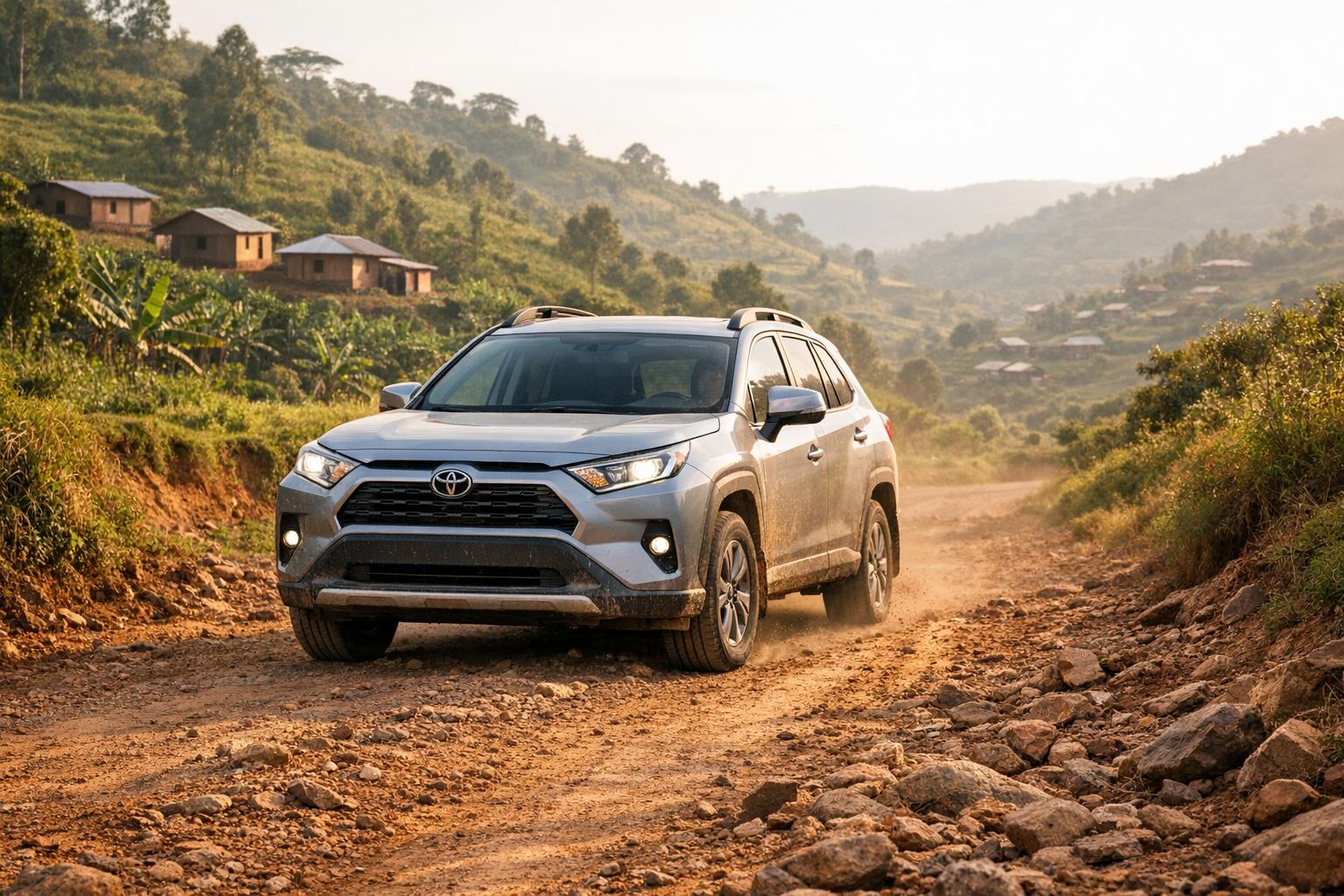
Looking for a reliable car in Uganda? Here’s a quick guide to the top 5 brands that excel on Uganda’s tough roads, balancing durability, fuel efficiency, and spare parts availability:
- Toyota: Dominates Uganda’s market due to unmatched reliability, fuel efficiency, and easy access to spare parts. Models like the Land Cruiser and Corolla are ideal for both urban and rural use.
- Nissan: Known for rugged models like the Hardbody and X-Trail, with affordable maintenance and solid performance on rough terrains.
- Mitsubishi: Offers tough vehicles like the L200 pickup, perfect for upcountry travel, though its service network is smaller compared to Toyota.
- Isuzu: Excels in trucks and pickups like the D-Max, built for heavy-duty tasks and rough roads.
- Suzuki: Highly reliable for city driving, with models like the Vitara and Swift offering great fuel efficiency and fewer breakdowns.
Quick Comparison:
| Brand | Strengths | Weaknesses | Best Use Case |
|---|---|---|---|
| Toyota | Reliability, spare parts | Higher theft risk | City & rural driving |
| Nissan | Rugged builds, affordable parts | Lower resale value | Transport & SUVs |
| Mitsubishi | Built for tough roads | Smaller service network | Upcountry travel |
| Isuzu | Heavy-duty performance | Limited passenger options | Commercial & pickups |
| Suzuki | City-friendly, fuel-efficient | Limited off-road capability | Urban commuting |
Uganda’s unique conditions demand vehicles that can handle rough roads, save on fuel, and are easy to maintain. While Toyota leads the pack, each brand has its niche depending on your specific needs.
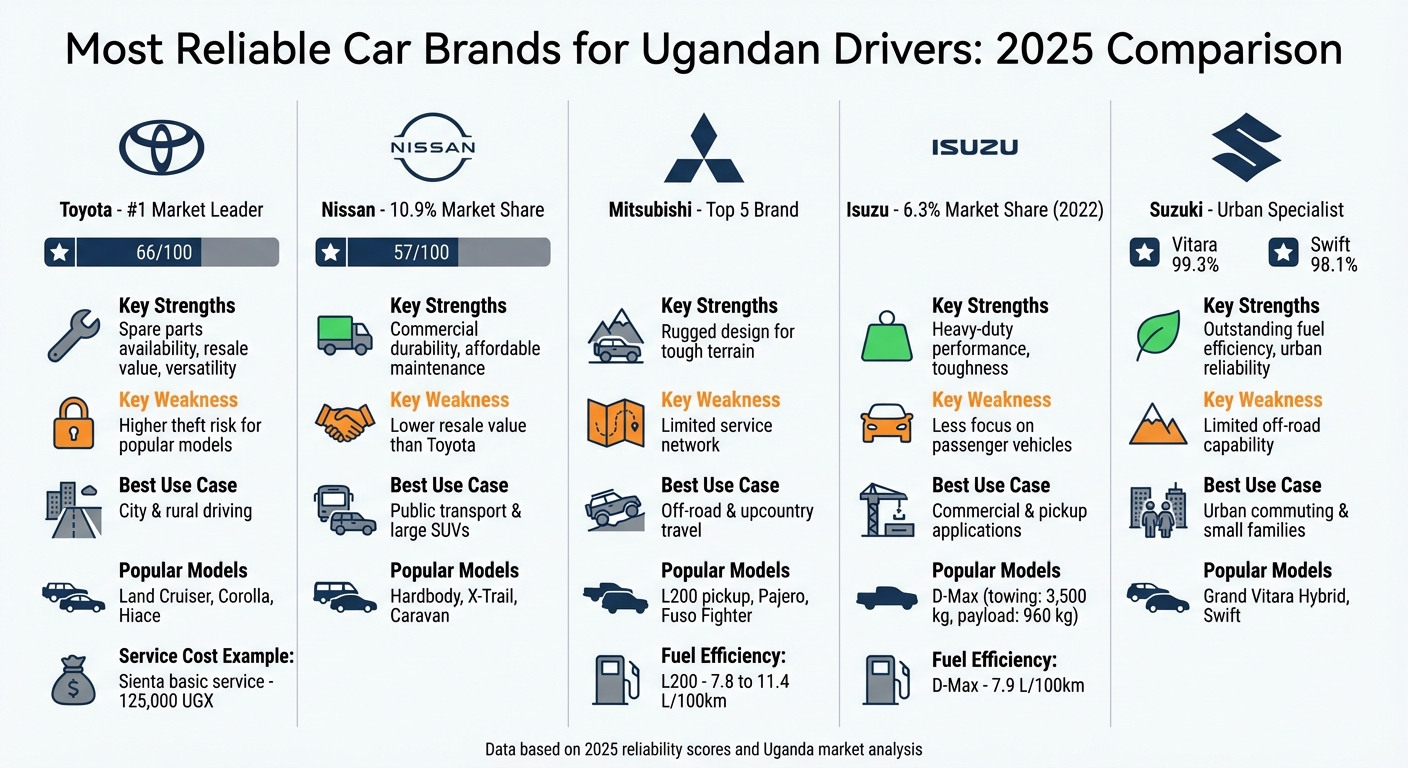
Top 5 Most Reliable Car Brands for Uganda: Comparison Chart
Top Affordable Cars in Uganda: Prices, Features & Fuel Efficiency!
sbb-itb-7bab64a
1. Toyota
Toyota holds a commanding position in Uganda’s automotive market. By late 2025, the brand reclaimed its global reputation for reliability, earning an impressive average score of 66 out of 100.
Durability on Rough Roads
The Toyota Land Cruiser series, especially the Prado and 70 Series, has earned a reputation for handling Uganda’s challenging road conditions with ease. Whether navigating pothole-filled city streets or rugged rural paths, these vehicles consistently deliver. Even commercial models like the Toyota Hiace – known locally as "Drones" – prove their toughness daily in Uganda’s demanding transport sector.
"The Land Cruiser series… continues to dominate the premium SUV segment. These vehicles offer unmatched reliability, excellent off-road capabilities, and strong resale value." – Uganda Car Rental Services
For other models, such as the Toyota Harrier, regular suspension maintenance is critical for tackling rough terrains. Toyota’s straightforward and proven technologies also make repairs manageable for local mechanics, even in areas far removed from major cities – a huge advantage in Uganda.
This durability is just one part of Toyota’s appeal, which is further bolstered by its focus on fuel efficiency.
Fuel Efficiency
Toyota strikes a practical balance between performance and fuel economy, making it one of the most cost-effective brands to own over time. When factoring in fuel, maintenance, and depreciation, Toyota emerges as a budget-friendly choice. The Toyota Corolla, for instance, is particularly economical for long-term ownership. Additionally, hybrid models like the Prius are gaining traction in Uganda, offering Toyota’s trademark durability with improved fuel efficiency.
This combination of reliability and efficiency is supported by the brand’s extensive availability of spare parts.
Spare Parts Availability
In Uganda, finding Toyota parts is rarely an issue. Thanks to its dominant market share, spare parts are readily available in Kampala and other major cities. For example, a basic service for a Toyota Sienta costs approximately 125,000 UGX, which includes engine oil (80,000 UGX), an oil filter (10,000 UGX), an air cleaner (15,000 UGX), and labor (20,000 UGX). For those seeking official support, CFAO Mobility provides genuine parts along with a 3-year/100,000 km (about 62,000 miles) manufacturer warranty.
"I’m a big fan of Toyotas. They’re reliable and easy to maintain." – Jeff Landrum, Mechanic
The 2012 Toyota Camry exemplifies this reliability, with mechanics noting that well-maintained units often run smoothly for over a decade with minimal issues. Following the recommended maintenance schedule can help avoid costly engine or transmission problems in the long run.
2. Nissan
Nissan holds the title of Uganda’s second most popular car brand, capturing a 10.9% market share, right behind Toyota. This strong presence ensures drivers can count on reliable access to maintenance and repair services.
Built for Uganda’s Roads
Designed to tackle Uganda’s challenging road conditions, Nissan vehicles deliver steady performance even on rough, pothole-filled terrains. A standout in the lineup is the Nissan Hardbody, which once claimed over 10% of the total new vehicle market share in Uganda. Beyond durability, maintenance remains budget-friendly, with spare parts readily accessible in Kampala and other major cities.
Easy Access to Spare Parts
With Japanese vehicles dominating Uganda’s car scene, sourcing Nissan parts is a hassle-free process. Local mechanics are well-versed in Nissan’s engineering, and the availability of standardized parts keeps repair costs reasonable. For instance, the Nissan Versa‘s estimated 10-year maintenance cost stands at $5,688. This accessibility plays a key role in Nissan’s reputation for reliability and minimal breakdowns.
Reliability and Breakdown Rates
In the 2025/2026 global reliability rankings, Nissan scored 57 out of 100, placing 6th among major manufacturers. While Toyota leads with a score of 66, Nissan still outperforms many American and European brands. Coupled with its strong support network, Nissan remains a solid choice for Ugandans seeking dependable and affordable transportation.
3. Mitsubishi
Mitsubishi holds its place as one of Uganda’s top five best-selling new vehicle brands, offering trucks and pickups built to handle the country’s demanding driving conditions. Much like Toyota and Nissan, Mitsubishi meets the need for durable and practical vehicles among Ugandan drivers.
Built for Tough Roads
Mitsubishi vehicles are designed to endure Uganda’s challenging road conditions. The Mitsubishi L200 pickup, for instance, was the second best-selling new vehicle in the country in 2016. For even tougher tasks, the Mitsubishi Fuso Fighter is a standout choice. In March 2024, EVERY Co Ltd exported a 2005 Fuso Fighter to Uganda’s energy sector. Its robust 7,500cc 6M60 engine makes it a reliable option for transporting sensitive cargo on rugged routes.
Balancing Fuel Economy and Performance
The 2025 Mitsubishi L200 offers a combined fuel efficiency of 7.8 to 11.4 L/100km, supported by a 75-liter fuel tank. Meanwhile, the Mitsubishi Mirage, with its 1.2L engine, provides an economical option for middle-income earners who need to manage daily fuel costs. This blend of performance and fuel efficiency resonates well with Uganda’s automotive market.
Easy Access to Spare Parts
Mitsubishi’s spare parts are widely available throughout Kampala and other regions, with local mechanics skilled in handling Japanese vehicles. Older models, like the Mitsubishi Pajero, remain a favorite in the used car market due to their affordability and proven reliability on Uganda’s roads. This ease of access to parts further cements Mitsubishi’s appeal in the country.
4. Isuzu
Isuzu has built a strong reputation in Uganda for producing tough, reliable vehicles that handle extreme conditions with ease. In 2022, the brand captured a 6.3% share of Uganda’s new light vehicle market. Motoring journalist Mate Tongola aptly describes Isuzu as a brand that has "gained the reputation of manufacturing hardy vehicles… Isuzu plays in the league of rugged boys". This reputation stems from features tailored to Uganda’s challenging roads.
Built for Rough Terrain
Isuzu’s trucks, pickups, and SUVs are engineered to handle Uganda’s pothole-ridden and high-altitude roads. The D-Max lineup, in particular, is built to excel in both off-road adventures and city driving. With a towing capacity of 3,500 kg (about 7,700 lbs) and a payload capacity of 960 kg (approximately 2,116 lbs), the D-Max is ready for heavy-duty tasks. For added safety on uneven terrain, the D-Max V-CROSS comes equipped with Advanced Driver Assistance Systems (ADAS), including Autonomous Emergency Braking and Lane Keep Assist.
Economical Fuel Consumption
The Isuzu D-Max Double Cab is not just about power – it’s also fuel-efficient. It achieves 7.9 L/100 km (29.8 mpg), making it a sensible choice for drivers who want to keep fuel expenses manageable without sacrificing performance.
Easy Maintenance and Spare Parts
One of the advantages of owning an Isuzu in Uganda is the accessibility of spare parts. These are readily available in Kampala and other major cities, and local mechanics are well-versed in maintaining Japanese vehicles. The Isuzu Forward truck, for instance, features quick-access front panels that simplify tasks like fluid replenishment and brake valve maintenance, making routine servicing more convenient.
5. Suzuki
Suzuki has earned a reputation for reliability, with the Vitara achieving an impressive 99.3% reliability rating. This makes it a standout choice in Uganda, where Japanese vehicles dominate the market, accounting for about 70% as of 2025. Claire Evans, Editor-in-Chief at What Car?, highlighted Suzuki’s strengths:
"The Swift has a lot going for it… Like other Suzuki models, it’s also very robust, noted for its durability".
Built for Uganda’s Roads
Suzuki’s design philosophy focuses on creating lightweight yet durable vehicles that can handle Uganda’s tough road conditions. For instance, the Grand Vitara Hybrid features all-wheel drive (AWD), offering stability and control on pothole-ridden roads and steep, high-altitude terrains. Stephen Kalema, a business writer at Watchdog Uganda, shared his perspective:
"The Grand Vitara Hybrid is a perfect choice for Uganda’s diverse and sometimes challenging terrains".
Isaac Tegule, Mobility Manager at CFAO Mobility, echoed this sentiment:
"With the Grand Vitara, you’re investing in reliability and a worry-free driving experience".
This rugged performance is complemented by an emphasis on fuel efficiency.
Fuel Efficiency That Delivers
The Grand Vitara Hybrid showcases Suzuki’s commitment to fuel economy. Its hybrid system keeps fuel costs low without compromising on performance, making it ideal for navigating Kampala’s busy streets or venturing into rural areas. The hybrid technology not only cuts fuel expenses but also reduces environmental impact.
Easy Access to Spare Parts
Suzuki owners in Uganda benefit from the availability of spare parts in Kampala and other major cities. Official distributors ensure quick service and maintenance, while Suzuki’s robust build reduces the need for frequent repairs. For example, the 2010–2017 Suzuki Swift achieved a reliability score of 98.1%, further proving the brand’s dependability.
Fewer Breakdowns, More Peace of Mind
Suzuki’s solid engineering results in fewer mechanical failures, a crucial factor for Uganda’s demanding driving conditions. This makes Suzuki a dependable option for drivers who require a reliable vehicle capable of handling both urban and off-road adventures with ease.
Pros and Cons
Here’s a quick breakdown of the strengths and drawbacks of each brand, based on our detailed review.
Each brand brings its own set of advantages and challenges. Toyota stands out for its unmatched availability of spare parts and strong resale value in Uganda. Nissan, with a 10.9% market share, offers excellent commercial value in models like the Caravan but lags behind Toyota in resale value. Suzuki shines in reliability, with impressive scores for models like the Vitara (99.3%) and Swift (98.1%), making them perfect for fuel-efficient urban driving. However, they fall short in heavy-duty off-road performance.
Mitsubishi is a favorite for rugged, upcountry travel, especially with models like the L200 pickup, but it struggles with a smaller service network compared to Toyota. Isuzu, holding 6.3% of the market, dominates in light commercial vehicles and pickups but places less emphasis on passenger cars.
One downside for Toyota is that popular models, like the RAV4, are often targeted for theft, which can lead to higher insurance premiums.
Here’s a summary of the key points in table format:
| Brand | Key Strength | Key Weakness | Best Use Case |
|---|---|---|---|
| Toyota | Spare parts availability & resale value | Higher theft risk for popular models | Versatile: City & rural use |
| Nissan | Commercial durability | Lower resale value than Toyota | Public transport & large SUVs |
| Suzuki | Outstanding fuel efficiency | Limited off-road capability | Urban commuting & small families |
| Mitsubishi | Rugged design for tough terrain | Limited service network | Off-road & upcountry travel |
| Isuzu | Toughness in the truck segment | Less focus on passenger vehicles | Commercial & pickup applications |
When considering long-term ownership costs – including insurance, maintenance, fuel, and depreciation – Toyota and Lexus emerge as the most cost-effective brands over five years. These insights aim to help Ugandan drivers make informed decisions when choosing reliable vehicles.
Conclusion
Choose a brand that aligns with your specific needs. Toyota remains a top choice for those who prioritize reliability, low maintenance, and strong resale value. Its models are built to perform well across various terrains, making them a versatile option for many drivers.
For city dwellers focused on fuel efficiency, the Suzuki Swift and Vitara shine with reliability ratings of 98.1% and 99.3%, respectively. These compact cars are perfect for navigating crowded streets, like those in Kampala, while keeping fuel costs manageable. On the other hand, if your driving takes you through rugged terrains or upcountry roads, models like the Nissan X-Trail or Mitsubishi Pajero deliver the durability and ground clearance you need. However, these may not offer the same extensive service network that Toyota provides.
Japanese automakers have also established widespread spare parts availability and trained mechanics in major cities, which helps keep maintenance costs low and reduces repair downtime.
FAQs
Why is Toyota the most trusted car brand for Ugandan drivers?
Toyota enjoys widespread trust in Uganda, thanks to its reliable durability, cost-effectiveness, and low maintenance demands – qualities that are crucial for handling the country’s often rugged roads. Models like the Hilux and Corolla are particularly favored for their ability to tackle tough terrain, deliver excellent fuel economy, and provide dependable performance over time.
Another reason Toyota dominates in Uganda is the easy availability of spare parts and the extensive network of service centers across the country. This ensures that repairs are not only quick but also affordable. On top of that, Toyota vehicles hold their resale value exceptionally well, making them a smart choice for drivers looking for both reliability and long-term value. Together, these advantages have cemented Toyota’s position as the go-to car brand for Ugandan motorists.
What are the benefits of owning a Nissan in Uganda?
Owning a Nissan in Uganda offers several practical benefits, making it a smart choice for drivers navigating the country’s unique challenges. Models like the X-Trail, Navara, and Caravan stand out for their rugged build and ability to handle Uganda’s tough road conditions, from bumpy dirt paths to uneven terrain. Whether for personal errands or commercial ventures, these vehicles are built to perform.
Another advantage is the easy access to spare parts and service centers, especially in major cities like Kampala. This means maintaining a Nissan is more affordable and less of a hassle compared to some European brands. Plus, with their fuel-efficient engines and reasonable pricing, Nissan vehicles are budget-friendly to own. To top it off, their strong resale value ensures they remain a solid investment for Ugandan drivers.
How does Suzuki’s fuel efficiency compare to other car brands in Uganda?
Suzuki has made a name for itself with fuel-efficient models, and the Suzuki Alto is a prime example. With an impressive fuel economy of 42–56 MPG (18–24 km/L), it’s an excellent choice for city driving. It holds its own against competitors like the Toyota Vitz, which offers 42–51 MPG (18–21.8 km/L), and outperforms the Honda Fit, which averages 38–42 MPG (16–18 km/L).
That said, Suzuki’s efficiency falls slightly short when compared to some hybrids and newer compact cars. Models like the Toyota Corolla Hybrid (32–41 MPG), Chevrolet Spark (30–38 MPG), and Kia Rio (33–41 MPG) showcase advancements in fuel-saving technology. Still, Suzuki remains a dependable and cost-effective choice, especially for urban drivers in Uganda looking for reliable performance.
Related Blog Posts
- 5 Most Reliable Family Cars Under $10,000 in Uganda
- Most popular cars in Uganda
- Toyota, Nissan, or Honda: Which is Best for Uganda?
- Top 5 Cars to Buy in Uganda for Less Than UGX 30,000,000