There are road trips, and then there is the drive from Kampala to Murchison Falls. Few journeys in East Africa combine the variety of landscapes, the thrill of wildlife encounters, and the raw beauty of Uganda’s countryside quite like this one. You leave behind the noise of the city, climb through the green hills of central Uganda, pass through the gentle plains of the north, and eventually arrive at one of the most powerful waterfalls on the African continent — all in a single day’s drive.
But like any long road trip in Uganda, this one rewards those who prepare well and punishes those who do not. From knowing where to fuel up along the route to understanding how to treat your car on the varied road surfaces between Kampala and Pakwach, a little planning goes a very long way.
This guide covers everything you need for a smooth, memorable Kampala to Murchison Falls road trip — the route, the fuel stops, the wildlife, the road conditions, and the car care habits that will keep your vehicle in good shape from start to finish.
The Route at a Glance
Total distance: Approximately 305 km (Kampala to Murchison Falls National Park main gate)
Estimated driving time: 5–6 hours (excluding stops)
Road type: Mostly tarmac with some gravel sections inside the park
Recommended departure time: 5:30–6:00 AM
The most commonly used route runs as follows:
Kampala → Gayaza → Zirobwe → Nakasongola → Masindi → Kichumbanyobo Gate (Murchison Falls National Park) → Paraa
Some drivers take the longer western route via Fort Portal and Hoima, which offers spectacular scenery but adds roughly 2–3 hours to the journey. For a first-time trip focused on reaching the park efficiently, the Masindi route is the standard choice.
Why Leave Early?
Leaving Kampala before sunrise is not just a suggestion — it is genuinely one of the most important decisions you will make on this trip. Here is why:
Kampala’s morning traffic builds rapidly from 7:00 AM onwards. A 5:30 AM departure means you clear the city before the gridlock sets in, giving you a clean run to Gayaza and beyond. You also hit the cooler morning hours during the longest stretch of driving, which is better for your engine and more comfortable for your passengers.
Early departure also means you arrive at the park in the mid-morning or early afternoon — prime time for game drives, when animals are most active before the midday heat drives them to shade.
Road Conditions: What to Expect
Kampala to Nakasongola (approximately 120 km): This section is on tarmac but varies significantly in quality. The road through Gayaza and Zirobwe has improved in recent years but still features sections with potholes, especially after the rainy season. Drive attentively and avoid the temptation to cruise at high speed — a pothole at 100 km/h can destroy a tyre and damage a rim in an instant.
Nakasongola to Masindi (approximately 80 km): This is generally the smoothest section of the route. The road is wide and well-maintained in parts. Watch for speed bumps in the towns of Nakasongola and Kigumba, which appear quickly and can be severe.
Masindi to Kichumbanyobo Gate (approximately 60 km): Road quality becomes more varied here. Some sections are excellent tarmac; others are rougher and require slower speeds. There are also more livestock and pedestrians to watch for as you approach the park boundary.
Inside the park (Kichumbanyobo to Paraa, approximately 40 km): This section is gravel and murram. The road is manageable in a standard saloon car during the dry season, but in the wet season (April–May and October–November), a vehicle with higher ground clearance is strongly advisable. Take it slow — you are in the park now, and animals can appear on the track with very little warning.
For detailed, regularly updated reviews of vehicles best suited to this kind of mixed-road journey, automag.ug is Uganda’s go-to resource for automotive news, car reviews, and road trip driving tips tailored to local conditions.
Fuel Stops: Where to Fill Up Along the Route
Fuel planning is one of the most frequently overlooked aspects of this road trip. Do not assume you can easily find a station at any point once you leave the greater Kampala area — some stretches are long and stations are spaced well apart.
Here is the recommended fuelling strategy:
Fill Up Before You Leave Kampala
Always begin the journey with a full tank. This sounds obvious but is easily forgotten in the rush of early morning departure prep. Fuel stations in Kampala — including those in Ntinda, Nakawa, Gayaza Road, and Jinja Road — are open from early morning. Fill up the evening before if your departure is before dawn.
Nakasongola Town (approximately 120 km from Kampala)
Nakasongola has several fuel stations and is a natural stopping point. Top up here even if you do not urgently need fuel — the stretch from Nakasongola towards Masindi has fewer reliable options, and prices can climb in smaller trading centres.
A good fuel rule for this route: refuel whenever your tank drops below half. On unfamiliar roads, range anxiety is real, and the cost of topping up at a slightly higher price is far less than the cost of running dry.
Masindi Town (approximately 200 km from Kampala)
Masindi is the last major town before the park and the most important fuel stop on the entire journey. Fill up completely here without exception. There are no fuel stations inside Murchison Falls National Park. The lodges at Paraa occasionally stock fuel in small quantities for emergencies, but you cannot rely on this.
Masindi also has decent restaurants and supermarkets if you need to stock up on food, water, and snacks for the park. Take the time to stretch, eat, and check your vehicle here before the final push.
Kichumbanyobo Gate and Beyond
Beyond the gate, you are on your own fuel-wise. This is also where the road becomes gravel — your fuel consumption will rise slightly on this surface compared to tarmac, so factor that into your calculations.
Practical tip: Carry a 5–10 litre jerry can of fuel in the boot as a backup reserve, especially if you are planning to spend multiple days in the park and do extensive game drives.
Vehicle Checks Before You Leave
A long road trip to Murchison Falls is not the time to discover that your car has been hiding a slow coolant leak or that your rear tyres are down to the legal minimum tread depth. Carry out these checks either the evening before departure or at the very start of your morning:
Tyre pressure and condition: Check all five tyres — including the spare. Inflate to the correct pressure for a loaded vehicle (check your door placard or owner’s manual). Inspect for any visible damage, bulges, or uneven wear.
Engine oil level: Pull the dipstick with the engine cold. Top up if below the minimum line. A long highway drive in the heat is hard on engine oil — make sure there is enough.
Coolant level: The reservoir should be between the MIN and MAX markers. Do not open the radiator cap when the engine is hot.
Brake fluid: Check the reservoir under the bonnet. Fluid at or below the minimum line warrants a visit to a mechanic before you travel.
Windscreen washer fluid: A dusty gravel road inside the park will coat your windscreen. Make sure the washer reservoir is full and that the wiper blades are in good condition.
Battery terminals: If your battery is older or has been showing signs of sluggishness (slow cranking, warning lights), have it tested before the trip. Being stranded in the park with a flat battery is far less charming than it sounds.
Lights: Test all lights — headlights, brake lights, indicators, and reverse lights. You may be driving in early morning darkness, and the gravel road in the park demands full visibility.
For readers considering an upgrade to a more capable road trip vehicle before making this journey, auto24.ug offers a regularly updated selection of quality second-hand cars in Uganda — including capable SUVs and 4x4s like the Toyota Land Cruiser Prado, Nissan X-Trail, and Subaru Forester that handle the Murchison route with ease.
What to See Along the Way
Zirobwe and the Central Plateau
The drive through Zirobwe takes you across Uganda’s central plateau — rolling green hills dotted with small farms, banana plantations, and the occasional church spire rising above the tree line. It is easy to be in a hurry and miss just how beautiful this section is. If the light is good in the early morning, it is worth a brief stop for photographs.
Nakasongola Cattle Corridor
As you move north of Nakasongola, the landscape shifts noticeably. The lush green of central Uganda gives way to a drier, flatter terrain — the famous cattle corridor that runs through northern Uganda. You will begin to see Ankole-Watusi cattle grazing at the roadside, tended by young herders. It is a striking visual reminder of how dramatically Uganda’s geography changes over relatively short distances.
Masindi and Surroundings
Masindi is a pleasant, unhurried town with a colonial history — it served as an administrative centre during the British protectorate era. If you have time, Masindi Hotel (one of the oldest hotels in Uganda) is worth a brief visit for its historical atmosphere. Ernest Hemingway reportedly stayed here, as did several early African explorers.
Just outside Masindi, the road to the park passes through sections of Budongo Forest — one of the largest tropical rainforests in East Africa and home to a significant population of chimpanzees. If your schedule allows an extra half-day, Budongo offers guided chimp trekking that is significantly less crowded and less expensive than the more famous treks in Bwindi.
Wildlife Spots Inside Murchison Falls National Park
Murchison Falls National Park is Uganda’s largest national park, covering approximately 3,840 square kilometres. It straddles the Victoria Nile and is home to an extraordinary diversity of wildlife — making it one of the finest safari destinations in East Africa.
The Nile Delta and Paraa
Paraa is the park’s main hub, situated on the banks of the Victoria Nile. The river crossing by ferry to reach the northern bank — where most of the large mammal game drives take place — is itself an experience. Hippos surface alongside the ferry, Nile crocodiles bask on the banks, and African fish eagles cry overhead. It costs nothing extra and takes about five minutes, but it sets the tone perfectly for what follows.
The Northern Bank Game Drive
The northern bank of the Victoria Nile is where Murchison’s classic big game viewing takes place. Elephants here are numerous and frequently approach vehicles with impressive indifference. Buffalo herds graze the open savannah in large numbers. Giraffes — specifically the Rothschild’s giraffe, one of the most endangered subspecies in the world — are regularly spotted near the river, and Murchison Falls is home to one of the most significant populations of this subspecies anywhere.
Lions are present in the park, though sightings require some patience. Uganda kob — the iconic antelope featured on the Ugandan coat of arms — are everywhere on the northern bank plains, often in herds of hundreds.
Practical tip: Book your game drive through the park’s Uganda Wildlife Authority (UWA) office at Paraa or arrange in advance through your lodge. Self-drive is permitted with your own vehicle — one of the advantages of arriving by private car.
The Falls Themselves
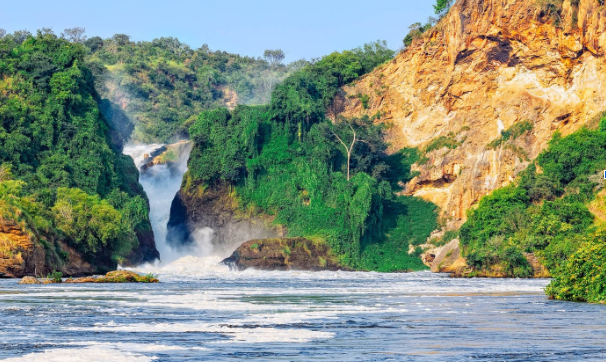
The falls are non-negotiable. The Victoria Nile — at this point carrying the combined drainage of much of central Africa — is forced through a narrow gorge only seven metres wide before exploding into a 43-metre drop. The resulting roar, mist, and sheer force of water is one of the most viscerally powerful natural experiences in Uganda.
You can view the falls from the bottom (by boat cruise from Paraa — highly recommended) and from the top (a short drive and walk from the top-of-falls car park). Both perspectives are dramatically different and both are worth experiencing.
The Boat Cruise
The launch trip from Paraa to the base of the falls is one of Uganda’s best wildlife experiences and should be considered essential to the trip. The two-hour journey up the Nile passes hippo pools with dozens of animals, Nile crocodiles of remarkable size, innumerable waterbirds including the prehistoric-looking shoebill stork (one of Africa’s most sought-after bird sightings), and the constant backdrop of forested banks leading to the falls.
Book the afternoon cruise for the best light — the golden hour on the Nile as you return to Paraa is unforgettable.
Fuel Efficiency Tips for the Road
Long highway driving is actually quite friendly to fuel consumption — but there are habits that erode efficiency significantly:
Maintain a steady speed. The most fuel-efficient highway speed for most vehicles is between 80–100 km/h. Driving at 120 km/h typically increases fuel consumption by 15–20% compared to 90 km/h. Use cruise control if your car has it.
Avoid aggressive acceleration. Accelerating hard from traffic lights or speed bumps burns significantly more fuel than a smooth, gradual build-up of speed. This is especially relevant on the pothole-heavy sections where you will be frequently slowing and accelerating.
Reduce unnecessary weight. Extra passengers and cargo increase fuel consumption. Pack only what you need — a fully loaded boot on a long trip makes a measurable difference.
Keep windows closed on the highway. Open windows at highway speeds create aerodynamic drag that increases fuel consumption. Use the air conditioning on its most efficient setting instead.
Service your air filter. A clogged air filter makes the engine work harder and burns more fuel. If your vehicle is due for a service or has been operating in dusty conditions, a fresh air filter is one of the cheapest and most effective fuel efficiency improvements available.
For those thinking about the longer-term fuel efficiency question — and whether an electric vehicle might eventually suit road trips like this one — EV24.africa offers import options for electric cars, giving Uganda-based drivers an expanding range of sustainable mobility choices as the country’s charging infrastructure continues to develop.
Where to Stay in Murchison Falls
Paraa Safari Lodge: The most iconic accommodation in the park, sitting directly on the Nile at Paraa. Midrange to upper-midrange pricing.
Pakuba Safari Lodge: Excellent value, situated on the northern bank with beautiful Nile views. Often less crowded than Paraa.
Nile Safari Lodge: A highly regarded camp outside the park’s southern boundary, offering beautiful bush atmosphere at competitive rates.
Budget options: UWA bandas (self-catering cabins) are available at Paraa for budget-conscious travellers. Basic but well-situated.
Booking in advance is strongly recommended, particularly during peak season (December–February and June–August).
The Return Journey: Tips for Driving Back
Most drivers return via the same Masindi route, which means you will have a good sense of the road by the time you head back. A few additional tips for the return leg:
Fuel up in Masindi before leaving town. Do not rely on stations between Masindi and Kampala — refuel while you have a guaranteed option.
Avoid driving the park’s internal gravel roads after dark. If your return journey starts in the late afternoon, try to be through the park gate and onto tarmac before sunset. Driving unfamiliar gravel roads in the dark while animals may be crossing is genuinely risky.
Take a longer break in Nakasongola on the return. Driver fatigue on the return leg is real. A proper break — not just a quick stretch — significantly reduces risk on the final 120 km back to Kampala.
Watch for trucks. The Kampala-Gulu highway sees significant heavy truck traffic, and overtaking on this road requires care and patience. Uganda’s trucking corridor is active around the clock.
For more travel guides, road trip tips, and car care advice for Ugandan routes, carkibanda.com offers regularly updated content for drivers and travel enthusiasts navigating Uganda’s roads.
Final Thoughts
The Kampala to Murchison Falls road trip is one of those journeys that stays with you. The moment the ferry pulls away from the southern bank at Paraa, with hippos snorting in the current and a fish eagle calling somewhere in the trees, you will understand why Ugandans and visitors return to Murchison Falls again and again.
Plan your fuel stops. Check your vehicle the night before. Leave early. And take the boat cruise — do not let anyone talk you out of it.
For the latest driving tips, road trip guides, and automotive advice designed for Uganda’s roads, visit automag.ug — your trusted companion for every kilometre of the journey.