If you have ever driven the Kabale–Kisoro road as it winds through the steep terraced hills of Kigezi, descended the sharp mountain switchbacks from Fort Portal toward Kasese, or navigated the gradient-heavy murram tracks into Bwindi Impenetrable Forest, you already know what Uganda’s hilly terrain does to a car. It demands everything from your engine, your tyres, your suspension — and above all, your brakes.
Uganda is not a flat country. From the volcanic highlands of the southwest to the escarpments of the Rwenzori foothills, the hilly districts of Kapchorwa, Ntoroko, and Kyenjojo, and the dramatic elevation changes along the Kampala–Mbarara highway, Ugandan roads subject braking systems to far greater stress than the manufacturers of many imported Japanese vehicles ever anticipated. A brake system designed for the gentle gradients of suburban Japan or the flat expressways of the UAE will face a very different test on the Kisoro road.
The consequences of poor brake maintenance in hilly terrain are not inconvenient — they are life-threatening. Brake fade, pad wear, fluid deterioration, and rotor overheating are not abstract mechanical concepts. They are the difference between stopping safely at the bottom of a hill and losing control on a descent.
This guide covers everything Ugandan drivers need to know about brake maintenance in hilly conditions: how brakes work under hill stress, the warning signs of a failing brake system, how to maintain every component properly, and the driving techniques that protect your brakes and your life on Uganda’s most demanding roads.
For the latest vehicle maintenance guides, driving safety tips, and automotive news tailored specifically for Ugandan drivers, visit automag.ug.
Why Uganda’s Hills Are So Hard on Brakes
To understand why hilly terrain demands extra brake attention, you first need to understand what happens to a braking system on a long downhill descent.
When you press the brake pedal, your vehicle slows by converting kinetic energy (movement) into heat through friction between the brake pads and the disc rotors (or drums on older vehicles). On flat roads, this heat is generated in brief bursts and dissipates quickly between applications. On a long, steep descent — like the final stretch into Kisoro town or the drop from the Kabale plateau toward the Rwanda border — brakes are applied continuously or repeatedly for many minutes. Heat builds up faster than it can dissipate.
When brake components overheat, three dangerous things can happen:
1. Friction fade — The brake pads overheat and their friction material softens or glazes, dramatically reducing their ability to grip the rotor. The pedal feels firm but the vehicle does not stop as it should.
2. Fluid fade — The brake fluid overheats and begins to boil, creating gas bubbles in the hydraulic lines. Since gas is compressible (unlike fluid), pedal pressure no longer transfers effectively to the callipers. The pedal feels soft and spongy and sinks toward the floor — a terrifying experience on a steep descent.
3. Mechanical fade — Excessive heat causes metal components to expand and distort. Rotors can warp, callipers can seize partially, and the precision fit between components deteriorates, reducing braking efficiency.
This phenomenon — collectively known as brake fade — is one of the most dangerous events that can occur while driving on hilly terrain. It is also one of the most preventable, with proper maintenance and the right driving technique.
Uganda’s specific combination of long, steep descents, heavy vehicle loads (overloaded taxis, pickup trucks carrying farm produce), high ambient temperatures, and the common use of older imported vehicles with aging brake components makes brake fade a genuinely serious and underappreciated road safety issue.
Know Your Brake System: A Simple Breakdown
You do not need to be a mechanic to understand your brakes — but knowing the key components helps you maintain them and catch problems early.
Brake Pads
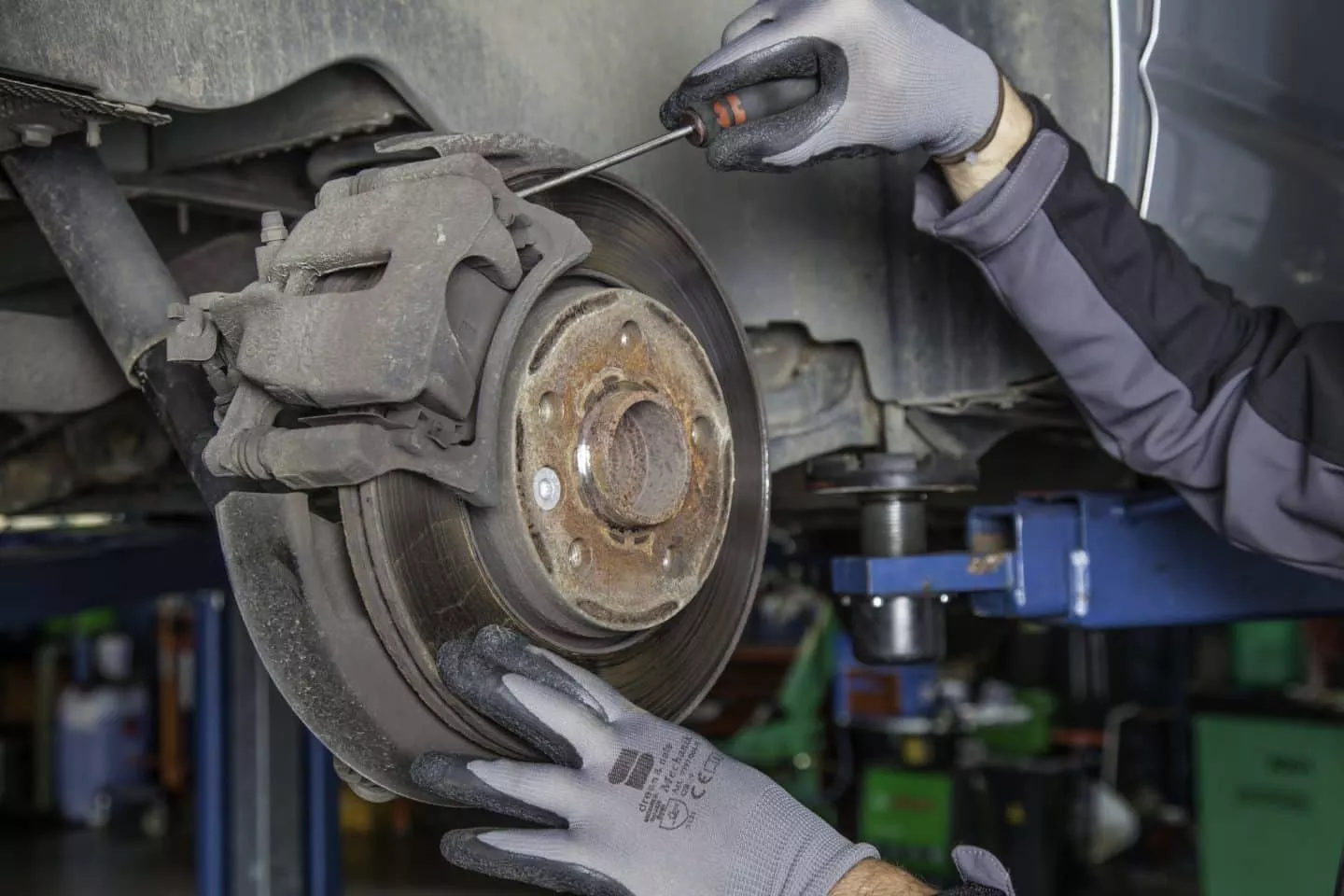
Brake pads are the friction material that clamps against the disc rotor to slow the vehicle. They have a metal backing plate and a layer of friction material — the part that actually does the work. As pads wear down, this friction layer gets thinner. Most modern pads have a wear indicator — a small metal tab that squeals against the rotor when the friction material is nearly exhausted, alerting you that replacement is due.
Minimum thickness: Most manufacturers recommend replacing pads when the friction material reaches 3mm or less. In hilly terrain conditions, replace them earlier — at around 4–5mm — because thin pads heat up faster and are more prone to fade on long descents.
Disc Rotors (Brake Discs)
The rotor is the metal disc that the pads clamp against. New rotors are smooth, thick, and thermally stable. Over time and with heavy use, rotors develop:
- Grooves and scoring from pad wear
- Warping from repeated thermal stress — which causes a pulsating or vibrating sensation when braking
- Thinning as material is worn away — rotors below minimum thickness dissipate heat less effectively and crack more easily under stress
Car Care Tip: If your steering wheel or brake pedal vibrates when you apply the brakes, this is a classic sign of a warped rotor. On Uganda’s hilly terrain, this is not just an annoyance — a warped rotor is a safety risk. Have it measured and resurfaced or replaced promptly.
Brake Fluid
Brake fluid is the hydraulic medium that transfers pressure from the pedal to the callipers. It operates under extreme conditions — the fluid in a hard-working braking system can reach temperatures of 150–200°C or more during a long descent.
Brake fluid is hygroscopic — it absorbs moisture from the atmosphere over time. As water content increases, the fluid’s boiling point drops, making it more vulnerable to vapourising under heat and causing fluid fade. Old, contaminated brake fluid is one of the leading causes of brake failure on mountain roads.
Car Care Tip: Replace brake fluid every two years or 40,000 km — whichever comes first. In Uganda’s hilly driving conditions, erring on the more frequent end is wise. The fluid should be clear to slightly yellow in colour; dark, murky fluid indicates heavy contamination and requires immediate replacement. Do not top up with a different grade of fluid — DOT 3 and DOT 4 are not directly interchangeable in all vehicles.
Callipers
The brake calliper houses the pistons that press the pads against the rotor when you apply the pedal. A seized or sticking calliper is a common problem in Uganda’s climate — alternating wet and dry seasons, dirt roads, and infrequent maintenance combine to corrode and bind calliper pistons and slide pins. A seized calliper causes uneven braking, premature pad wear on one side, and a vehicle that pulls to one side during braking — a hazardous condition on narrow mountain roads.
Brake Lines and Master Cylinder
The master cylinder converts your pedal pressure into hydraulic force. Brake lines carry that force from the master cylinder to each wheel. Both are subject to corrosion over time, particularly on older imported vehicles. A brake line crack or master cylinder leak causes a sudden, catastrophic loss of brake pressure — there is no warning before it happens. Regular visual inspections are essential.
Warning Signs: When Your Brakes Are Telling You Something
Your vehicle will almost always give you warning signs before brake failure. Knowing what to listen and feel for — and responding quickly — can prevent a dangerous situation.
Squealing or Screeching Sounds
A high-pitched metallic squeal when applying the brakes almost always indicates that the brake pad wear indicator is contacting the rotor. This is not a problem yet — it is a designed warning. But it means you need new brake pads within days, not weeks. Do not delay this repair, especially if you drive hilly routes regularly.
Grinding Metal-on-Metal Sound
If the squeal has progressed to a deep grinding or growling sound, the friction material has worn through entirely and the metal backing plate of the pad is directly contacting the rotor. This is an emergency. Every application of the brakes is now destroying your rotors at significant expense, and your braking distance has increased substantially. Do not drive the vehicle further than necessary to reach a mechanic.
Soft, Spongy, or Sinking Pedal
A brake pedal that feels soft, requires extra pressure, or sinks gradually toward the floor indicates one of two things: air in the brake lines (requiring bleeding), or boiling/contaminated brake fluid (requiring replacement and bleeding). Either condition dramatically reduces braking effectiveness — particularly dangerous on a steep descent. Have the system inspected immediately.
Vibration or Pulsation When Braking
A shuddering sensation in the pedal or steering wheel during braking is almost always caused by warped rotors. On Uganda’s steep hills where long braking events are frequent, this is a particularly common problem with older or inadequately maintained vehicles. Warped rotors reduce the consistency of braking contact, making it harder to control stopping distance precisely.
Vehicle Pulling to One Side When Braking
If your vehicle consistently pulls left or right when you apply the brakes, the braking force is unequal between the two front wheels. This is typically caused by a seized calliper, uneven pad wear, or a sticking brake line. On a narrow mountain road with steep drops on one side, unexpected directional pull during emergency braking is extremely dangerous.
Burning Smell After a Descent
If you notice a sharp, acrid burning smell after driving down a long hill — even if your brakes felt fine throughout the descent — this is a serious warning. It means your brakes have been working at or beyond their thermal limit. Pull over safely, allow the brakes to cool for at least 15–20 minutes without applying the handbrake (which can cause the rear pads to bond to hot drums or rotors), and then reassess the pedal feel before continuing. If the smell is accompanied by smoke from a wheel, a calliper may be seized and the vehicle should not be driven further.
Brake Maintenance Schedule for Hilly Terrain Driving
Standard brake service intervals are designed for typical driving conditions. If you regularly drive hilly terrain in Uganda — Kabale, Kisoro, Bwindi approaches, Kapchorwa, Fort Portal–Kasese, Ntoroko, Kigezi highlands, or any route with significant sustained descents — your brake components wear faster and require more frequent attention.
Here is a practical maintenance schedule tailored to Uganda’s hilly driving:
Every Month (or Every 3,000–5,000 km)
- Visually inspect brake fluid level in the reservoir. The reservoir is usually a translucent plastic container near the firewall marked MIN and MAX. If the level is consistently dropping, there is a leak somewhere in the system — find it before it becomes a failure.
- Listen for any new noises during braking — squealing, grinding, or clunking that was not there before
- Check for brake fluid leaks under the vehicle after parking — look for wet spots near the wheels or along the inner chassis
Every 10,000–15,000 km (or Every 6 Months)
- Inspect brake pad thickness on all four wheels. Ask your mechanic to check at every service. In hilly terrain, front pads typically wear significantly faster than rear pads — often 2–3 times faster — because the front brakes do the majority of the stopping work.
- Inspect rotors for scoring, cracking, or warping. A simple visual inspection can reveal deep grooves; a micrometer measurement confirms whether thickness is still within safe limits.
- Lubricate calliper slide pins. These small components allow the calliper to float and apply even pressure. In Uganda’s alternating dusty-dry and muddy-wet conditions, they corrode and seize rapidly. A small amount of high-temperature brake grease on the pins during each service prevents calliper issues.
Every 2 Years or 40,000 km
- Replace brake fluid completely. This is non-negotiable in hilly driving conditions. Old fluid with high water content can boil during a long descent and cause fluid fade — one of the most dangerous brake failures possible.
- Inspect and rebuild or replace callipers if any signs of piston stiction, uneven wear, or fluid seepage are present.
- Inspect brake lines — particularly the flexible rubber hoses near the wheels, which crack and deteriorate faster than metal lines and are a common source of sudden pressure loss.
Car Care Tip: After purchasing a used vehicle in Uganda — whether from a bond yard, an individual, or through an online platform — have the entire brake system inspected by a trusted mechanic as one of your first actions. Used vehicles imported from Japan or other markets are often several years old by the time they reach Ugandan roads, and brake fluid, pads, and rotors may be well past their service life despite the vehicle appearing outwardly clean.
Driving Techniques That Protect Your Brakes on Ugandan Hills
Good maintenance is only half the equation. The way you drive on hills has an enormous effect on how quickly your brakes wear and how safe they remain throughout a descent.
Master Engine Braking
Engine braking is the single most effective technique for preserving your brakes on long downhill descents. When you shift to a lower gear (manual or automatic) before or during a descent, the engine’s compression and internal resistance slow the vehicle without requiring you to press the brake pedal at all.
The rule for Ugandan hill driving: descend a hill in the same gear you would use to climb it. If you would use second gear to climb a particular hill fully loaded, use second gear to descend it. The engine will hold your speed without the brakes overheating.
For automatic vehicles: most modern automatics allow you to select 2, L, or a specific gear hold mode. Use these actively on steep descents — do not simply rely on D (Drive) mode and brake continuously.
Use the Brakes Intermittently, Not Continuously
If you do need to use the brakes during a descent, apply them in firm, controlled intervals rather than holding constant light pressure throughout. Firm braking slows you, then you release and allow the brakes to cool while the engine controls your speed. Then brake again if needed.
Continuous light brake pressure is one of the fastest ways to overheat brake components. It generates steady heat without the cooling intervals that intermittent braking allows.
Reduce Speed Before the Descent Begins
Once you are already descending at speed, it is much harder to manage brake heat safely. The correct technique is to slow down before you begin the descent — at the crest of the hill, not halfway down. Check your speed, select your gear, and enter the descent at a controlled, manageable pace.
Car Care Tip: On the sharp switchback descents common on the Kabale–Kisoro road and the Fort Portal–Kasese mountain section, identify the hairpin bends ahead of time and slow well in advance — not at the bend itself. Entering a sharp corner too fast on a hill forces heavy, sudden braking; this is both the most dangerous moment and the most thermally damaging to your brakes.
Avoid Overloading Your Vehicle
Extra weight dramatically increases the thermal load on your braking system. A matatu carrying 18 passengers instead of 14, a pickup truck stacked above the cab with produce, or an SUV loaded with luggage, passengers, and roof-rack cargo all require significantly more braking force — and generate proportionally more heat — on every descent. On hilly terrain, overloading is not just an inconvenience or a legal violation; it is a direct brake safety risk.
Keep Your Distance on Hills
Maintain a generous following distance behind the vehicle in front on hill descents. If they brake suddenly, you need stopping distance that accounts for both your reaction time and your own braking distance — which is longer on a slope than on flat ground. On loaded vehicles with worn brakes, this distance needs to be even greater.
Disc Brakes vs. Drum Brakes: What Most Ugandan Cars Have
Many vehicles in Uganda’s used car market — particularly older Toyota models, Nissan Saloons, and some commercial vans — still use drum brakes on the rear axle. Understanding the difference matters for maintenance.
Disc brakes (standard on front wheels of most vehicles) use exposed rotors that shed heat efficiently. They are more resistant to brake fade, easier to inspect, and more consistent in performance.
Drum brakes (common on rear axles of many older vehicles) enclose the friction material inside a metal drum. They dissipate heat less effectively, are more prone to fade, and are harder to visually inspect. Drum brakes are also self-energising — which means they can lock up unpredictably when cold or damp, a particularly hazardous characteristic on steep mountain road surfaces.
If your vehicle has rear drum brakes, inspect them at least annually or every 20,000 km. Drum brake shoes wear more slowly than disc pads but are often ignored for too long. Drums also need to be checked for cracking, out-of-round wear, and moisture accumulation inside — all of which degrade performance.
Choosing the Right Brake Components for Ugandan Conditions
When replacing brake pads or rotors, the quality of the parts you choose has a direct bearing on safety — particularly in hilly terrain.
Brake Pads
Avoid the very cheapest replacement pads available in Ugandan markets. Budget pads often have inconsistent friction material quality and lower heat tolerance — the opposite of what you need for mountain driving. Look for:
- OEM (original equipment manufacturer) pads for your specific vehicle model — the safest and most thermally appropriate choice
- Reputable aftermarket brands available locally, such as Brembo, Akebono, or TRW
- Semi-metallic or ceramic compounds for vehicles that regularly traverse hilly terrain — these have higher heat tolerances than basic organic pads
Brake Fluid
Use DOT 4 brake fluid rather than DOT 3 if your vehicle supports it. DOT 4 has a higher boiling point (minimum 230°C dry boiling point vs. 205°C for DOT 3), making it significantly more resistant to vapourising during the extended thermal stress of a long hill descent. Always confirm your vehicle’s specification — using the wrong grade can damage seals.
Owning a Vehicle Suited to Uganda’s Hill Country
Brake performance is also partly a function of the vehicle you drive. Newer vehicles with electronic brakeforce distribution (EBD), ABS (anti-lock braking systems), and hill descent control manage brake heat and braking efficiency far better than older vehicles without these systems.
When shopping for a vehicle intended for regular hilly terrain use — whether for personal travel, safari adventures, or business in Uganda’s highland districts — it is worth prioritising these safety features in your selection.
auto24.ug is Uganda’s leading platform for quality second-hand vehicles, with a wide range of 4x4s and SUVs well-suited to hilly conditions. You will find models like the Toyota Land Cruiser Prado, Nissan X-Trail, Mitsubishi Pajero, and Subaru Forester regularly listed — all of which come with disc brakes on all four wheels and modern ABS systems that make hilly driving considerably safer. Reviewing listings and specifications before purchase allows you to make a well-informed decision for the specific terrain you drive most.
For buying guides, vehicle reviews, and maintenance tips tailored to Uganda’s road conditions, carkibanda.com is another excellent resource for Ugandan drivers navigating vehicle ownership decisions.
A Note on Electric Vehicles and Regenerative Braking
One of the genuine advantages of electric vehicles in hilly terrain is regenerative braking — a system in which the electric motor acts as a generator during deceleration, recovering energy back into the battery while simultaneously slowing the vehicle. This reduces reliance on conventional friction brakes dramatically, extending pad and rotor life and eliminating much of the heat generation that causes brake fade on descents.
For Ugandan drivers curious about the future of hilly terrain motoring, EV24.africa offers electric vehicle import services into Uganda. As EV technology continues to mature and charging infrastructure develops across western Uganda and the highland regions, regenerative braking could eventually make the brake fade concerns discussed in this article a significantly smaller issue for Uganda’s hill country drivers.
Brake Maintenance Checklist for Ugandan Hilly Terrain Drivers
Before any journey involving significant hill driving — Kabale, Kisoro, Bwindi, Fort Portal, Kapchorwa, Kigezi, or Ntoroko — run through this checklist:
- Brake fluid level in reservoir: between MIN and MAX marks
- Brake fluid colour: clear to pale yellow (replace if dark or murky)
- Brake fluid last replaced: within the past 2 years or 40,000 km
- Brake pads: friction material above 4mm on all wheels
- Rotors: no deep scoring, cracking, or vibration under braking
- Calliper slide pins: lubricated, no binding
- Brake lines and hoses: no cracks, leaks, or chafing
- Handbrake/parking brake: holding firmly on a slope test
- No pulling to one side during normal braking
- No squealing, grinding, or unusual sounds when braking
- ABS warning light: not illuminated on dashboard
- Spare brake fluid (small bottle): in vehicle kit
Frequently Asked Questions
How often should I replace brake pads if I drive Uganda’s hilly regions regularly? In normal urban use, brake pads may last 30,000–50,000 km. In hilly terrain with frequent sustained descents, front pads can wear in as little as 15,000–25,000 km depending on driving style and vehicle weight. Check them at every service and replace when friction material reaches 4mm or less.
Can I drive with slightly worn brakes just for a short hill journey? No. Worn brakes on a steep descent are significantly more dangerous than on flat roads. The distance you need to stop increases, and thin pads heat up far faster than thick ones. If your brakes need attention, address it before the hill journey — not after.
My brake pedal feels normal on flat roads but gets spongy after long descents. What is wrong? This is a classic sign of fluid fade — the brake fluid is overheating and approaching its boiling point. Replace your brake fluid immediately with a fresh DOT 4 specification fluid. Also assess whether your driving technique needs adjustment — are you using engine braking effectively during descents, or relying entirely on the foot brake?
Where can I find good spare parts for brakes in Uganda? Quality brake pads and rotors for Toyota, Nissan, Subaru, and other common Ugandan vehicle brands are available through official dealers and reputable parts suppliers in Kampala, Mbarara, Kabale, and Fort Portal. Avoid uncertified street-market parts from unrecognised brands for safety-critical components like brakes.
Is ABS important for driving on Uganda’s hilly roads? Very much so. ABS (anti-lock braking system) prevents wheels from locking up under hard braking, maintaining steering control even during emergency stops. On narrow mountain roads with steep drops, the ability to steer while braking hard can be the difference between a near-miss and a serious accident. Prioritise vehicles with ABS when making your next purchase.
Final Thoughts: Brakes Are Not Optional
In Uganda’s hill country, brakes are the most critical safety system your vehicle has. A failing engine is inconvenient. Failing brakes on a steep descent are catastrophic.
The good news is that brake problems are almost entirely preventable with regular inspection, timely fluid replacement, quality parts, and the right driving technique. None of these measures are expensive relative to the cost of brake failure — in repair bills, in vehicle damage, or in human life.
If you drive hilly routes regularly and cannot remember the last time your brakes were inspected, that inspection is overdue. Book it today. Uganda’s hills are beautiful — and they are perfectly safe to drive, in a car whose brakes are up to the task.
For more vehicle maintenance guides, safety tips, and automotive resources for Ugandan drivers, keep reading at automag.ug and carkibanda.com.
This article is brought to you in partnership with Auto24.ug, Uganda’s leading platform for quality second-hand vehicles.