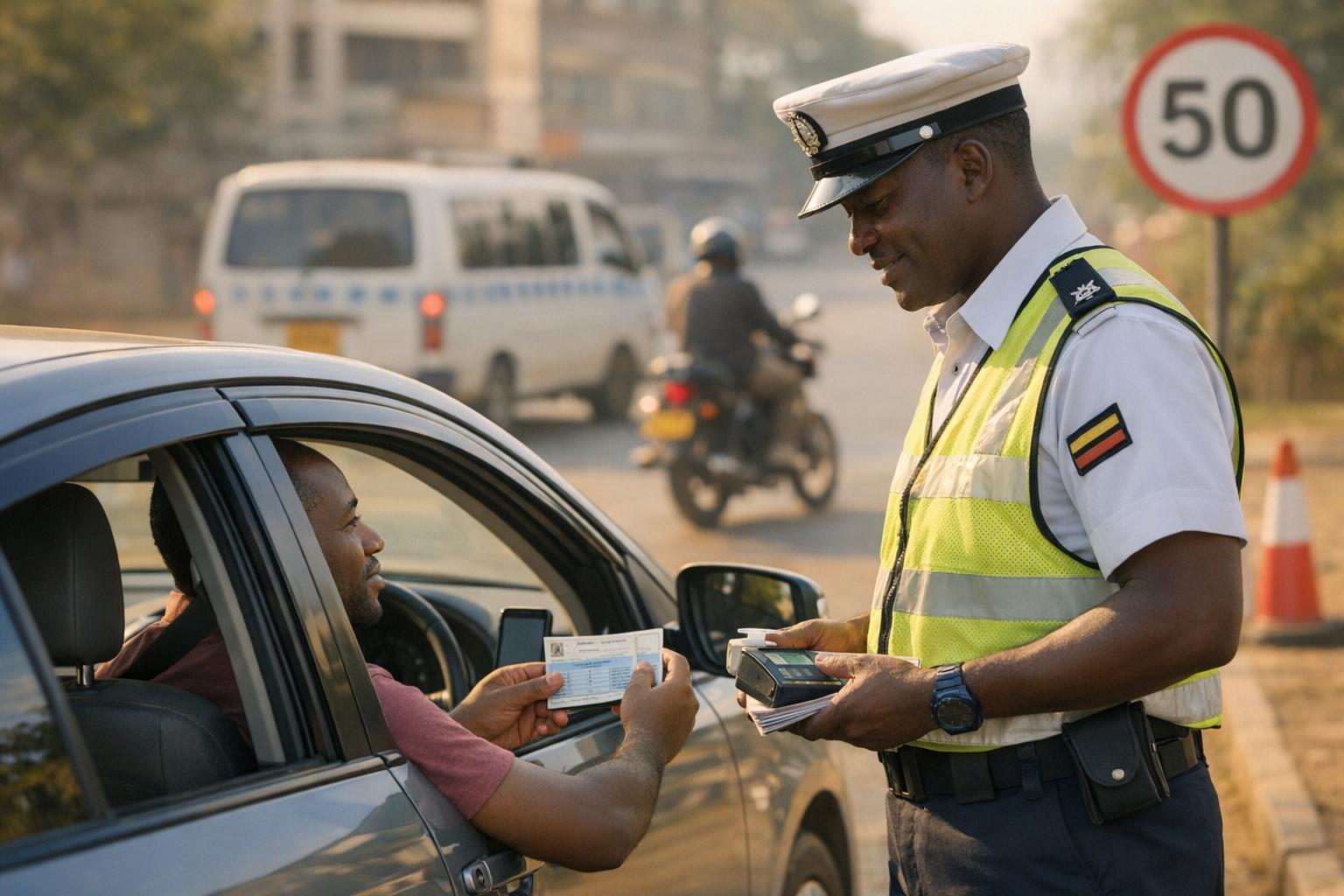
Driving in Uganda comes with strict regulations to ensure safety and accountability. Here are the seven most common traffic offenses, along with their fines and penalties:
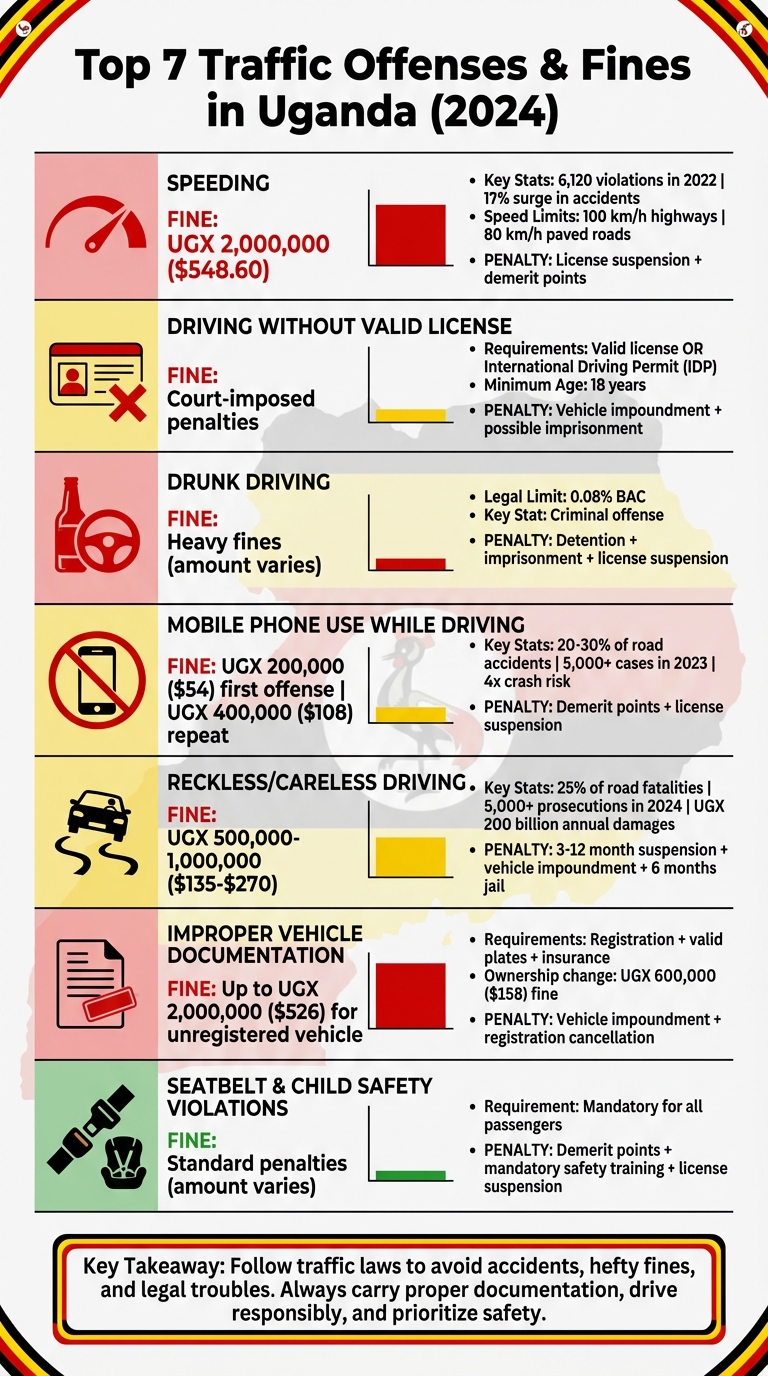
- Speeding: Fines increased to UGX 2,000,000 ($548.60) under the 2023 amendment.
- Driving Without a Valid License: Requires a proper license or an International Driving Permit for non-residents.
- Drunk Driving: Legal BAC limit is 0.08%. Violations lead to fines, detention, and potential imprisonment.
- Using Mobile Phone While Driving: Fines start at UGX 200,000 ($54), doubling for repeat offenders.
- Reckless or Careless Driving: Fines range from UGX 500,000 ($135) to 1,000,000 UGX ($270), with harsher penalties for repeat offenses.
- Improper Vehicle Documentation: Fines up to UGX 2,000,000 ($526) for missing or incorrect paperwork.
- Seatbelt and Child Safety Violations: Mandatory for all passengers, with fines and demerit points for non-compliance.
Key Takeaway: Follow traffic laws to avoid accidents, hefty fines, or legal troubles. Always carry proper documentation, drive responsibly, and prioritize safety.
Uganda Traffic Offenses and Fines 2024 Complete Guide
Ugandan Car Owners: Check if Your Car Has Penalties
sbb-itb-7bab64a
1. Speeding
Speeding remains one of the most common traffic offenses in Uganda. In 2022, authorities recorded 6,120 speeding violations, contributing to a 17% surge in road accidents. The total number of incidents rose from 17,443 to 20,394, with motorcyclists tragically accounting for over 25% of all road fatalities.
To address this issue, the Ugandan government introduced the Traffic and Road Safety (Amendment) Bill 2023, which came into effect on July 1, 2023. This legislation dramatically increased speeding fines, raising them tenfold from UGX 200,000 (about $54.90) to UGX 2,000,000 (around $548.60). Parliament MP Emmanuel Otaala emphasized the urgency of this measure, stating:
"This law should have come yesterday. You cannot replace human life once it is lost."
Uganda also enforces specific speed limits: 100 km/h (62 mph) on highways and 80 km/h (50 mph) on paved or gravel roads. However, enforcing these limits presents significant challenges. Policy analyst Jane Nalunga expressed concerns about corruption undermining the new penalties:
"If somebody is confronted with a penalty of Ush2 million, he or she would rather give a Ush200,000 bribe to the police officer [who has arrested him or her]."
Motorbikes, which number over 1 million across the country – including 120,000 in Kampala – add another layer of complexity to road safety efforts. The government hopes that the increased fines will act as a deterrent and help restore order on the roads. However, the success of these measures depends heavily on consistent enforcement and addressing corruption within the system.
2. Driving Without a Valid License
In Uganda, driving without a valid license is considered a serious offense. Every driver is required to have the appropriate license class for the type of vehicle they operate. For Ugandan residents, this means obtaining their license through the country’s official licensing system.
For non-residents, the rules are slightly different. They must carry both their original domestic driver’s license and an International Driving Permit (IDP). The IDP, recognized by the United Nations, acts as a translation of a home country license into 12 languages, including English. This document is often mandatory for renting a car in Uganda, as most rental agencies require both the IDP and the domestic license. To either drive or apply for an IDP in Uganda, a person must be at least 18 years old, and the permit typically remains valid for one year.
Foreign drivers should ensure they obtain an IDP before traveling to Uganda and always keep it alongside their domestic license while driving. Up next, the issue of drunk driving poses an additional threat to road safety in the country.
3. Drunk Driving
Driving under the influence is considered a criminal offense in Uganda, with a legal blood alcohol concentration (BAC) limit set at 0.08% for drivers.
To enforce this, police have the authority to conduct breathalyzer and blood tests. If a driver is found to exceed the 0.08% BAC threshold, they can be detained until they are sober.
The legal basis for handling such offenses is outlined in the Uganda Penal Code Act (Chapter 128). Specifically, Section 12 discusses intoxication in relation to criminal responsibility, while Section 21 addresses cases where drunk driving leads to fatalities. These laws are part of broader efforts to enhance road safety and reduce dangerous behaviors.
Alcohol consumption significantly impairs driving ability by affecting judgment, slowing reaction times, and decreasing coordination. These legal measures aim to prevent impaired drivers from endangering others on the road.
4. Using Mobile Phone While Driving
Uganda takes traffic safety seriously, and using a mobile phone while driving is one of the country’s most hazardous offenses. It’s a major contributor to 20-30% of road accidents. With Uganda’s narrow roads and heavy traffic, distractions caused by mobile phones significantly raise the risk of crashes – making drivers four times more likely to be involved in an accident compared to those who stay focused.
The Traffic and Road Safety Act 1998 (as amended) addresses this issue directly. Section 69 prohibits handling a mobile phone while driving, categorizing it as careless driving. The law specifically targets any visible phone use, though hands-free operation is generally allowed as long as it doesn’t cause distraction. First-time offenders face a fine of 200,000 UGX (around $54 USD), while repeat violations can result in fines of 400,000 UGX (approximately $108 USD) and even license suspension.
In 2023, Uganda Police reported over 5,000 cases of mobile phone-related violations. In Kampala alone, these infractions accounted for 15% of urban accidents. Traffic officers conduct roadside checks and issue on-the-spot fines using point-of-sale machines. Evidence like dashcam footage or witness statements can also be used to support cases in court. Drivers issued tickets have up to 14 days to appeal at magistrates’ courts.
To avoid fines and, more importantly, stay safe, make it a habit to pull over before using your phone. Activating features like ‘Do Not Disturb While Driving’ can also help. The rules are enforced strictly, so keeping your phone out of hand while driving is not just a legal requirement – it’s a lifesaving practice.
Next, we’ll look into how reckless or careless driving poses additional threats to road safety in Uganda.
5. Reckless or Careless Driving
In Uganda, reckless and careless driving are considered serious violations under the Traffic and Road Safety Act. Reckless driving involves willfully ignoring safety – like swerving suddenly without reason or speeding excessively in busy areas. On the other hand, careless driving refers to operating a vehicle without proper attention, such as ignoring traffic signals or tailgating dangerously. Both offenses are detailed in Section 49 of the Act and come with hefty penalties.
The fines depend on the severity of the offense. Reckless driving can lead to penalties of up to 1,000,000 UGX (around $270), while fines for careless driving can go up to 500,000 UGX (approximately $135). Repeat offenders face harsher consequences, including license suspensions (ranging from 3 to 12 months), vehicle impoundment for up to seven days, and even jail time of up to six months. First-time offenders may be assigned community service instead.
These offenses are a major contributor to road fatalities, accounting for 25% of such incidents. In 2024 alone, over 5,000 prosecutions were recorded. The economic impact is equally alarming, with damages and medical costs exceeding 200 billion UGX (roughly $54 million) annually. For instance, in 2023, a Kampala driver who caused a multi-vehicle pileup was fined 800,000 UGX, while a boda-boda rider ignoring lane discipline received a 300,000 UGX fine.
Traffic police actively enforce these laws through patrols, speed cameras, dashcams, and eyewitness reports. Checkpoints are especially common on high-risk routes like Kampala highways. According to the Uganda Road Safety Association, about 70% of these cases are linked to driver distractions. They stress the need for tighter regulations on boda-boda operations, which account for 40% of violations. Defensive driving courses and public awareness campaigns have helped reduce citations by 10% since 2022. This strict enforcement highlights Uganda’s commitment to road safety, even before tackling documentation-related offenses. Up next: the penalties for improper vehicle documentation.
6. Improper Vehicle Documentation
Beyond enforcing penalties for unsafe driving, keeping your vehicle documentation in order is just as important for road safety. According to Section 10 of the Traffic and Road Safety Act, all vehicles must be registered, display valid license plates, and carry insurance as required by the Insurance Act of 2017. The Chief Licensing Officer oversees an electronic registry, and police officers are authorized to inspect vehicles to ensure compliance with these requirements.
The penalties for failing to meet documentation standards are severe. Driving an unregistered vehicle can lead to fines of up to 100 currency points – equivalent to 2,000,000 UGX (approximately $526). Other violations, like neglecting to report ownership changes, can result in fines of up to 30 currency points, or 600,000 UGX (around $158). Under the current system, one currency point equals 20,000 UGX.
The Uganda Revenue Authority (URA) actively intercepts vehicles with expired or missing permits, including those registered in foreign countries. This enforcement aligns with the government’s broader efforts to improve compliance. By integrating systems like the Tax Identification Number (TIN), Business Registration Number (BRN), and National Identification Number (NIN), authorities aim to reduce fraud and enhance vehicle tracking.
To avoid fines and stay compliant, ensure your vehicle is registered in the electronic system, promptly report any ownership changes, and keep both physical and digital copies of your documentation up to date. The URA is increasingly focusing on encouraging voluntary compliance by engaging with stakeholders rather than relying solely on penalties. Up next, a summary table outlines the fines for various offenses, providing a handy reference for drivers.
7. Seatbelt and Child Safety Violations
After ensuring proper vehicle documentation, personal safety measures take center stage. Wearing seatbelts and using child restraints aren’t just recommendations in Uganda – they’re legal requirements. The Traffic and Road Safety Act, 1998 (as amended) outlines clear rules mandating seatbelt use for drivers and passengers, as well as proper restraints for children.
To encourage compliance, the Act enforces penalties through a demerit points system for violations. This system underscores the importance of adhering to these safety measures, creating a unified framework for road safety across the country. Always remember: buckle up and ensure children are secured in restraints suitable for their age and size.
Offense and Fine Summary Table
Here’s a quick overview of common traffic violations in Uganda and the penalties attached. Keep in mind that these fines and consequences might change based on updates to local laws and regulations.
| Offense | Fine Details | Repeat Offense Penalties | Additional Consequences |
|---|---|---|---|
| Speeding | Fines depend on how much the speed limit is exceeded. | Higher penalties apply with repeated violations. | • License suspension possible • Demerit points added • Mandatory traffic safety course |
| Driving Without a Valid License | Monetary fines are imposed, often requiring a court appearance. | Repeat violations lead to heavier fines and stricter legal action. | • Vehicle impoundment • Possible short-term imprisonment • Court-ordered driving ban |
| Drunk Driving | Hefty fines are issued due to the serious risks involved. | Penalties grow harsher with each offense. | • Extended license suspension • Possible imprisonment • Vehicle confiscation for repeat violations |
| Using Mobile Phone While Driving | Fines are issued for distracted driving. | Penalties increase for repeated offenses. | • Demerit points added • License suspension after multiple infractions |
| Reckless or Careless Driving | Fines vary based on the severity of the offense. | Subsequent violations result in stricter penalties. | • Longer license suspensions • Potential imprisonment • Permanent license revocation in severe cases |
| Improper Vehicle Documentation | Fines or fees apply for missing or incorrect paperwork. | Non-compliance over time leads to harsher penalties. | • Vehicle impoundment until documents are corrected • Possible suspension or cancellation of registration • Court summons |
| Seatbelt and Child Safety Violations | Fines are issued for not following safety rules. | Repeat violations bring higher fines and stricter measures. | • Demerit points added • Mandatory safety training • License suspension after repeated offenses |
This table highlights the importance of following Uganda’s traffic laws, as detailed in earlier sections.
Conclusion
Abiding by Uganda’s traffic laws not only protects lives but also helps drivers avoid hefty fines. Rules like speed limits and seatbelt requirements are in place to reduce the risk of accidents and severe injuries caused by reckless driving. Breaking these laws can lead to significant penalties, and repeated violations might even result in imprisonment or the suspension of your driving license.
Since May 2020, the demerit points system has added another layer of accountability. Each traffic offense now comes with points that could lead to stricter consequences, ensuring drivers take their responsibilities seriously.
Another critical regulation is the legal obligation for drivers to assist accident victims, regardless of their financial situation.
To stay on the right side of the law, make sure your vehicle documents are up to date, check your license status regularly, and practice safe driving habits. By following these guidelines, every driver plays a role in creating safer roads across Uganda. For more tips on vehicle safety, traffic laws, and updates, head over to AutoMag.ug.
FAQs
How do I check how many demerit points I have in Uganda?
You can find out your demerit points in Uganda through the Uganda Driver Licensing System (UDLS), which works in conjunction with the express penalty scheme. However, detailed steps for checking these points are not clearly provided in the available resources.
What documents should I always carry to avoid documentation fines?
To steer clear of fines related to documentation, make sure you always have these with you:
- Your driver’s license
- Vehicle registration documents
- Insurance papers
These are crucial for staying compliant with traffic laws and avoiding unnecessary penalties.
Can I challenge a traffic ticket, and what’s the deadline?
Yes, you can contest a traffic ticket in Uganda. Generally, you have 72 hours from the time you receive the ticket to either pay the fine or challenge it. This timeframe was emphasized when the system was first introduced.
Related Blog Posts
- 10 Safety Tips for Long Drives in Uganda
- How to register a used car in Uganda
- Ride-sharing Regulations in Kampala: What You Need to Know
- Avoid pitfalls when transferring your vehicle in Uganda