
Importing a car into Uganda can be complex and costly due to various taxes, fees, and documentation requirements. To avoid delays and unexpected expenses, here’s what you need to know:
- Key Costs: Import duties (15%-35%), VAT (18%), withholding tax (6%), and other charges like environmental levies and registration fees. Uganda calculates taxes based on the CIF value (Cost, Insurance, and Freight).
- Essential Documents: Certificate of Conformity (CoC), Bills of Lading, commercial invoice, original logbook, and Tax Identification Number (TIN). Ensure all details match to prevent clearance issues.
- Vehicle Eligibility: Comply with Uganda’s age and safety standards. Vehicles over 15 years old face steep age-based penalties (up to 50%).
- Special Rules for EVs: Electric vehicles incur a flat 25% duty, while parts and kits are duty-free to promote local assembly.
- Customs Clearance: Use the URA portal to upload documents and pay taxes accurately. Licensed clearing agents can help navigate valuation discrepancies and avoid errors.
- Stay Updated: Uganda’s import policies and tariffs often change during fiscal year transitions (July 1). Monitor updates to plan ahead.
Following this checklist ensures a smoother, more predictable car import process in Uganda.
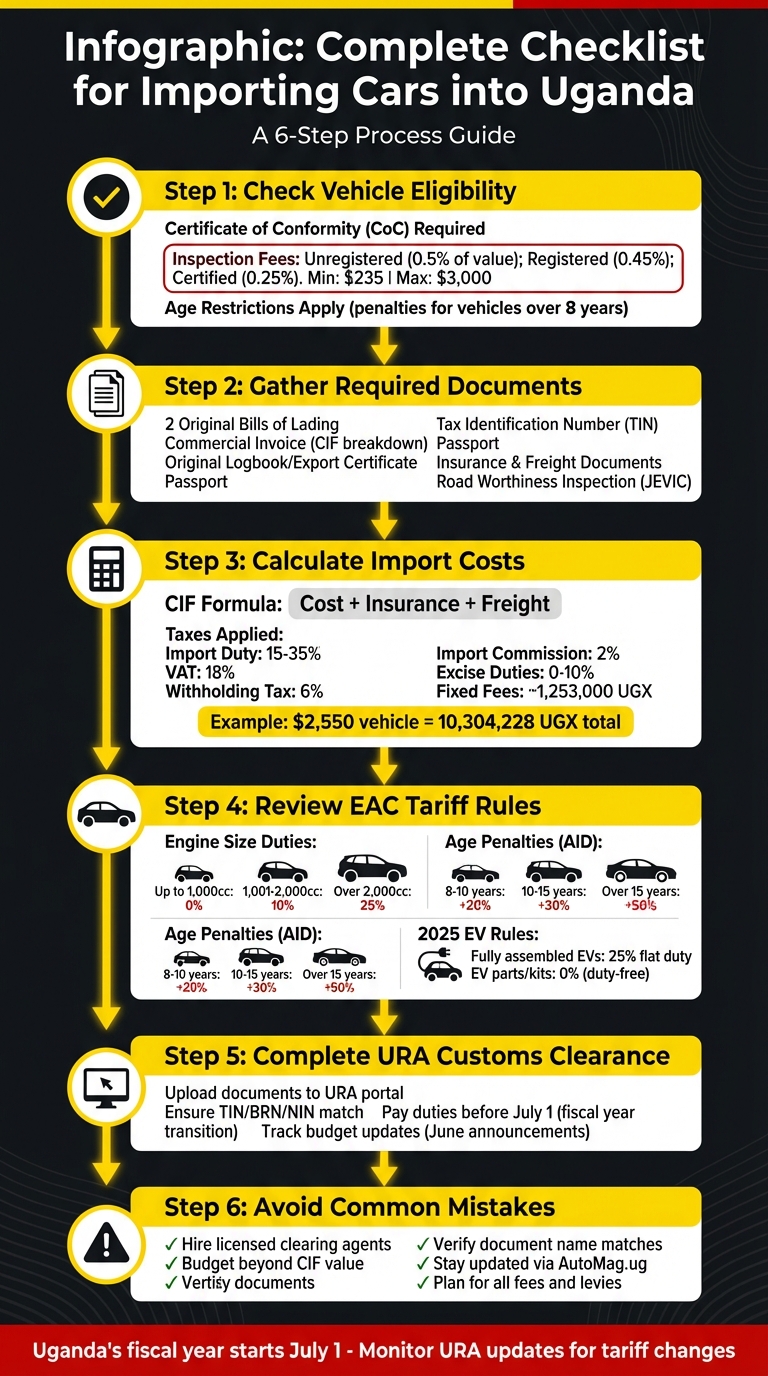
6-Step Guide to Importing Cars into Uganda: Costs, Documents & Compliance
How to calculate Taxes on Used Goods Vehicles in Uganda | #Customs101
sbb-itb-7bab64a
Step 1: Check Vehicle Eligibility and Requirements
Before importing a vehicle into Uganda, make sure it complies with the country’s import standards. This step is crucial to avoid penalties or having your vehicle rejected. One essential document you’ll need is the Certificate of Conformity (CoC).
Get a Certificate of Conformity (CoC)
The Certificate of Conformity (CoC) verifies that your vehicle meets Uganda’s safety and quality standards. This document is issued under the PVoC program, managed by the Uganda National Bureau of Standards (UNBS).
When budgeting for the CoC, keep in mind that the inspection fee depends on the vehicle category:
- Unregistered products: 0.5% of the vehicle’s value
- Registered products: 0.45%
- Certified products: 0.25%
The minimum fee is $235, while the maximum is capped at $3,000. Make sure to account for these costs and secure the CoC before exporting your vehicle.
Step 2: Collect All Required Import Documents
Once you’ve confirmed your vehicle is eligible, the next step is to gather all the necessary paperwork. Missing even a single document can lead to customs delays or even prevent clearance entirely. Having everything in order will help make the process smoother.
Gather Essential Import Documents
Here’s what you’ll need to collect: two clear, negotiable Original Bills of Lading, a commercial invoice, an original logbook or export certificate, and your passport.
Make sure the consignee name on the Bills of Lading matches the name on your URA-issued Tax Identification Number (TIN) certificate. Any mismatch between the details on your bills and the TIN certificate could cause clearance issues.
If you’re employed in Uganda, your employer may assist you in obtaining a TIN. If not, you can apply directly through the URA. Depending on your residency status, additional documents, such as a work permit, immigration permit, or a Certificate of Residence Change, may also be required.
Obtain Insurance and Freight Documents
Since Uganda calculates import taxes based on the CIF (Cost, Insurance, and Freight) value, make sure to secure your insurance and freight documents. Your commercial invoice must clearly outline the vehicle cost, insurance charges, and freight fees separately – this breakdown is crucial for the URA tax formula.
Additionally, the Bill of Lading is used to calculate port authority charges. These fees are determined by your vehicle’s weight or cubic measurement (M3), not just its purchase price. Ensure you receive two original copies of the Bill of Lading through a reliable courier service like DHL.
Arrange Certification with Accredited Providers
The Uganda National Bureau of Standards (UNBS) requires a mandatory Road Worthiness Inspection for used cars, conducted by JEVIC. For pre-export verification, EAA (East Africa Automobile Services) is an approved provider for the Certificate of Conformity (CoC). Verify that your chosen certification body is recognized by UNBS to avoid shipment issues. Schedule this inspection well before shipment to prevent delays or penalties at the border.
Step 3: Calculate Your Total Import Costs
Calculate the Dutiable Value
Once you’ve gathered your documents, it’s time to figure out the total cost of importing your vehicle. Uganda uses the CIF method – Cost, Insurance, and Freight – to determine the dutiable value. This means you’ll need to add up the purchase price, marine insurance, and shipping costs to arrive at this base figure. Keep in mind that the Uganda Revenue Authority (URA) may use their own estimate instead of your proforma invoice, which could increase the taxes you owe.
After establishing the dutiable value, the next step is to calculate all applicable taxes and fees.
Add All Taxes and Fees
Uganda’s tax structure is applied to the CIF value and includes the following:
- Import duty: Ranges from 15% to 35%, depending on the type of vehicle.
- Value-added tax (VAT): 18%.
- Withholding tax: 6%.
- Import commission: 2%.
- Excise duties: Between 0% and 10%.
In addition to these taxes, there are fixed fees that typically add about 1,253,000 UGX to your total. These fees cover registration and other related charges. To calculate the total, you can use this formula:
(CIF Value × Exchange Rate × 105%) + Fixed Fees
For instance, if a vehicle is valued at $2,550.36 and the exchange rate is 3,380 UGX, the total taxes amount to 10,304,228 UGX. Don’t forget to budget for additional costs like bond cancellation fees, insurance stickers, and road usage licenses.
Compare Costs by Vehicle Type
After calculating taxes and fees, it’s important to consider how the type of vehicle impacts the final cost. Import expenses can vary widely depending on the vehicle’s size and category. For example, handling fees at the Port of Mombasa are based on either the vehicle’s volume (measured in cubic meters) or weight. This means larger vehicles, like SUVs and trucks, typically incur higher costs.
To help with planning, the URA Motor Vehicle Calculator can estimate duties. However, it’s worth noting that this tool may sometimes be unavailable due to technical issues. Before making a purchase, compare costs across different vehicle categories – such as standard cars, electric vehicles, and trucks. You might also consider negotiating a lower purchase price with exporters, which can help reduce the CIF value and, in turn, your total tax burden.
Step 4: Review EAC and EV Tariff Rules
Understand the EAC Three-Tier Duty System
Uganda applies the East African Community (EAC) Common External Tariff, which organizes import duties by engine size. Here’s how it works: vehicles with engines up to 1,000cc are exempt from duty, those between 1,001cc and 2,000cc are taxed at 10%, and engines over 2,000cc are charged 25%. These percentages are applied to the CIF (Cost, Insurance, and Freight) value after fees.
For instance:
- A Toyota Vitz with a 996cc engine incurs no import duty, though VAT and other charges still apply.
- A Toyota Corolla with a 1.8L (1,800cc) engine and a CIF value of $10,000 would face a 10% duty, amounting to $1,000.
- A Toyota Prado with a 2.7L (2,700cc) engine and a CIF value of $20,000 would be taxed at 25%, resulting in a $5,000 duty.
Many importers often find that vehicles in the 10% tier, like the Corolla, strike a balance between cost and value. Now, let’s explore how electric vehicles are treated under the updated tariff rules.
Check 2025 EV Tariff Changes
In 2025, Uganda revised its electric vehicle tariffs through the URA Finance Act 2025. Fully assembled electric vehicles now carry a flat 25% import duty, regardless of size. However, parts and completely knocked down (CKD) kits for EVs are exempt from duty to encourage local assembly.
For example:
- Importing a fully built Tesla Model 3 means paying a 25% duty plus 18% VAT.
- On the other hand, bringing in BYD battery components for local assembly would incur no duty.
This policy shift aims to support environmental goals while promoting local manufacturing. But don’t forget, the age of the vehicle also plays a major role in calculating duties.
Calculate Age-Based Penalties
Vehicles face additional import duties (AID) based on their age. These penalties are added to the base rates as follows:
- 8–10 years old: 20% AID
- 10–15 years old: 30% AID
- Over 15 years old: 50% AID
For example, importing a 9-year-old SUV with a 1,500cc engine and a CIF value of $12,000 would incur:
- 10% base duty: $1,200
- 20% age penalty: $2,400
This brings the total additional cost to $3,600. To avoid steep fines for misclassification – up to 200% of the duty owed – it’s crucial to verify your vehicle’s age and specifications. Tools like VIN decoders can help ensure accuracy.
Step 5: Complete Customs Clearance with URA
Upload Documents to the URA Portal
Once you’ve calculated duties and gathered all necessary paperwork, it’s time to submit everything through the URA online portal. The URA now integrates TIN (Taxpayer Identification Number), BRN (Business Registration Number), and NIN (National Identification Number) into a single database, making the clearance process more efficient. Be sure your TIN is correctly linked to your NIN or BRN to avoid delays caused by mismatched information.
You can upload the required documents yourself or work with a licensed clearing agent to manage the digital submission. Either way, ensure all documents are consistent to prevent errors in classification. Once the upload is complete, your focus should shift to paying duties accurately to avoid any penalties.
Pay Duties Correctly to Prevent Fines
The URA imposes penalties for under-declared duties, so accuracy is critical. This becomes even more important during fiscal year transitions, as tariff rates may change. If you’re importing goods toward the end of June, aim to complete payments before July 1 to account for potential rate adjustments.
In recent years, the URA has adopted a more collaborative approach to enforcement. For example, in March 2026, the agency provided compliance training for over 60 school directors in Kyotera District and held community sensitization events in Tororo and Jinja. These sessions are particularly helpful for new importers, offering clear guidance on how to meet tax obligations and avoid common errors. If you’re new to the process, attending one of these regional meetings could save you time and money.
Once you’ve completed your documentation and payments, stay informed about fiscal updates that could impact your future import costs.
Track Government Budget Updates
Uganda’s fiscal year begins on July 1, and the annual budget reading in June often brings changes through Tax Amendment Bills. These updates can significantly affect import costs. For instance, recent policies have increased penalties for older internal combustion engine vehicles while introducing duty exemptions for electric vehicle components. Additionally, the URA regularly updates its Motor Vehicle Valuation Guide, which can alter the dutiable value of vehicles.
To stay ahead, monitor announcements from the Ministry of Finance between April and June. Subscribing to the URA’s "The Taxman" newsletter or reviewing their quarterly updates can help you stay informed about new exemptions and compliance procedures. Keep in mind that during fiscal transitions, the URA portal and motor vehicle calculators may undergo maintenance, so plan your clearance process accordingly.
Step 6: Avoid Common Import Mistakes
After ensuring compliance and accurate documentation, it’s essential to address potential procedural and financial missteps to keep the clearance process smooth.
Hire Licensed Clearing Agents
Collaborating with a licensed clearing agent can save you from expensive errors during customs clearance. A frequent issue involves mismatches between the name on your Bill of Lading and your Tax Identification Number (TIN). As Barasa Oluru Protus, a BE FORWARD Supporter, explains:
If the name on the documents does not match the name on your TIN, then delays in the clearing process in Uganda will be experienced.
Licensed agents are also familiar with the Uganda Revenue Authority (URA)’s practice of using estimated vehicle values instead of proforma invoices. They can help you navigate these valuation discrepancies and handle complex requirements like bond cancellations and obtaining road usage licenses.
Additionally, many licensed agents provide services that cover liability for transit-related issues. As Barasa Oluru Protus highlights:
If any damage or loss occurs to your vehicle, the city delivery service will be held responsible for it. Also, if your car breaks down, they will repair it at no extra cost.
Plan for All Costs Beyond CIF Value
Focusing solely on the CIF (Cost, Insurance, and Freight) value can lead to budget surprises. Importers often overlook additional charges like import duty, VAT, and other levies. Besides the CIF value, you’ll need to account for:
- Import Duty
- Value Added Tax (VAT)
- Withholding Tax
- Infrastructure Levy
- Environmental Levy for older vehicles
- Port and border fees
Factoring in these expenses ahead of time can prevent financial headaches.
Use AutoMag.ug for Current Information

Import regulations and tariff rates can change frequently, especially around fiscal year transitions. AutoMag.ug is a reliable source for the latest automotive news, import guidelines, and updates on Uganda’s automotive industry. Make it a habit to check the site regularly to stay informed about any policy shifts that might affect your import costs.
Conclusion
Bringing a vehicle into Uganda is no small task – it requires careful planning, precise documentation, and a solid grasp of the country’s tax structure. From confirming that your vehicle meets age restrictions to obtaining the right certifications, every step is critical. Overlooking even one requirement can lead to delays and unexpected costs.
The financial aspect is equally important. Barasa Oluru Protus, a BE FORWARD Supporter, highlights the risks:
Sometimes we found ourselves budgeting for underestimate… this can be a very cataclysmic in our financial plan that will really lead one to tense expectation
This underscores the importance of preparing for all costs, including Import Duty, VAT, Withholding Tax, Environmental Levy, Infrastructure Fee, and registration fees. For example, importing a vehicle valued at $2,550 could result in total charges exceeding 10,300,000 UGX. Failing to account for these can derail your budget.
To avoid costly errors, working with licensed clearing agents is a smart move. These professionals understand the intricacies of bond cancellations, road usage licenses, and the strict 48-hour payment deadlines that can catch importers off guard.
Lastly, stay informed about changing regulations and tariffs. AutoMag.ug is a reliable resource for updates on Uganda’s automotive industry, including import guidelines and policy changes. Regularly checking their updates can help you navigate the process smoothly and avoid surprises. Following these steps will ensure a more seamless import experience.
FAQs
What does CIF include when URA calculates my taxes?
CIF, which stands for Cost, Insurance, and Freight, represents the combined value of the vehicle, insurance costs, and freight charges. This total is what the Uganda Revenue Authority (URA) uses to calculate the taxes owed when importing a car.
How can I avoid URA valuing my car higher than my invoice?
To make sure the Uganda Revenue Authority (URA) doesn’t assess your car at a higher value than what’s on your invoice, it’s important to declare the real purchase price. Provide authentic, well-documented proof, such as the invoice and any related expenses. Accurate and transparent paperwork not only establishes trust but also helps ensure the valuation matches your declared amount. Be cautious about undervaluing, as this could prompt the URA to reassess the value based on what they believe to be market rates.
What extra costs should I budget for beyond duty and VAT?
When planning your budget, remember to account for more than just duty and VAT. Additional expenses like local levies, registration fees, and administrative charges can add up. These costs will vary based on the type of vehicle and the specific import process. To get a clear picture, consider using tools provided by the Uganda Revenue Authority or reaching out to the appropriate authorities for precise estimates.
Related Blog Posts
- How to Import a Car to Uganda: Complete Guide 2025
- Used Car Inspection: 10-Point Checklist Before Buying
- Importing a car to Uganda: taxes explained
- Car import duties in Uganda: URA fees, taxes and clearance process