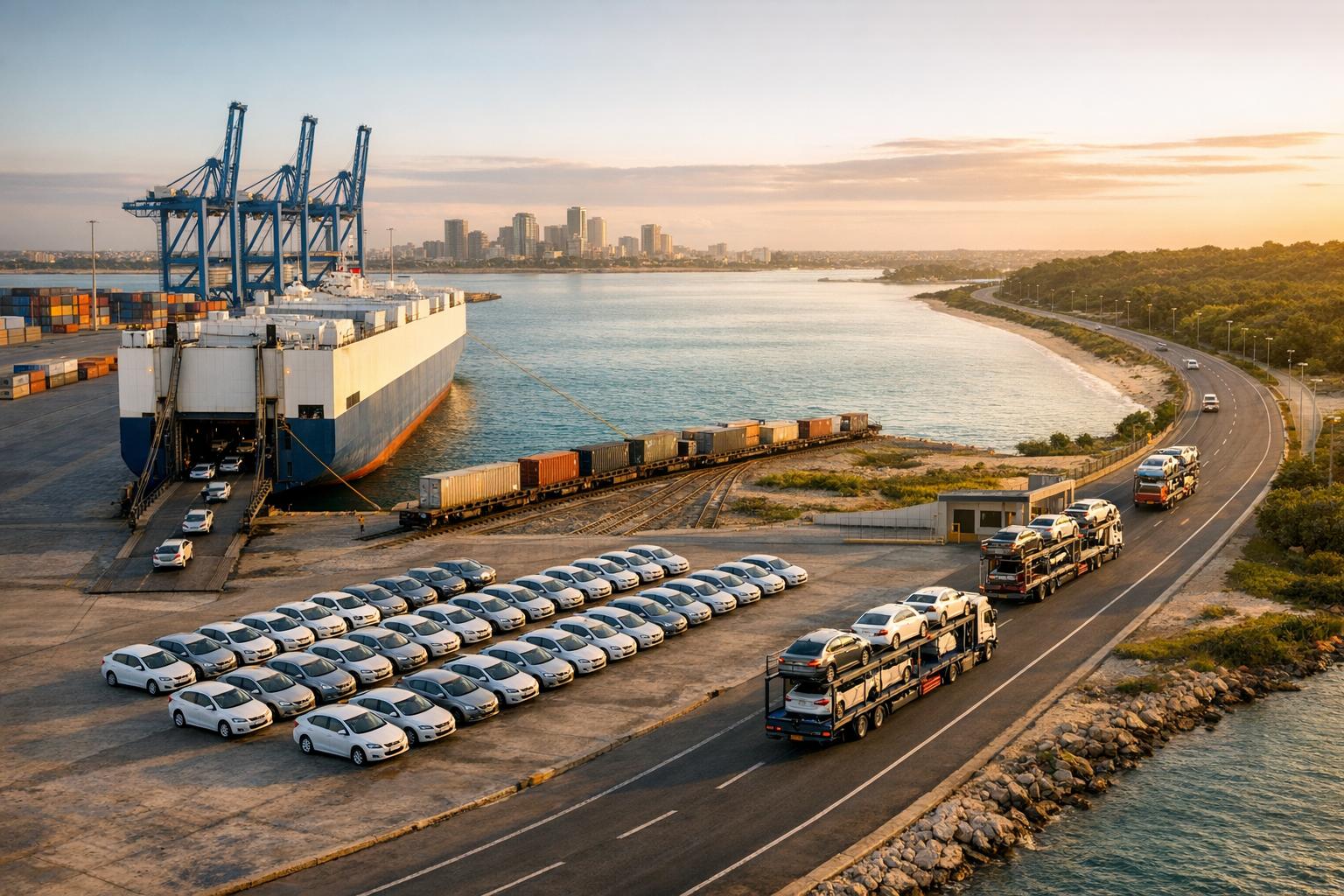
Dar es Salaam Port has become a key gateway for Uganda’s automotive imports, offering cost savings and efficient logistics for landlocked importers. By modernizing its infrastructure and streamlining trade routes, the port has reduced vehicle import costs and delivery times, making it a preferred choice over other corridors like Mombasa. Uganda’s automotive sector, which generates over $150 million annually in revenue, benefits from improved customs systems and direct rail and road connections to the Mutukula border. These advancements support Uganda’s growing demand for vehicles while bolstering related industries like logistics and repair services.
Key Highlights:
- Cost Savings: Importers save approximately $150 per bus using Dar es Salaam Port.
- Faster Processing: Transit times reduced from 21 to 7 days.
- Modernized Infrastructure: Upgrades include deeper berths, advanced cargo handling equipment, and direct rail links.
- Economic Impact: Uganda’s automotive imports contribute significantly to national revenue and job creation.
The port’s improvements ensure smoother imports, lower costs, and stronger trade ties between Tanzania and Uganda, driving growth in Uganda’s automotive market.
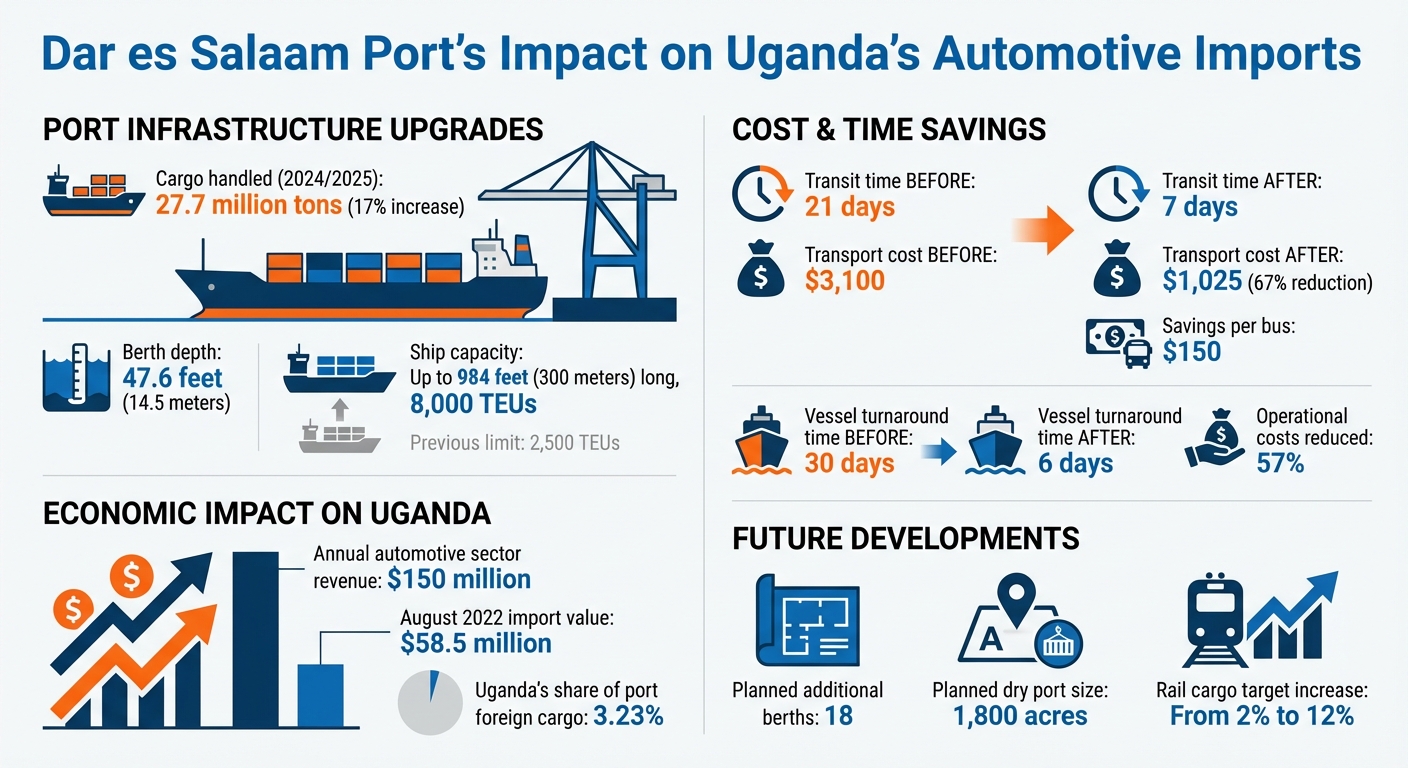
Dar es Salaam Port Impact on Uganda’s Automotive Imports: Key Statistics
10 Crucial Things You Should Know Before Picking Up A Car From Dar es Salaam Tanzania
sbb-itb-7bab64a
Dar es Salaam Port: Infrastructure and Capacity
Dar es Salaam Port stands as Tanzania’s main maritime hub, playing a pivotal role in supporting Uganda’s automotive import growth. During the 2024/2025 financial year, the port handled 27.7 million tons of cargo, reflecting a 17% rise compared to the previous year. This increase in capacity and operational efficiency directly impacts Uganda’s ability to import vehicles more smoothly.
Modernization efforts at the port have centered on accommodating larger ships and speeding up processing times. As part of the Dar es Salaam Maritime Gateway Project (DMGP), upgrades included deepening berths 1–7 to 47.6 feet (14.5 meters) and expanding the turning basin to 49.2 feet (15 meters). These improvements now enable the port to handle Post-Panamax ships up to 984 feet (300 meters) in length, with a capacity of 8,000 TEUs – far surpassing the previous limit of 2,500 TEUs. Captain Abdullah Mwingamno of TPA highlighted the significance of these advancements:
"These achievements are the result of the government’s strategic investments in modernising the port. We can now confidently assure our customers and partners that Dar es Salaam Port is fully equipped to handle modern mega-ships efficiently."
Recent Expansion and Upgrades
Collaborations with DP World and Tanzania East Africa Gateway Terminal Limited (TEAGTL) have revolutionized operations. Public-private partnerships have dramatically reduced operational costs by 57% and slashed vessel turnaround times from 30 days to just 6. Future projects, including the construction of 18 additional berths and integrated rail connections, are set to enhance efficiency even further.
The integration of rail systems marks another significant step forward. The port now connects directly to the Meter Gauge Railway (MGR), Standard Gauge Railway (SGR), and TAZARA lines. This internal rail network aims to shift more cargo transport from road to rail, targeting an increase from 2% to 12%. This shift will help ease road congestion for vehicles heading to Uganda. Additionally, a planned 1,800-acre dry port along the Tanzam highway will bolster this multimodal approach.
Vehicle Handling Facilities
Automotive cargo processing has been streamlined with a dedicated Roll-on/Roll-off berth. The port has also installed advanced equipment, including Ship-to-Shore Gantry Cranes, Rubber Tyred Gantry (RTG) Cranes, and modern forklifts. These tools enhance handling speed and reduce the risk of damage to high-value shipments. For Ugandan importers, these upgrades translate into safer and faster processing of vehicles.
The advancements at Dar es Salaam Port are setting the stage for more efficient and reliable automotive imports into Uganda.
Uganda’s Automotive Import Patterns
Dar es Salaam Port plays a key role in supporting Uganda’s thriving automotive import sector. This industry, valued at $58.5 million in August 2022 alone, is a cornerstone of Uganda’s economy. The efficient routing through Dar es Salaam ensures a steady flow of vehicles, which not only facilitates personal mobility but also drives commercial activity.
Import Statistics and Data
Uganda’s automotive imports generate an estimated $150 million annually in revenue through import duties, VAT, and registration fees, collected by the Uganda Revenue Authority (URA). Journalist Salmah Namwanje from Nile Post highlights the sector’s significance:
"The car import business in Uganda is a multi-million dollar industry. In recent years, the revenue generated from taxes and duties on imported vehicles has consistently bolstered the national budget."
The majority of Uganda’s vehicles come from Japan, the United Arab Emirates (UAE), and the United Kingdom (UK). These trade partnerships have remained steady, although regulatory changes continue to influence the flow of imports. Beyond vehicles, the industry supports logistics, spare parts, and repair services, providing jobs to thousands. This growth reflects the combined impact of population expansion and evolving regulations.
What’s Driving Vehicle Demand
Several factors fuel the rising demand for vehicles in Uganda. Rapid population growth and urbanization are creating a greater need for transportation solutions, both for personal use and commercial purposes. Vehicles are essential in enabling trade, mobility, and employment throughout the country.
Regulatory changes have also shaped the market. In October 2018, Uganda introduced a ban on importing vehicles older than 15 years to enhance road safety and reduce pollution. While this policy has pushed the market toward newer, costlier models, it has also modernized the national fleet. Additionally, the government is promoting eco-friendly initiatives, such as electric vehicles, and is working to develop local automotive assembly as a long-term strategy to complement imports.
Trade Connections Between Dar es Salaam Port and Uganda
Dar es Salaam Port’s expanded capacity, combined with advanced logistics and digital customs systems, has directly improved Uganda’s automotive import process.
The infrastructure linking Dar es Salaam Port to Uganda has made vehicle transportation between the two nations much smoother. The Central Corridor is the main trade route, supported by a fully developed road network stretching from Dar es Salaam to the Mutukula border crossing. Additionally, digital customs systems have simplified vehicle imports across East Africa.
The Central Corridor and Single Customs Territory
The Single Customs Territory (SCT), introduced in July 2014 under the East African Community Customs Union, transformed how vehicles are imported. This system allows importers to assess and pay duties in the destination country while their vehicles remain at Dar es Salaam Port. As the East African Community explains:
"Under SCT assessment and payment of duties is done at the destination Partner State while goods are still at the first point of entry."
This approach has drastically reduced both time and costs. Transit times have decreased from 21 days to just 7 days, while transport costs have dropped from $3,100 to $1,025 – a savings of about 67%. Issa Ssekito, spokesperson for the Kampala City Traders Association, highlights that "restrictions imposed in Mombasa and on the Northern Corridor to Kampala at the end of the day make it more expensive to import".
Direct Clearance Systems
The SCT operates on interconnected customs systems that enable real-time data sharing among East African Community partner states. This integration allows vehicles to be cleared directly to Uganda without requiring transit inspections at the border. A single declaration now replaces multiple documents, significantly reducing administrative work. Automated revenue transfers between customs authorities further streamline the process.
Uganda also manages its own Foreign Cargo Center at Dar es Salaam Port through a licensing agreement. This setup allows Ugandan authorities to process cargo directly, minimizing logistical delays and costs. In 2015/16, Uganda accounted for 3.23% of all foreign cargo handled at the port. These efficient clearance systems have solidified Dar es Salaam Port’s role in supporting Uganda’s automotive sector growth.
How Dar es Salaam Port Affects Uganda’s Automotive Market
Dar es Salaam Port has become a game-changer for Uganda’s automotive sector, thanks to improved logistics and more efficient customs processes. These advancements have brought down import costs and sped up vehicle delivery, creating tangible benefits for Ugandan buyers and businesses.
Reduced Costs and Delivery Times
For vehicle traders in Uganda, using Dar es Salaam Port has proven to be a cost-effective option. Issa Ssekito, spokesperson for the Kampala City Traders Association, highlighted the savings:
"Since then, he has been saving about Sh13,050 ($150) on each bus he imports."
Better road connections to the Mutukula border and a Tanzania–Uganda agreement offering preferential rates have further reduced expenses and cut down delivery times. These improvements have made vehicle imports more affordable and efficient, fueling growth in the market.
Supporting Market Expansion
The port’s upgraded infrastructure and streamlined clearance systems have not only improved logistics but also opened doors for Uganda’s automotive market to grow. Each year, Uganda imports thousands of vehicles from major suppliers like Japan, the UAE, and the UK. With lower costs and faster deliveries, vehicles have become more accessible to consumers and businesses alike, driving growth in transportation and trade.
This thriving import market also supports a range of related industries. From logistics companies to spare parts dealers and repair services, the automotive sector creates jobs for thousands of Ugandans. John Mathenge, Chief Executive of the Federation of East African Freight Forwarders Associations, underscored the importance of having multiple trade routes:
"For landlocked countries like Uganda, in principle, it makes business sense to have alternative routing for the cargo."
Conclusion
Dar es Salaam Port has become a key resource for Uganda’s automotive sector, offering landlocked importers an alternative route with tangible benefits. Thanks to infrastructure upgrades – like the completed road to the Mutukula border – and preferential rates under a Memorandum of Understanding (MoU) between Tanzania and Uganda, importing vehicles has become more cost-effective for Ugandan businesses.
The financial savings, combined with quicker delivery times, have significantly reduced expenses while boosting the growth of Uganda’s transportation industry. Beyond cost reductions, this route strengthens supply chain reliability, helping avoid disruptions caused by strikes or political issues along other trade corridors.
Dar es Salaam Port’s strategic upgrades have simplified vehicle imports, cut costs, and supported market expansion. Its infrastructure is a major contributor to these successes. With a capacity of 14.1 million metric tons and 12 berths, the port is well-equipped to handle rising vehicle imports. This is crucial, as Uganda’s car import sector generates over $150 million annually for the economy, supporting jobs in logistics, spare parts, and vehicle repair services.
As the demand for fuel-efficient cars in Uganda continues to grow, Dar es Salaam Port plays a central role in ensuring affordable imports and driving economic development.
FAQs
How does the Single Customs Territory speed up car imports to Uganda?
The Single Customs Territory speeds up car imports to Uganda by simplifying customs procedures. It allows for smooth sharing of customs data and ensures that duties are assessed and paid directly at the destination. This approach cuts down on delays and expenses. Plus, it improves regional trade efficiency, resulting in quicker clearance times and easier importation.
What additional fees should Ugandan importers expect beyond port charges?
Ugandan importers need to plan for additional expenses beyond the standard port charges. These include import duties, value-added tax (VAT), and registration fees. Factoring in these costs is crucial when budgeting for vehicle imports into Uganda.
How reliable is the Dar–Mutukula route during peak seasons?
The reliability of the Dar–Mutukula route during peak seasons isn’t clearly outlined in the available sources. That said, it’s reasonable to assume that factors like heavier traffic and logistical hurdles during busy periods could impact its overall efficiency.
Related Blog Posts
- Uganda’s Localization Policies in Automotive Manufacturing
- Uganda bans diesel bus imports to boost local manufacturing
- Uganda, Kenya, and Tanzania align on regional transport rules
- Import a Car from South Africa to Kampala: Complete Guide for Buyers