Buying a used car can save money, but it’s risky if you don’t know what to look for. Sellers might tamper with odometers, falsify service records, or hide accident or flood damage. These issues not only cost you more but also jeopardize safety. Here’s how to protect yourself:
- Odometer Fraud: Check for physical wear like worn pedals or seats that don’t match the mileage. Look for tampering signs like misaligned dashboard digits or scratches around the instrument cluster. Use an OBD-II scanner to verify mileage stored in the car’s system.
- Service Records: Verify maintenance logs by contacting listed repair shops. Cross-check records with CARFAX or AutoCheck reports, and ensure VINs match across all documents.
- Accident Damage: Inspect for uneven paint, misaligned panels, or tool marks on bolts. Check the frame for welding marks, rust, or straightening signs.
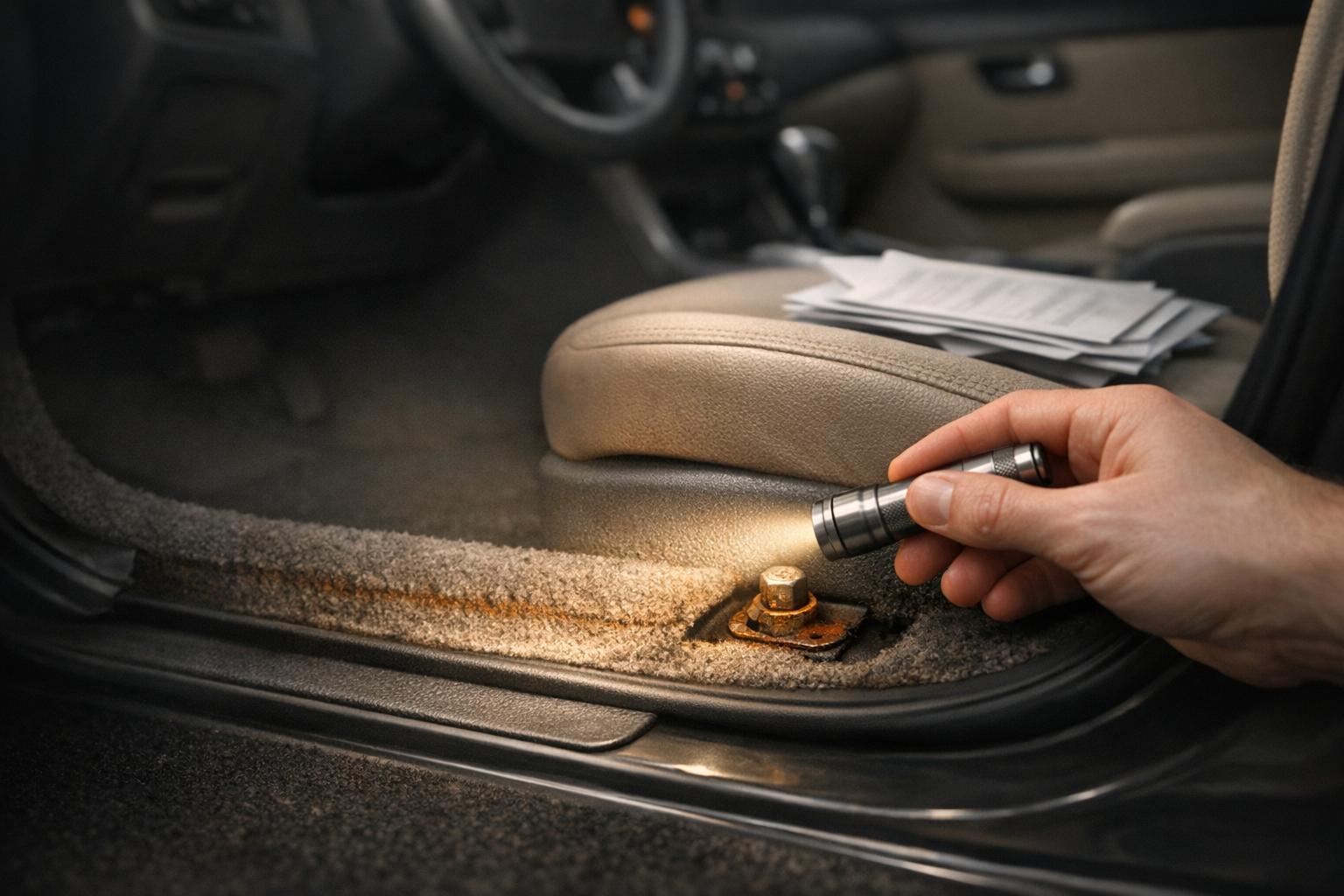
- Flood Damage: Watch for musty smells, rust under seats, or electrical issues. Flood-damaged cars often have hidden problems.
- Seller Behavior: Be cautious of sellers rushing the deal, withholding the VIN, or refusing inspections.
Always test-drive the car, get a pre-purchase inspection, and use trusted platforms like AUTO24.ug for verified listings. Spending time on these checks can save you from costly mistakes.
13 Biggest Red Flags To AVOID When Buying A Used Car!
sbb-itb-7bab64a
How to Spot Tampered Odometers
Odometer fraud hides a vehicle’s true mileage, which could lead to overpaying for a car that’s seen more wear and tear than you realize.
Check Physical Wear and Tear
Start by comparing the vehicle’s reported mileage with its physical condition. A car with low mileage should show minimal wear. Look for firm seat cushions, a steering wheel with a well-defined texture, and brake pedals with normal wear. On the flip side, polished or excessively worn brake pedals, flattened seat cushions with split seams, or a loose shifter could signal higher usage than the odometer suggests.
Pay close attention to areas like the upholstery, steering wheel, brake pedal, shifter knob, door hinges, and tires. If the wear on these parts doesn’t match the mileage, it’s worth investigating further. Tires often provide a clue – check the four-digit DOT code on the sidewall (e.g., "1224" means the 12th week of 2024) to see if the tire age aligns with the vehicle’s mileage. Once you’ve assessed the car’s physical condition, move on to the instrument cluster for more signs of tampering.
Look for Odometer Tampering Signs
Odometer tampering often involves replacing the instrument cluster, which can leave behind telltale clues. Look out for mismatched backlighting, unusual fonts, missing screws, or odd part numbers. As Eva J. Parker from VinInspect explains:
a rolled-back odometer is often accompanied by a swapped cluster. Check for mismatched backlighting or fonts, odd part numbers, or missing screws
.
For older cars with mechanical odometers, examine the number wheels – crooked or misaligned digits can be a red flag. The Consumer Law Group, P.C. highlights another warning sign:
fingerprint smudging on the inside of the instrument cluster could be a sign someone was tampering with the odometer
.
Check the dashboard bezel for pry marks, scratches, or missing fasteners, as these could indicate someone has accessed the cluster. When turning the ignition to the "on" position, make sure all dashboard warning lights briefly illuminate during the self-test. If key lights, like the check engine light, stay off, it could mean the seller has disabled them to hide potential problems.
How to Verify Service Records and History
After examining the odometer, it’s time to dig into the service records. These documents are your best shot at confirming the vehicle’s true history. Be cautious – fake or altered records can make a poorly maintained car look like it’s been cared for. That’s why verifying the paperwork is a critical step before making a purchase.
Cross-Check Maintenance Logs
Service records should paint a clear and consistent picture. Look closely at the dates and mileage entries. They should show a steady increase in mileage over time. If you notice sudden drops in mileage between service visits or unexplained gaps in the timeline, it could be a red flag for odometer tampering. For instance, if one receipt shows 45,000 miles in January 2024 but the next shows 38,000 miles in June 2024, there’s a strong chance the odometer has been rolled back.
To confirm the records, contact the repair shops listed on the receipts and verify the work was actually done on the stated dates and mileages. Also, ensure that every receipt’s VIN matches the one on the vehicle’s dashboard, door sticker, and history reports. Check that oil change stickers and timing belt labels align with the entries in the logs.
You should also compare these records against digital reports from services like CARFAX or AutoCheck, which gather data from a variety of sources. These reports can uncover inconsistencies that the seller might not disclose. For newer cars, you might find service history stored in the vehicle’s infotainment system. Cross-check this digital record with any physical paperwork you receive. Additionally, an OBD-II scanner can help you read mileage data stored in the car’s Engine Control Unit (ECU) or Transmission Control Module. Scammers often manipulate only the dashboard display, so this step can reveal hidden tampering. Together, these checks provide a thorough way to spot any discrepancies.
Review Inspection and Export Certificates
For imported vehicles, third-party documents can offer another layer of verification. Export certificates, for example, are much harder to fake than local service records. These certificates often include critical details, like the car’s mileage and condition before it left its home country. Agencies such as JEVIC (Japan Export Vehicle Inspection Center) or EAA document this information, giving you an additional way to verify the seller’s claims.
Always inspect the original title for any notations that could hint at problems. Look for phrases like "Exceeds Mechanical Limits" or signs of "title washing", where sellers transfer a car between states to erase salvage or high-mileage designations. To further protect yourself, ask for a signed mileage statement confirming the odometer reading. Any hesitation or refusal to provide this could indicate fraud.
It’s worth noting that under the Federal Odometer Act, victims of odometer fraud can recover triple damages or at least $1,000. While legal recourse is available, it’s always better to catch these issues before they become your problem.
How to Detect Hidden Accidents and Repairs
After you’ve gone through the basic checks, it’s time to dig deeper and search for signs of hidden accident damage. Even when a vehicle’s service records seem spotless, previous collisions might still leave behind clues. Sellers often focus on cosmetic fixes to make a car look perfect, but with a keen eye, you can often spot evidence of past repairs. Catching these issues early can save you from buying a car with potential safety or reliability concerns.
Look for Visible Warning Signs
Start by closely examining the car’s paint and body panels under bright sunlight. Watch for an "orange peel" texture – this dull, uneven finish is often a sign of an aftermarket paint job. You might also notice small debris trapped under the clear coat. Run your hand over the panels to feel for rough spots or sanding marks that might indicate prior repairs.
"If a panel is higher than the other, or perhaps a hood is closer to the fender on one side than the other, there is a good chance this car was repaired in the past." – Tom Zoebelein, Auto Body Repairer
Check for uniform gaps and alignment between panels. Misaligned gaps or uneven character lines could mean the car’s structure shifted during a collision and was later repaired. Take a look at the headlights too – if one appears brand new while the other looks cloudy or aged, it could suggest a replacement after an accident. These subtle signs might reveal hidden repairs that could compromise safety.
Inspect bolt heads on hinges and fenders. Factory-installed bolts usually have smooth, unbroken paint with no tool marks. Scratches or chipped paint on these bolts are red flags that the panels were removed for repairs. Also, check for paint overspray on areas like rubber seals, window trim, hoses, or inside the wheel wells – these spots shouldn’t have body paint. For steel panels, use a magnet. If it doesn’t stick, there may be a thick layer of body filler covering underlying damage.
Inspect Frame and Structural Integrity
Surface checks are helpful, but don’t forget to look underneath the car. Inspect the frame rails for scratches, gouges, or clamp marks, which could indicate that the frame was straightened after a collision.
"If it has been straightened after a crash, marks from the device used to straighten the frame may show." – Lyndon Bell, Autoweb
Be on the lookout for unusual welding marks on the frame or floor pan, as these might signal that sections were cut out and replaced. Fresh undercoating can also be suspicious if it seems like it’s hiding repairs. And if you spot significant rust on the frame rails, it’s usually a sign to walk away.
To ensure you don’t miss anything, consider hiring a professional mechanic for a pre-purchase inspection (PPI). While it typically costs between $100 and $150, a certified mechanic can uncover hidden issues like frame damage or suspension problems from past accidents. Spending this small amount upfront could save you thousands in future repairs and help you avoid buying a structurally compromised vehicle.
Buy from Trusted Platforms for Transparency
When you’re shopping for a used car, the platform you choose matters just as much as the car itself. Uganda’s used car market comes with its fair share of challenges: ghost sellers who disappear after taking deposits, fake listings featuring stock photos, and vehicles with altered histories. Most of these cars are imported through Mombasa port – originating from Japan, the UAE, or the UK – then cleared by Kenyan customs before arriving at car bonds in Kampala, such as those on Nasser Road or in Kireka. Each step in this process opens the door to potential tampering or misrepresentation. To avoid falling victim to these issues, it’s crucial to use platforms that provide verified and transparent vehicle histories.
This is where trusted platforms like AUTO24.ug come into play. By offering verified information, they eliminate the uncertainties and risks associated with traditional listings. These platforms focus on providing the documentation and details you need to make informed decisions, removing concerns about cloned logbooks or undisclosed damage.
Advantages of Verified Listings
Verified listings, backed by thorough inspections, provide critical documentation that helps confirm the vehicle’s condition. Unlike traditional sellers, these platforms offer tangible records that make it easier to spot inconsistencies. For instance, AUTO24.ug includes detailed multi-angle photos and original auction sheets, which display key details like mileage, condition grades, and repair history. This allows you to identify potential issues – like tampered mileage – before you even see the car in person.
Take this example: if a car was auctioned in Japan with 180,000 km on its odometer, but it now shows only 80,000 km in Uganda, that’s a clear sign of tampering. This level of transparency simply isn’t possible when relying solely on a logbook.
In addition to photos and auction records, verified listings include essential information such as the chassis number, model year, engine specifications, fuel type, and service history. You can even request URA chassis verification to ensure the vehicle isn’t a clone – an issue that’s becoming more common in Uganda. For example, if you see a 2016 Toyota RAV4 priced at UGX 35,000,000 while the typical market price ranges between UGX 52,000,000 and UGX 58,000,000, that’s a major red flag that warrants further investigation. This level of detail protects you from costly mistakes and ensures that every claim about the vehicle can be verified.
Other Warning Signs and Final Checks
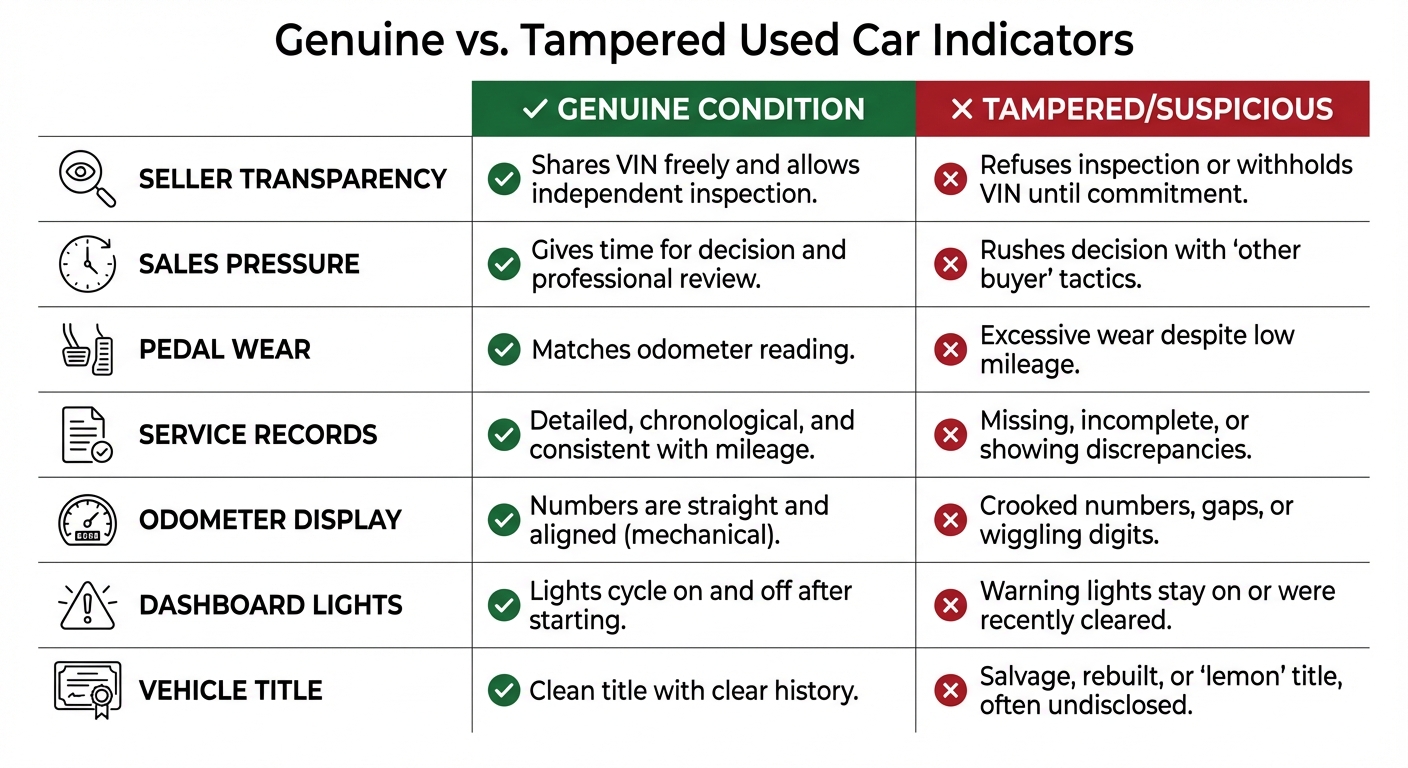
Genuine vs Tampered Used Car Indicators Comparison Chart
Watch for Suspicious Seller Behavior
The way a seller acts can reveal a lot about potential problems with a vehicle. For instance, if a seller refuses to allow an independent pre-purchase inspection, that’s a major red flag. As Carfax Hub advises:
If a seller won’t let you take the car to an independent mechanic for inspection, walk away immediately
. Honest sellers understand that inspections are a standard part of the buying process.
Be wary of sellers who use high-pressure tactics to rush your decision. Statements like "another buyer is coming in an hour" or "this deal won’t last" are classic warning signs. Similarly, if a seller withholds the Vehicle Identification Number (VIN) until you’ve committed to the purchase, it may be an attempt to conceal issues. A VIN should always be readily available so you can run a history report, which typically costs between $4.99 and $9.99. If the seller avoids answering questions about the car’s history or provides vague responses, it’s best to trust your instincts and walk away.
Unusually low prices are another red flag. If a deal sounds too good to be true, it probably is. Cars with salvage or rebuilt titles – often undisclosed – can lose 20% to 40% of their resale value. Additionally, over 450,000 vehicles are sold each year with falsified odometer readings, costing consumers more than $1 billion annually. Don’t let these scams catch you off guard.
These behavioral warning signs should be considered alongside the physical and documentation checks mentioned earlier.
Comparison Table: Genuine vs. Tampered Indicators
Here’s a quick comparison of what to look for when evaluating a vehicle:
| Indicator | Genuine Condition | Tampered/Suspicious Condition |
|---|---|---|
| Seller Transparency | Shares VIN freely and allows independent inspection | Refuses inspection or withholds VIN until commitment |
| Sales Pressure | Gives time for decision and professional review | Rushes decision with "other buyer" tactics |
| Pedal Wear | Matches odometer reading | Excessive wear despite low mileage |
| Service Records | Detailed, chronological, and consistent with mileage | Missing, incomplete, or showing discrepancies |
| Odometer Display | Numbers are straight and aligned (mechanical) | Crooked numbers, gaps, or wiggling digits |
| Dashboard Lights | Lights cycle on and off after starting | Warning lights stay on or were recently cleared |
| Vehicle Title | Clean title with clear history | Salvage, rebuilt, or "lemon" title, often undisclosed |
When combined with checks on odometer accuracy, service records, and accident damage, these tips can help you thoroughly evaluate any used car.
Before finalizing a purchase, invest in an OBD2 scanner (priced between $20 and $50) to check diagnostic codes, even if the check engine light isn’t on. Additionally, take the car on an extended test drive – at least 20 to 30 minutes – covering stop-and-go traffic as well as highway speeds. This ensures the engine reaches full operating temperature and gives any hidden issues a chance to reveal themselves. As Jon Linkov, Autos Editor at Consumer Reports, emphasizes:
Finding a trouble-free used car has nothing to do with luck and everything to do with applying good research and investigative skills
.
Conclusion
Buying a used car can be a smart decision, but it requires diligence to avoid common pitfalls like tampered odometers, fake service records, or hidden accident damage. As Jon Linkov, Autos Editor at Consumer Reports, wisely advises:
"If the dealer doesn’t have the title or won’t show it to you, consider a different car or a different dealer."
Transparency is key. To ensure a safe purchase, take the time to cross-check every document and detail. Verify that the title matches the odometer reading, test drive the car for at least 30 minutes on varied roads, and use the 17-digit VIN at nhtsa.gov/recalls to check for open safety recalls. Even small signs, like paint overspray or misaligned panels, can hint at prior accident repairs.
Using verified platforms can also simplify the process. Services like AUTO24.ug provide vehicle history reports and verified listings, helping you avoid risks like title jumping or undisclosed mechanical issues. These platforms also encourage sellers to offer complete documentation and allow independent inspections.
Don’t overlook potential water damage, which can cause serious long-term issues. As John Ibbotson, Chief Mechanic at Consumer Reports, warns:
"Even if a vehicle looks acceptable and may be working when you inspect it, water damage could lead to many electrical problems down the road."
Finally, always invest in an independent mechanic inspection. Spending a little upfront can save you from costly repairs later. A careful and transparent approach will protect your investment and give you peace of mind.
FAQs
What’s the fastest way to confirm the real mileage?
The fastest way to check a car’s mileage is by using a trusted VIN report service. Simply input the vehicle’s VIN to access key details like title history, service records, and auction data. Pay close attention to any mileage discrepancies in these records, as they can indicate potential tampering. This approach provides a straightforward and reliable way to verify the car’s actual mileage.
Which documents should match the VIN exactly?
The Vehicle Identification Number (VIN) needs to be consistent across the car’s title, all official documents, and any physical labels or plates on the vehicle, like the VIN sticker or engraving. This consistency is crucial for confirming the car’s identity.
When should I walk away from a seller?
Sometimes, the best decision is to walk away. Watch for warning signs like tampered odometers, fake service records, or hidden accidents. Deals that seem too good to be true often are, so proceed with caution.
Other red flags include dishonest behavior, misleading paperwork, or cosmetic repairs designed to mask more serious problems. These can signal misrepresentation or even outright fraud, potentially leading to expensive headaches down the road.
If something doesn’t feel right, trust your instincts – it’s better to be safe than sorry.