Uganda’s tough roads, high temperatures, and inconsistent fuel quality make engine durability a top priority. The best engines for these conditions are known for their long lifespan, low maintenance needs, and ability to handle rugged terrain and subpar fuel. Whether you’re navigating Kampala’s crowded streets or hauling heavy loads through rural areas, choosing the right engine can save you time and money.
Top Engine Picks:
- Toyota 1KD-FTV Diesel: A 3.0L turbo-diesel known for its durability and torque, ideal for towing and steep climbs. Lifespan: 400,000+ km with proper care.
- Isuzu 4JJ1-TC Diesel: A 3.0L turbo-diesel built for heavy-duty use, lasting up to 500,000 km. Affordable maintenance and strong low-end torque make it a favorite.
- Honda K-Series & J35: Reliable petrol engines with a lifespan of 300,000+ km. Great for city driving and light off-road use.
- Ford 5.0 Coyote V8 & 3.5 EcoBoost V6: High-power engines for towing and rugged terrain, with lifespans of 320,000+ km.
- Chevrolet LS-Series V8: A robust small-block V8 with a lifespan of 450,000 km, perfect for heavy loads and steep roads.
- Toyota 2JZ Inline-6: Legendary for its toughness, this engine can exceed 500,000 km with basic maintenance.
Key Takeaways:
- Diesel engines like Toyota’s 1KD-FTV and Isuzu’s 4JJ1-TC are excellent for long distances and heavy-duty tasks.
- Petrol engines such as Honda’s K-Series offer reliability for urban and light off-road conditions.
- Consistent maintenance, high-quality fuel, and proper care are essential to maximize engine lifespan.
Quick Comparison Table:
| Engine | Type | Lifespan (km) | Fuel Efficiency (km/L) | Key Features |
|---|---|---|---|---|
| Toyota 1KD-FTV Diesel | Diesel | 400,000+ | ~10–12 | High torque, ideal for towing |
| Isuzu 4JJ1-TC Diesel | Diesel | 300,000–500,000 | ~10–15 | Low maintenance, strong for heavy use |
| Honda K-Series | Petrol | 300,000+ | ~10–14 | Reliable for city and light off-road |
| Ford 5.0 Coyote V8 | Petrol | 400,000+ | ~7–9 | High power, rugged conditions |
| Chevrolet LS-Series V8 | Petrol | 450,000+ | ~8–10 | Heavy loads, durable build |
| Toyota 2JZ Inline-6 | Petrol | 500,000+ | ~10–12 | Legendary durability |
For Uganda’s unique driving challenges, these engines are your best bets for performance and reliability.
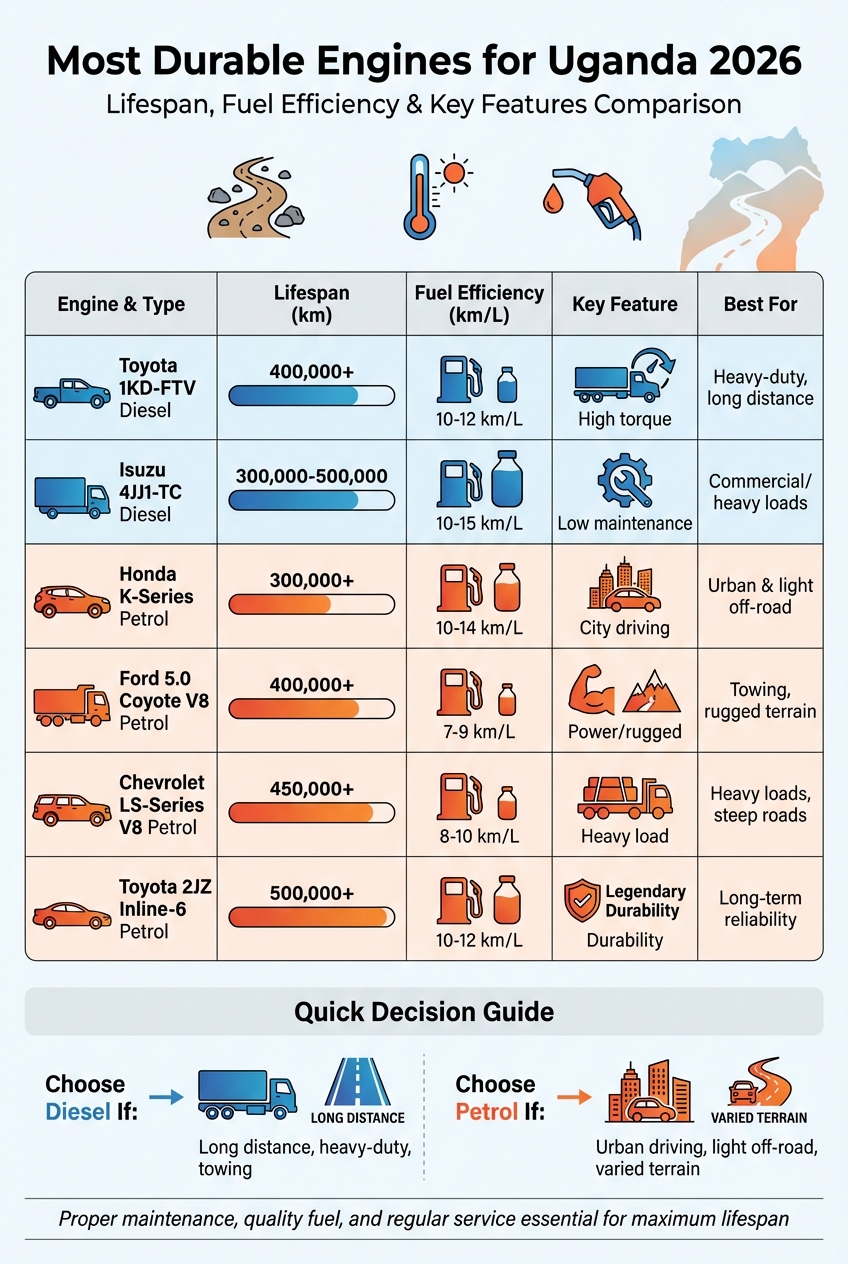
Most Durable Engines for Uganda 2026: Lifespan and Fuel Efficiency Comparison
Durable Vs Reliable: Whats best
1. Toyota 1KD-FTV Diesel and 2GR V6
Uganda’s challenging driving conditions demand engines that can handle both city streets and rugged terrains, and the Toyota 1KD-FTV and 2GR V6 engines deliver just that. The 1KD-FTV is a 3.0-liter turbo-diesel engine commonly found in the Hilux, Fortuner, and Land Cruiser Prado, while the 2GR V6 is a 3.5-liter gasoline engine. Both engines are built to endure Uganda’s tough terrain and climate. The 1KD-FTV, in particular, is known for its durability, provided it’s well-maintained. However, it does require regular upkeep to prevent issues like EGR carbon build-up and injector problems.
Durability Rating
The 1KD-FTV scores between average and above-average in durability when maintained correctly. While it performs well in demanding conditions, it has some weaknesses, such as cracked pistons and injector failures, which prevent it from achieving top-tier durability ratings. On the other hand, the 2GR V6 benefits from Toyota’s strong reputation for quality and reliability, supported by a widespread service network.
Expected Lifespan (km)
With proper maintenance every 5,000 km (3,100 miles) or six months, the 1KD-FTV can easily surpass 400,000 km (248,000 miles). Some owners have even reported reaching milestones of up to 755,000 km (469,000 miles).
Fuel Efficiency (km/L)
Under typical Ugandan conditions, which include a mix of city and highway driving, the 1KD-FTV delivers about 10 km/L (23.5 mpg). This balance between fuel economy and torque makes it a reliable choice for towing and other heavy-duty tasks.
Repair Costs in Uganda (UGX)
Spare parts for these engines are readily available through Toyota Uganda (CFAO), local dismantlers, and international suppliers. Here’s a breakdown of some common repair costs:
- Fuel injectors: 190,000 to 1,050,000 UGX ($50–$280) per unit
- Fuel injection pump: 715,000 to 1,335,000 UGX ($190–$355)
- Complete used engine assembly: 1,700,000 to 7,150,000+ UGX ($450–$1,900+)
Genuine parts come with a six-month warranty, and routine maintenance can take anywhere from 1 to 8 hours, depending on the service. While repair costs can add up, the engine’s performance on Uganda’s varied terrains often offsets these expenses.
Terrain Suitability
Both engines are designed to handle Uganda’s diverse landscapes, from urban streets to rugged rural roads. The 1KD-FTV stands out for its high torque, making it excellent for towing and climbing steep hills. However, it does require high-quality diesel and regular EGR system cleaning every 60,000–100,000 km (37,000–62,000 miles) to avoid power loss and "limp mode". Installing water separators can also help protect the sensitive common-rail injectors from contamination caused by inconsistent fuel quality.
2. Isuzu 4JJ1-TC Diesel
The Isuzu 4JJ1-TC is a 3.0-liter turbo-diesel engine designed to handle Uganda’s demanding road conditions. Found in vehicles like the Isuzu Elf (N-Series) trucks and NPR commercial vehicles, this engine is built with durability in mind. It features a deep-skirt cast iron cylinder block and a forged steel crankshaft, both of which resist wear and fatigue. Edwin, an automotive consultant with the Africa-Uganda Business Travel Guide, highlights its reputation:
"For years now the Isuzu Elf has been known to be untouchable when it comes to rough roads in Uganda. This has helped it build a strong reputation locally".
One key feature that sets the 4JJ1-TC apart is its timing chain, which is more reliable than the conventional timing belt, reducing the risk of major engine failures.
Durability Rating
When it comes to reliability, the 4JJ1-TC earns high praise from mechanics and fleet operators alike. Its simple design, including roller rocker arms and hydraulic lash adjusters that automatically maintain valve clearance, keeps maintenance needs to a minimum. Fleet operators have reported these engines running up to 400,000 miles (about 643,737 km) without requiring major repairs. Additionally, the related 4HK1-TC engine in the same class has achieved a B10 durability rating of 600,000 km, meaning only 10% of these engines need major work by that point. This level of reliability ensures a long operational life, making it a dependable choice for heavy-duty use.
Expected Lifespan (km)
With proper care, the 4JJ1-TC engine typically lasts between 300,000 and 500,000 km (186,000 to 311,000 miles). To extend its life, regular maintenance is essential. Key service intervals include:
- Oil and filter changes every 7,500–10,000 km (4,660–6,200 miles)
- Fuel filter replacement every 20,000 km (12,400 miles)
- Injector servicing every 150,000 km (93,200 miles)
- Timing chain tensioner inspections after 300,000 km
Following these guidelines helps ensure the engine performs efficiently over the long haul.
Fuel Efficiency (km/L)
The 4JJ1-TC delivers reliable fuel economy while producing 330–450 Nm of torque at 2,800–3,000 rpm. This strong low-end torque makes it ideal for hauling heavy loads, such as construction materials, across Uganda’s tough terrain. Its efficient power output, combined with a cooling system designed to handle high temperatures, makes it a popular choice for fleet operators working in Uganda’s tropical climate.
Repair Costs in Uganda (UGX)
In addition to its performance, the 4JJ1-TC is known for its affordable maintenance. Spare parts are readily available in Kampala’s Industrial Area and along major highways, keeping repair costs manageable compared to other diesel engines. Here’s an approximate breakdown of common repair costs:
- Water pump assembly: 2,335,000 UGX ($621)
- Fuel filter case: 595,000 UGX ($158)
- Thermostat: 251,000 UGX ($67)
- Cooling fan belt: 105,000 UGX ($28)
- Professional rebuild kit: 4,700,000–7,500,000 UGX ($1,250–$2,000)
Pre-owned Isuzu Elf trucks equipped with the 4JJ1-TC start at around 40,000,000 UGX, depending on their condition and year. While the initial investment might be higher than some alternatives, the engine’s durability and lower maintenance costs make it a smart long-term choice.
Terrain Suitability
Whether navigating Kampala’s busy streets or tackling rugged rural roads, the 4JJ1-TC is up to the challenge. Its high torque output and robust construction make it a favorite among commercial operators transporting heavy loads like sand and bricks. While minor issues such as DPF clogging in stop-and-go traffic or occasional injector seal leaks at high mileages can occur, these can be mitigated. Allowing the engine to cool down after heavy use helps prevent turbocharger damage and ensures proper lubrication. This makes the 4JJ1-TC a reliable workhorse for Uganda’s diverse terrain and demanding conditions.
3. Honda K-Series and J35
Honda’s K-Series and J35 engines have built a reputation for reliability in Uganda. The K-Series, a 2.0L–2.4L inline-4, combines a cast-iron sleeved aluminum block for durability with a lightweight design. Meanwhile, the J35, a 3.5L V6, powers models like the Honda Pilot and Ridgeline. Both engines feature variable timing systems – VTC for the K-Series and VTEC for the J35 – designed to optimize performance across various RPM ranges.
Durability Rating
When it comes to longevity, these engines consistently score high. The K-Series achieves a 9/10 durability rating, while the J35 follows closely with 8.5/10. Their relatively straightforward designs – DOHC for the K-Series and SOHC for the J35 – make them easier to service compared to the more intricate European engines. However, since both engines use interference designs, regular maintenance of timing belts or chains is critical, especially in Uganda’s dusty conditions, to prevent valve damage.
Expected Lifespan (km)
With proper care, the K-Series often surpasses 320,000 km (200,000 miles), and the J35 typically lasts between 300,000 and 320,000 km. To reach these milestones, regular maintenance is key. This includes oil changes every 8,000–10,000 km using full synthetic oil (0W-20 or 5W-20), valve adjustments every 48,000 km, and timely replacement of timing components. For the J35, the timing belt should be replaced at 120,000 km. Models equipped with Variable Cylinder Management (VCM) require more frequent oil checks – every 1,000 km – due to higher consumption.
Fuel Efficiency (km/L)
The K-Series delivers a fuel efficiency of approximately 10–14 km/L in mixed driving conditions, while the J35 averages around 9.6 km/L. The J35’s power output ranges from 210 hp to 310 hp, providing ample torque for towing and navigating steep terrain. This makes it a great choice for SUVs and pickups used in commercial or safari settings. Both engines pair their fuel efficiency with manageable maintenance costs, which are outlined below.
Repair Costs in Uganda (UGX)
Maintenance costs for the K-Series and J35 engines are reasonable, with spare parts readily available in Kampala. Estimated service costs include:
- Routine oil and filter change: 160,000–300,000 UGX ($43–$80)
- Major service: 700,000–1,300,000 UGX ($186–$346)
- J35 timing belt kit replacement: 2,400,000–4,000,000 UGX ($639–$1,064)
- Carbon cleaning service: 900,000–2,400,000 UGX ($240–$639)
- Engine mount replacement (per mount): 500,000–1,700,000 UGX ($133–$453)
The K-Series stands out with lower long-term maintenance costs, thanks to its timing chain that doesn’t require periodic replacement. For the J35, it’s advisable to replace the water pump and tensioners along with the timing belt to save on future labor costs.
Terrain Suitability
Both engines offer excellent adaptability to Uganda’s diverse terrains. The K-Series is well-suited for urban driving and light off-road use, making it a great fit for vehicles like the Honda CR-V. On the other hand, the J35 shines in more demanding environments, with its higher torque output ideal for rugged, unpaved roads and steep inclines – especially when paired with a 4WD system. While both engines handle tropical climates effectively, the J35 may require additional attention to VCM-related issues, such as potential oil leaks that could affect electrical components. Installing a VCM disable kit can help manage oil consumption and extend the life of engine mounts.
4. Ford 5.0 Coyote V8 and 3.5 EcoBoost V6
Ford’s 5.0L Coyote V8 and 3.5L EcoBoost V6 engines bring two different approaches to durability and performance, perfectly suited for Uganda’s tough road conditions. The naturally aspirated 5.0L Coyote V8 delivers 395 horsepower and 400 lb-ft of torque, often lasting between 250,000 and 300,000 miles (around 400,000–480,000 km) with proper upkeep. Meanwhile, the 3.5L EcoBoost V6 provides 375 horsepower and an impressive 470 lb-ft of torque at just 2,500 RPM, giving it the low-end power needed for towing and climbing steep grades. Let’s dive into how these engines stack up in terms of maintenance, lifespan, fuel economy, and repair costs.
Durability and Maintenance
The 5.0L Coyote V8 is often regarded as the most reliable option in the F-150 lineup. Its naturally aspirated design is simpler and more forgiving when it comes to varying fuel quality, a common challenge in Uganda. On the other hand, the 3.5L EcoBoost V6, with its turbocharged setup, demands more meticulous care. While earlier models faced issues with cam phasers and timing chains, recent updates have addressed many of these problems. However, regular maintenance is non-negotiable – using high-quality synthetic oil and sticking to scheduled service intervals is essential to avoid issues like carbon buildup and turbocharger wear.
Expected Lifespan
When properly maintained, the Coyote V8 can reliably reach between 250,000 and 300,000 miles (400,000–480,000 km), making it a solid choice for challenging environments. The EcoBoost V6, while capable of lasting up to 200,000 miles (320,000 km) with good care, is more sensitive to neglect. Poor maintenance can cut its lifespan significantly, sometimes to as low as 125,000 miles (200,000 km). Routine oil changes (every 5,000–8,000 km) and ensuring you refuel at reputable stations are key to keeping both engines running smoothly for years.
Fuel Efficiency
Fuel economy for these engines depends on the driving conditions and load. The 3.5L EcoBoost, with its twin-turbo design and 10-speed automatic transmission, offers better efficiency when hauling heavy loads or driving in hilly regions. The 5.0L Coyote V8, while not as fuel-efficient under similar conditions, shines in reliability. Its simpler design ensures steady performance even when fuel quality is inconsistent – a feature many drivers value in Uganda’s diverse driving environments.
Repair Costs in Uganda
Maintenance and repair costs for these engines differ due to their complexity:
- Routine oil and filter change: 200,000–350,000 UGX ($53–$93)
- Major service: 900,000–1,600,000 UGX ($240–$426)
- Cam phaser replacement (EcoBoost): 12,000,000–17,600,000 UGX ($3,200–$4,700)
- 10-speed transmission service: 1,500,000–2,500,000 UGX ($400–$666)
- Transmission rebuild: 15,000,000–22,500,000 UGX ($4,000–$6,000)
The Coyote V8’s straightforward design often leads to lower long-term repair costs. For both engines, it’s essential to service the 10-speed transmission every 50,000 miles (80,000 km) and source critical parts, like timing components and sensors, from authorized dealers to avoid counterfeit parts.
Terrain Suitability
Uganda’s roads demand engines that can handle a mix of conditions, and both the Coyote V8 and EcoBoost V6 rise to the challenge. The Coyote V8’s reliability and ability to handle heavy payloads make it ideal for long trips over rough, unpaved roads. Meanwhile, the EcoBoost V6’s strong low-end torque makes it a great choice for towing and navigating steep, hilly terrain. To keep these engines in top shape, it’s important to use engine braking on steep descents and clean air filters frequently to combat dust buildup. Both engines are built to perform, but their success depends on consistent care and attention.
sbb-itb-7bab64a
5. Chevrolet LS-Series V8
The Chevrolet LS-Series V8 has earned a reputation for being tough and dependable. Experts at CarBuzz highlight its reliability, stating:
"The LS has proven reliable and easy to maintain in almost every form".
This small-block V8 engine series, on the market since 1997, delivers power ranging from 355 to 420 horsepower and up to 460 lb-ft of torque. These features make it an excellent choice for tackling Uganda’s rugged terrain and supporting heavy-duty applications. The 5.3L variant, for instance, can tow up to 11,500 lbs – ideal for commercial use and navigating challenging, hilly roads.
Durability Rating
The LS-Series stands out for its robust construction. Cast-iron versions, such as the LM7 and LQ4, are particularly well-suited for heavy-duty tasks and rough, unpaved roads, offering more rigidity compared to their aluminum counterparts. Additionally, its naturally aspirated design handles varying fuel quality better than turbocharged engines. However, it’s worth noting that the high-pressure fuel injectors require consistently clean fuel to ensure optimal performance.
Expected Lifespan (km)
With regular maintenance, the LS-Series can last between 386,000 and 450,000 kilometers (240,000–280,000 miles). Dmitry Sapko, an automotive expert, praises the engine, saying:
"The Chevy’s 5.3 liters V8 L82/L84 engine combines robust performance, a long lifespan, and an efficient fuel economy suitable for any adventure you partake in".
To maintain this longevity, oil changes should be done every 5,000–7,500 kilometers, and GDI intake valve cleaning or walnut blasting is recommended every 110,000 kilometers to prevent carbon buildup.
Fuel Efficiency (km/L)
Fuel efficiency is not the LS-Series’ strongest feature, as it lags behind smaller engines in this regard. However, newer versions include Dynamic Fuel Management (DFM) and Active Fuel Management (AFM) systems, which deactivate cylinders during light loads to improve efficiency. These systems, though, require diligent upkeep to avoid issues like lifter failure. For many drivers in Uganda, this trade-off is acceptable, as they prioritize the engine’s reliability and towing capability over fuel savings, especially when transporting heavy loads through mountainous areas.
Repair Cost in Uganda (UGX)
Repair and maintenance costs for the LS-Series are manageable, thanks to its modular design. Here’s a breakdown of typical expenses:
- Annual preventative service: 900,000–1,600,000 UGX ($240–$426)
- Timing component/water pump service: 1,900,000–3,600,000 UGX ($506–$960)
- Full engine rebuild: 9,000,000–19,000,000 UGX ($2,400–$5,066)
- Used engine replacement: 1,600,000–7,000,000 UGX ($426–$1,866) plus labor
Key issues to watch for include excessive oil consumption, cooling system leaks, and AFM/DFM lifter problems. To avoid frequent failures, it’s recommended to source critical parts from authorized dealers rather than relying on cheaper, potentially counterfeit alternatives.
Terrain Suitability
The LS-Series performs exceptionally well in Uganda’s demanding conditions. Its high torque output makes it a reliable choice for climbing steep hills and hauling heavy loads. Regular inspections can help address potential problems such as cracked cylinder heads. To minimize wear caused by dust, cleaning air filters frequently is essential. Cast-iron block variants are especially suited for rough terrain and commercial use, where durability is a top priority. Additionally, using engine braking on steep descents can help reduce strain on the engine and brakes.
6. Lexus/Toyota 2JZ Inline-6
After covering some standout diesel and V8 engines, let’s turn to a legendary inline-six design: the Lexus/Toyota 2JZ. This 3.0-liter engine has built a reputation for its toughness and longevity. Built with a cast-iron block and an aluminum head, it’s designed to endure even the most challenging driving conditions, such as those found in Uganda. Automotive expert Amaka Anagor-Ewuzie sums it up perfectly:
"This legendary 3.0‑liter inline‑six had a cast iron block and an aluminum head and was known to be bulletproof. It only needs standard maintenance to keep on clocking hundreds of thousands of miles."
The 2JZ comes in two main versions: the naturally aspirated 2JZ-GE, found in models like the Lexus GS300 and IS300, and the twin-turbocharged 2JZ-GTE, famously used in the Toyota Supra MK4. While the GTE offers thrilling performance, the GE is more practical for everyday driving, with lower costs and simpler upkeep.
Durability Rating
The 2JZ earns a 5/5 for reliability, largely due to its cast-iron block, which provides exceptional structural strength. This prevents warping even in stop-and-go traffic or under high temperatures. The GTE variant is particularly robust, featuring a forged steel crankshaft and heavy-duty connecting rods that can handle 600–700 horsepower on stock internals. Its "square" 86-mm bore and stroke design also ensures smooth, balanced operation.
Expected Lifespan (km)
With proper maintenance, the 2JZ often lasts between 482,800 and 804,600 km (300,000 to over 500,000 miles). Senior automotive writer Ben Fildes highlights this longevity:
"Even stock 2JZs have been known to reach 300,000 miles or more with little more than regular oil changes and basic maintenance."
However, keep an eye out for valve cover gasket leaks and coil pack issues. For GTE variants, proper turbo warm-up and cool-down routines are crucial to maintaining turbo seals.
Fuel Efficiency (km/L)
The naturally aspirated 2JZ-GE, with its 10:1 compression ratio, strikes a good balance between performance and fuel economy. While exact mileage depends on factors like vehicle weight and driving habits, it consistently delivers smooth power without the hefty fuel consumption typical of larger V8 engines.
Repair Cost in Uganda (UGX)
Maintaining a 2JZ is generally affordable, especially given its performance and reliability. Lexus owners in Uganda typically spend about 2,100,000 UGX (around $551) annually on upkeep. Here’s a breakdown of common costs:
- Annual preventative service: ~2,100,000 UGX ($551)
- Parts and fluids (gaskets, belts, oil): 615,000–3,075,000 UGX ($161–$806)
- Fitting labor: 1,025,000–6,150,000 UGX ($269–$1,612)
- Used 2JZ-GE engine replacement: 4,100,000–16,400,000 UGX ($1,075–$4,300)
- Used 2JZ-GTE engine: Typically 20–60% more expensive than the GE variant
The global popularity of the 2JZ ensures a robust aftermarket for parts, making repairs more accessible. Japanese components are particularly easy to find in Uganda compared to older German alternatives. If you’re buying a used 2JZ, it’s wise to request compression and leak-down tests and check for soot in the oil, as these can reveal head gasket or turbo problems.
Terrain Suitability
The 2JZ is well-suited to Uganda’s varied terrains, thanks to its high torque and durable iron block. It performs admirably in hilly areas, where engines often face increased strain and heat. Weighing about 226 kg (498 lbs), it provides stability, though vehicles equipped with this engine may need enhanced suspension to handle pothole-filled roads. Its straightforward timing belt system also makes maintenance easier for both DIY enthusiasts and mechanics.
Pros and Cons
When it comes to tackling Uganda’s challenging driving conditions, each engine type offers its own benefits and trade-offs:
- Diesel engines, like the Toyota 1KD-FTV, are known for their excellent fuel economy and strong torque, making them ideal for long-distance travel and hauling heavy loads. However, they require clean fuel to avoid expensive injection system issues.
- Petrol engines equipped with VVT-i technology, such as those found in the Toyota Probox and Vitz, strike a balance between performance and efficiency. That said, they may need closer monitoring for oil consumption once they hit around 160,000 km (100,000 miles).
- The Toyota 1HZ diesel is a standout choice for extreme off-road conditions, thanks to its rugged and straightforward design. While it’s incredibly durable, it doesn’t deliver as much power as more modern common-rail diesel engines.
Below is a table comparing these engine options, highlighting their expected lifespans, fuel efficiency, and important considerations:
| Engine | Expected Lifespan (km) | Fuel Efficiency (km/l) | Key Considerations |
|---|---|---|---|
| Toyota 1KD-FTV Diesel | 300,000 – 400,000 | Approximately 12–15 | Excellent torque; highly sensitive to fuel quality |
| Toyota 1HZ Diesel | 500,000+ | Lower efficiency | Extremely durable for off-road conditions |
| Toyota VVT-i Petrol (Probox/Vitz) | 250,000+ | 15–21.8 | Great efficiency; monitor for oil usage |
Conclusion
Navigating Uganda’s challenging terrain requires vehicles that can handle both urban commutes and rugged off-road adventures. That’s why diesel engines from Toyota and Isuzu stand out as top choices for 2026. Models like Toyota’s D-4D series and Isuzu’s 3.0 Ddi engines are built to perform reliably under these demanding conditions.
For long-term durability, it’s wise to opt for low-mileage diesel models. Vehicles such as the Toyota Hilux, Land Cruiser, Isuzu D-Max, and Forward series not only excel in performance but also benefit from well-established service networks, making maintenance more predictable and accessible.
Fuel quality plays a crucial role in keeping modern common rail diesel systems running smoothly. Always refuel at trusted stations to safeguard key components like injectors and fuel pumps. Additionally, using lubricants recommended by the manufacturer is essential to protect engines from Uganda’s dusty roads and high temperatures.
When it comes to sourcing a vehicle, platforms like AutoMag.ug provide a dependable way to find pre-owned cars tailored to Uganda’s unique driving conditions. Prioritizing vehicles with verified service records and documented maintenance histories can save you from unexpected repair expenses down the line.
Ultimately, choosing the right diesel engine for Uganda’s roads is all about balancing upfront costs with long-term reliability. With proper care, high-quality fuel, and regular maintenance, diesel engines from Toyota and Isuzu offer the dependable performance you need to tackle Uganda’s diverse driving challenges.
FAQs
Why are diesel engines like the Toyota 1KD-FTV and Isuzu 4JJ1-TC well-suited for Uganda’s roads?
Diesel engines like the Toyota 1KD-FTV and Isuzu 4JJ1-TC are well-suited for Uganda’s varied driving conditions. Their sturdy construction, fuel efficiency, and dependability make them stand out. The Toyota 1KD-FTV, for instance, boasts a durable cast-iron block paired with a high-torque, low-fuel-consumption common-rail diesel system. This combination makes it a great choice for both city driving and tackling off-road adventures.
On the other hand, the Isuzu 4JJ1-TC, often found in robust commercial vehicles, is built to take on rough terrain and carry heavy loads with ease. These engines are engineered to handle Uganda’s challenging landscapes, unpredictable weather, and available fuel quality, ensuring they deliver consistent performance and reliability over time.
What steps can I take to make my car engine last longer in Uganda?
To keep your engine running smoothly and extend its lifespan in Uganda’s driving conditions, sticking to a regular maintenance schedule is key. Start with oil and filter changes every 3,000–6,000 miles, based on your driving habits and what your vehicle’s manufacturer suggests. Keeping your cooling system clean and ensuring the coolant is at the right level will help prevent overheating, which can cause serious damage.
Don’t overlook your battery – inspect it often and plan to replace it every 2–3 years to avoid sudden breakdowns. Also, make it a habit to check the brake and transmission fluid levels, as well as your tire pressure. Regularly rotating your tires will help them wear evenly and boost your car’s performance.
Pay attention to warning signs like strange noises, fluid leaks, or dashboard alerts. Tackling these issues early can save you from bigger, costlier repairs later. By following these steps, you can ensure your engine stays reliable and performs well over the years.
What are the best maintenance tips for engines in hot and rugged conditions?
Engines working in hot, dusty, and rugged conditions need extra attention to keep them running smoothly and reliably. First, stick to the recommended service intervals and always use the correct oil viscosity. A fully synthetic 5W-30 oil or the grade specified by the manufacturer is typically ideal. In dusty environments, oil and filter changes become even more critical – aim to do this every 3,000 to 6,000 miles since clogged filters can cause serious issues.
Taking care of the cooling system is equally important. Always use a 50/50 mix of antifreeze and distilled water instead of plain water to help prevent overheating. Make it a habit to check the radiator and coolant reservoir weekly for leaks and flush the system as recommended by the manufacturer. Also, ensure the radiator fins are clean to maintain proper airflow.
When dealing with rugged terrain, protecting key components is a must. Keep air intake and cabin filters clean to avoid blockages, inspect belts and hoses regularly for signs of wear, and maintain proper tire pressure, adjusting it based on load and road conditions. Rotating tires every 6,000 miles and replacing the battery every 2–3 years can also go a long way in preventing breakdowns and ensuring your engine performs reliably in tough environments.
Related Blog Posts
- 5 Most Reliable Family Cars Under $10,000 in Uganda
- Most popular cars in Uganda
- Diesel or Petrol: What’s best in Uganda
- Top 5 Cars to Buy in Uganda for Less Than UGX 30,000,000