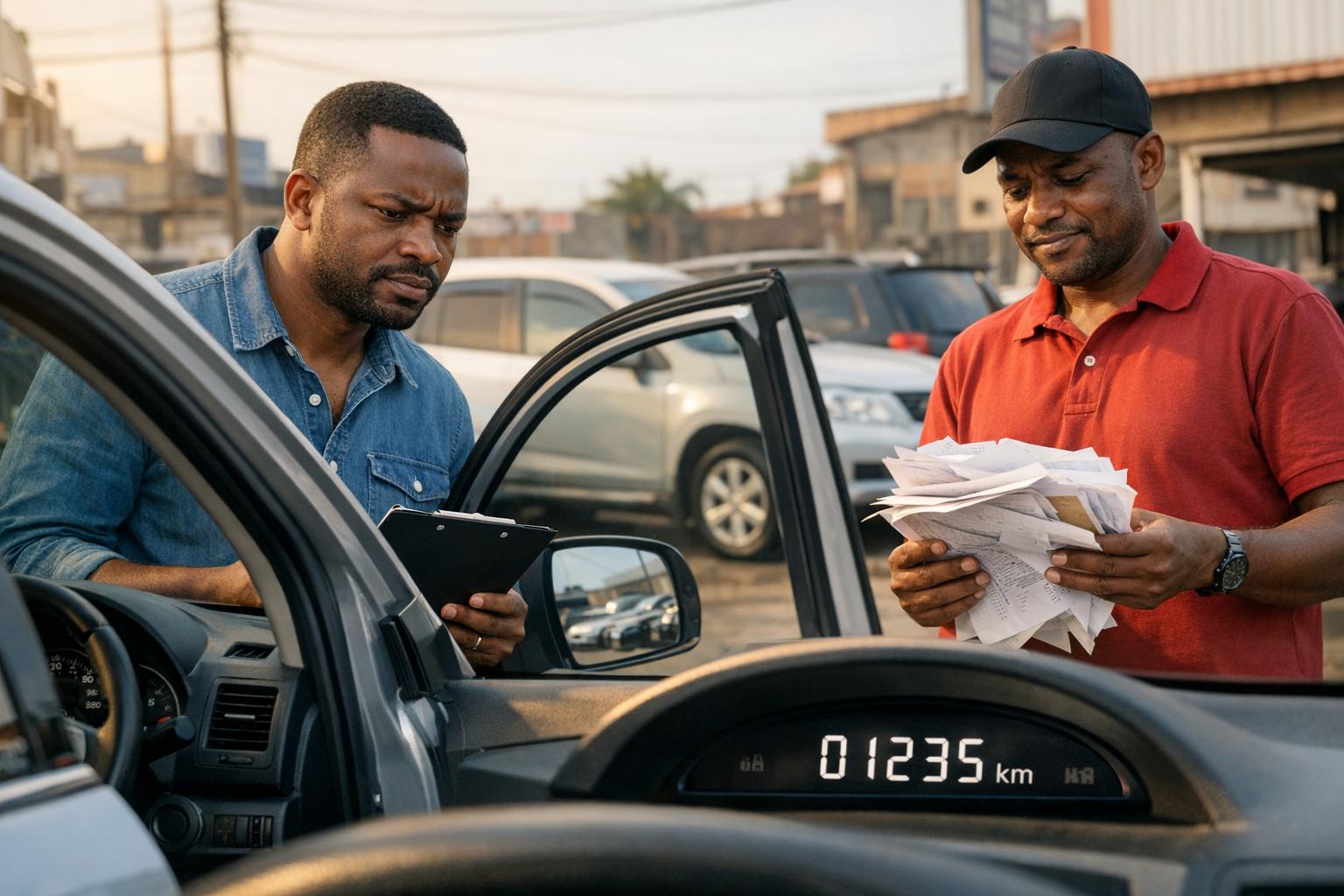
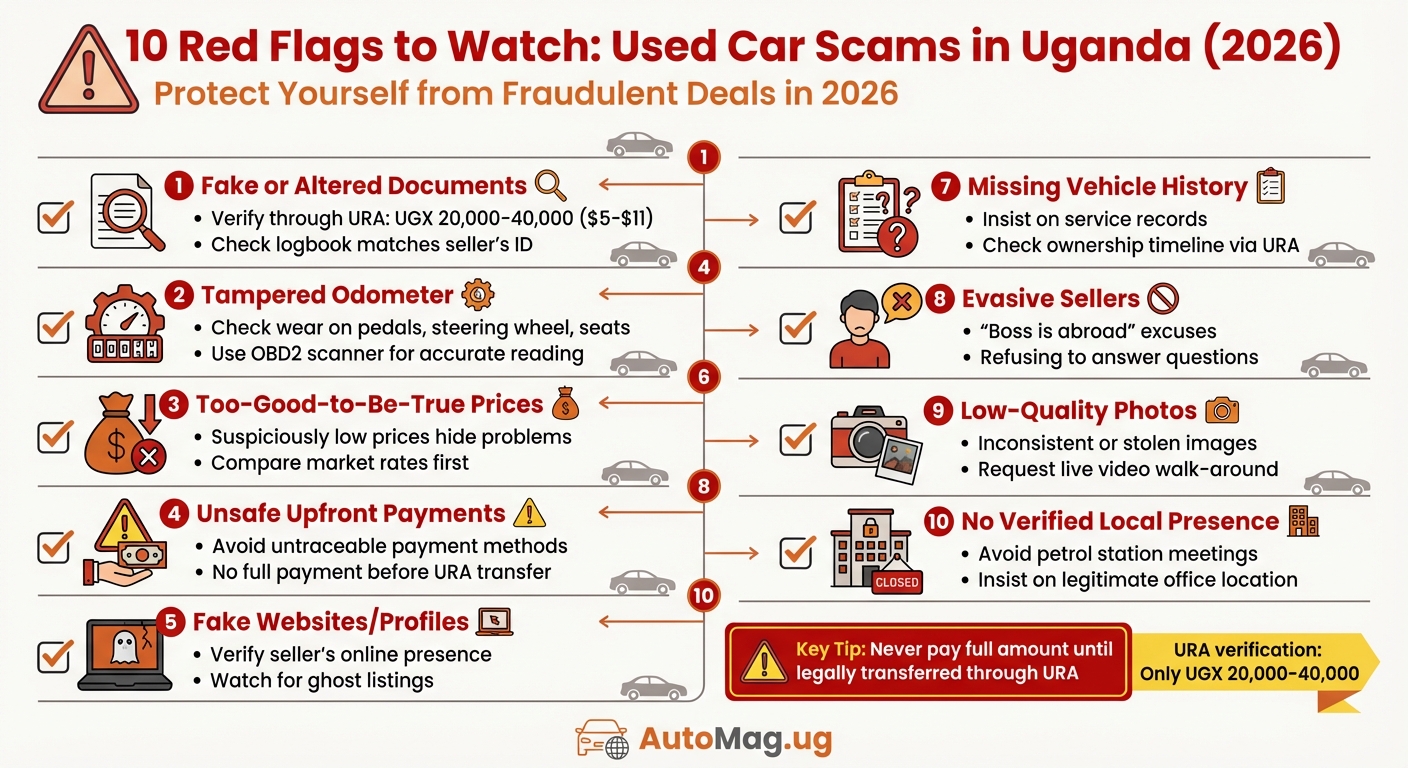
Buying a used car in Uganda can be risky, with scams becoming more sophisticated in 2026. Fraudsters often use fake documents, tampered odometers, and high-pressure sales tactics to trick buyers. To protect yourself, watch for these 10 red flags:
- Fake or altered documents: Verify logbooks and ownership through the Uganda Revenue Authority (URA). A simple check costs $5–$11.
- Tampered odometers: Look for wear on pedals, steering wheels, and seats. Use tools like OBD2 scanners for accurate mileage.
- Too-good-to-be-true prices: Suspiciously low prices often hide fines or mechanical issues. Compare market prices before committing.
- Unsafe upfront payments: Avoid untraceable payments or large deposits before ownership transfer.
- Fake websites or profiles: Be cautious of online listings with inconsistent photos or unverifiable sellers.
- High-pressure sales tactics: Scammers rush buyers to skip due diligence. Always take your time to verify details.
- Missing vehicle history: Insist on service records and check ownership history via URA.
- Evasive sellers: Walk away if sellers dodge questions or offer vague excuses about ownership.
- Low-quality photos: Inconsistent or overly polished images can indicate fraud.
- No verified local presence: Avoid sellers without an office or proper representation.
Key Tip: Never pay the full amount until the car is legally transferred to your name through URA. Spending a small fee on verification can save you from major financial loss.
For a safer purchase, verify documents, inspect the car with a trusted mechanic, and avoid rushed decisions. If something feels off, trust your instincts and walk away.
10 Red Flags When Buying Used Cars in Uganda – Scam Warning Signs
1. Fake or Altered Vehicle Documents
Verifying Vehicle Documents
Scammers often use forged logbooks, sales agreements, or receipts that look legitimate. To avoid being tricked, always verify documents through the Uganda Revenue Authority (URA) database. You can perform a basic search for UGX 20,000 (roughly $5.30) or opt for full certification at UGX 40,000 (about $10.60). A basic search provides vehicle details, while certification offers legal proof. Results are typically available within two working days. Spending this small amount can save you from significant financial losses. Once you’ve confirmed the documents, the next step is to check the seller’s credibility.
Checking the Seller’s Credibility
The name on the logbook must match the seller’s National ID or driving permit exactly. Be wary of sellers who claim the vehicle’s owner is abroad or unreachable. As Jeff from ttunda.com aptly put it:
Used cars here don’t come with warranties. They come with stories; some true, many twisted.
Also, ensure the chassis and engine numbers align with the logbook. If the vehicle has a new plate but shows signs of heavy use, it could be stolen and re-registered. To check for outstanding fines, text "ESP [NUMBERPLATE]" to 8888 or dial *165#. Some fines can exceed UGX 1,000,000.
Securing Payments and Transfers
Never pay the full price until the ownership transfer is finalized at a URA office. The transfer process should be completed with the seller present. Standard transfer fees are UGX 84,000 for cars, UGX 74,000 for motorcycles, and UGX 104,000 for commercial vehicles. Additionally, vehicles now require URA online validation for an E-log book, which is crucial for insurance and legal ownership transfers.
2. Tampered Odometer Readings
Transparency in Vehicle History
After verifying documents, take a close look at the vehicle’s mileage to spot any potential fraud. Odometer tampering is a common trick used to inflate a car’s value by showing lower mileage. In the United States alone, it’s estimated that by 2024, around 2.14 million vehicles on the road might have had their odometers rolled back. This kind of fraud costs buyers an average of $3,300 per vehicle when they unknowingly purchase cars with manipulated mileage. The same practice is prevalent in Uganda’s used car market.
The vehicle’s condition often reveals the truth. Check high-contact areas like the steering wheel, seats, gear shift, and pedal rubber for signs of wear. If these parts show significant use but the odometer reads under 100,000 km (62,000 miles), tampering is a strong possibility. Also, review service records carefully. Long gaps in the maintenance history can indicate the odometer was rolled back before the next documented service.
Seller Credibility and Behavior
For a more accurate mileage check, use an OBD2 scanner to retrieve data directly from the vehicle’s control modules. According to OBDeleven:
Scammers may alter only the dashboard numbers while control modules retain original mileage.
If the car has an older mechanical odometer, look for crooked or misaligned numbers and check the dashboard screws for signs of tampering. Since many used cars in Uganda are imported from Japan, ask for the original export or deregistration certificate, which includes the mileage at the time of export.
Just like with document verification, insist on an independent inspection to confirm the details. Be cautious of sellers who refuse third-party inspections or try to rush the sale. A shiny exterior combined with old number plates could point to hidden mileage issues. If the seller claims the owner is overseas, consider it a major warning sign and walk away. These checks not only help you verify the mileage but also assess the seller’s trustworthiness, ensuring you don’t fall victim to tampered readings.
3. Prices That Seem Too Good to Be True
Transparency in Vehicle History
If a used car’s price is far below market value, it’s worth digging deeper. In Uganda, sellers often base their pricing on subjective reasons rather than actual market data. A suspiciously low price could be a way to conceal liabilities, such as fines exceeding UGX 1,000,000 (about $280). To check for outstanding fees, you can text "ESP [space] NUMBERPLATE" to 8888 or dial *165# and follow the path: Payments → Fees & Taxes → Multiplex, to review any parking arrears. Sellers offering such deals may also use high-pressure tactics, which should raise your alertness.
Seller Credibility and Behavior
Be wary of sellers who combine low prices with rushed negotiations. If someone is pushing you to make a quick decision or giving excuses like "my boss is abroad" while their name doesn’t match the logbook, proceed with caution. Always insist on meeting in a verifiable office rather than random spots like petrol stations or roadside locations.
Payment Security and Transaction Methods
A low price might also be a cover for hidden mechanical issues. A car that looks spotless with fresh paint and polish could have serious problems under the hood, including issues with the engine, gearbox, or suspension. To avoid surprises, always arrange for an independent mechanical inspection and check local platforms for market price comparisons before negotiating. As Jeff from ttunda.com puts it:
Used cars here don’t come with warranties. They come with stories; some true, many twisted.
When it comes to payment, never hand over the full amount or a large deposit until the vehicle has been legally transferred into your name through the URA system. A formal vehicle search at the URA costs between UGX 20,000 and UGX 40,000 (approximately $5.60–$11.20) – a small price to pay to avoid much bigger losses.
4. Requests for Upfront Payment Through Unsafe Channels
Seller Credibility and Behavior
One of the clearest warning signs in Uganda’s used car market is unsafe upfront payment practices. Scammers often disguise themselves as agents for international sellers, collecting local payments that never actually reach the supposed seller. Take the case of George Agaba – back in August, he handed over a $40,000 (around Shs148 million) deposit to a Kireka dealer for a 2008 Toyota Land Cruiser TX that never materialized. Another example from June 2023 involves Naome Grace, who used forged documents to sell a rented Toyota Sienta (registration UBM 082W) for Ugx 18 million. The car, in reality, belonged to Naija Confort rental company. Both cases highlight how scammers use similar tactics to prey on multiple victims. Car importer Eddie Matovu points out:
The loophole is that car dealers are appointing many agents and this is something that must be avoided.
These shady practices underline the importance of secure payment methods and careful seller verification.
Payment Security and Transaction Methods
To protect yourself, always stick to verified and traceable payment options. Avoid untraceable methods like Western Union or MoneyGram, which scammers often exploit. Fraudsters have even gone as far as setting up fake escrow services to trick buyers into transferring funds before receiving the vehicle. Authentic escrow services, on the other hand, charge a modest fee – typically between $50 and $80 (about Shs185,000 to Shs296,000) – to hold your money until you confirm the car’s condition. Car importer Richard Mugerwa explains:
The money will be held in an escrow account until confirmation from the buyer that the car has been received and in good condition.
If you’re importing a car, make sure payments go directly from your bank account to the seller’s account in their home country. Avoid using local third-party agents. For domestic purchases, delay full payment until the vehicle is legally transferred into your name through the URA system. This method complements the document verification and seller checks discussed earlier, offering a more secure and reliable buying experience.
5. Fraudulent Websites or Social Media Accounts
Seller Credibility and Behavior
Scammers often create fake online profiles that imitate legitimate dealers or claim to represent trusted international companies. They trade under well-known brand names without authorization, banking on the trust these brands have built over time. A common trick involves posting "ghost listings" – vehicles that have either been used in previous scams or are actually rental cars owned by third parties. When buyers request an in-person inspection, these scammers typically offer excuses like being "too busy", "out of state", or even located in another country, making it impossible to verify the vehicle physically.
In many cases, unsuspecting buyers have paid large deposits only to find out the dealership was fake. Meanwhile, the same vehicle remains listed online to lure in more victims. As Business Insider cautions:
If the price of a used vehicle seems too good to be true, it probably is. Fraudsters will often post pictures of rare or exotic cars at low prices… and attempt to get you to send them money before shipping the car, which likely does not exist.
These deceptive tactics often pave the way for even riskier financial schemes.
Payment Security and Transaction Methods
Once scammers hook buyers with fake listings, they use additional tricks to extract money. They might demand fake "escrow" or "guarantee" fees, typically ranging from $50 (about Shs 185,000) to $80 (about Shs 296,000), claiming these fees will protect your payment. To rush the process, they pressure buyers with claims like "other buyers are waiting", discouraging essential steps such as VIN checks or mechanical inspections. In some cases, they even provide forged documents as fake proof of ownership.
To avoid falling victim, always verify ownership directly with the Uganda Revenue Authority (URA) instead of relying solely on documents from the seller. You can also consult authorities like Multiplex or the Uganda Traffic Police to check for any outstanding fines. If you’re importing a vehicle, transfer funds directly to the seller’s account abroad rather than through local agents. These steps are crucial to ensuring a safe and legitimate transaction, as emphasized earlier.
6. High-Pressure Sales Tactics and Time Limits
Seller Credibility and Behavior
If a seller is pressuring you to make an immediate decision, that’s a clear red flag. Scammers often create a false sense of urgency to stop you from doing basic checks, like confirming ownership through the Uganda Revenue Authority (URA) or inspecting the car’s condition.
Take the case from June 2023 involving Naome Grace and dealer Mukasa Hannington. Grace used this high-pressure tactic to convince Hannington to pay a deposit of 12,000,000 Ugx (about $3,240) on their first meeting – before any legal transfer had been completed. According to Police Spokesperson SCP Enanga Fred:
Mukasa Hannington did not establish proof of car ownership from URA, but relied on forged documents.
This kind of pressure often comes alongside demands for quick payments, which we’ll dive into next.
Payment Security and Transaction Methods
In addition to verifying the seller’s credibility, securing your payment method is just as critical. Scammers often demand immediate deposits or partial payments, claiming the deal won’t last or that other buyers are lined up . To protect yourself, never pay the full price – or even a large deposit – until the vehicle is legally transferred to your name in the URA system. Conducting a formal vehicle search through URA costs only 20,000 Ugx to 40,000 Ugx (around $5 to $11) and can save you from costly mistakes.
Always meet the seller in a trusted, verifiable business location rather than questionable spots like petrol stations. Before committing to a purchase, use the 8888 SMS service (Type: ESP [space] PLATE to 8888) to check for any outstanding traffic fines tied to the vehicle. These small steps can make a big difference in ensuring a safe and legitimate transaction.
Dont get scammed.Do this when you go to buy a car in Kampala
sbb-itb-7bab64a
7. Missing or Incomplete Vehicle History
When it comes to buying a car, missing or incomplete vehicle history can be a major red flag. It might hint at hidden issues or even fraud, making it essential to dig deeper before making a purchase.
Verify Complete Vehicle History
A complete vehicle history is your first line of defense against potential headaches. Legitimate sellers should readily provide service records, maintenance receipts, and a clear ownership timeline. If someone claims the car has low mileage but can’t show recent service documents, that’s a big warning sign. Sometimes, a shiny exterior can hide costly mechanical problems lurking underneath.
To ensure everything checks out, take advantage of resources like the Uganda Revenue Authority (URA). For a small fee – 20,000 to 40,000 Ugx (about $5 to $11) – you can perform an official vehicle search at ura.go.ug. This simple step could save you from inheriting hidden issues, such as traffic fines that can sometimes exceed 1,000,000 Ugx for commuter taxis.
Authenticity of Vehicle Documents
Pay close attention to the vehicle’s paperwork. The name on the logbook must exactly match the seller’s National ID or permit, as emphasized in Section 1. Also, double-check that the chassis and engine numbers on the car align with those listed in the logbook. If they don’t match, the vehicle could have been tampered with or “rebirthed”.
"If the logbook name doesn’t match what’s on the seller’s National ID/Permit, etc., run and don’t look back." – Jeff, ttunda
Additionally, revisit earlier steps for verifying traffic fines and other potential discrepancies.
Seller Credibility and Behavior
A seller’s behavior can also give away potential problems. Be wary of anyone offering excuses like “the boss is abroad” when they can’t provide essential documents. Similarly, avoid deals where the seller refuses to hand over the car’s title and registration paperwork.
It’s also wise to steer clear of transactions in shady locations like petrol stations. And never, under any circumstances, pay the full price until the car is legally transferred to your name in the URA system. This process usually takes two working days, and completing it together with the seller at URA offices adds an extra layer of security.
8. Evasive or Untrustworthy Seller Actions
Beyond issues with documents and payments, a seller’s behavior can often reveal shady practices. If a seller dodges straightforward questions about the car’s history or mechanical condition, take it as a strong warning sign to back out.
Seller Credibility and Behavior
Be cautious of excuses like "my boss is abroad", especially if the seller’s name doesn’t match the one on the logbook. This is a common warning sign in Uganda’s used car market. Legitimate sellers should either be the registered owner or have valid authorization documents to sell the vehicle. Always insist on meeting at a verified location, such as an established office, to avoid unnecessary risks.
Another red flag to watch for is high-pressure sales tactics. If a seller pushes you to "decide now" or claims there are other buyers waiting, they might be trying to rush you into a decision before you can verify the car’s details. This approach was notably seen in a July 2023 case involving a Toyota Sienta (UBM 082W), which was sold using forged documents.
Payment Security and Transaction Methods
Never pay the full amount until a joint URA transfer is completed, legally registering the car in your name. Sellers demanding upfront payment or cash-only transactions could be attempting to avoid creating a traceable paper trail. As SCP Enanga Fred, the Police Spokesperson, emphasized:
We therefore, urge all used-car dealers and car rental dealers to always be very vigilant and carry out sufficient due diligence. For instance, Mukasa Hannington did not establish proof of car ownership from URA, but relied on forged documents.
When combined with earlier warning signs, these behaviors form a practical checklist to help you secure a safe and legitimate purchase.
9. Low-Quality or Inconsistent Vehicle Photos
When it comes to spotting potential scams, low-quality or inconsistent photos can be a major red flag. Photos often reveal a lot about the seller’s honesty. Scammers frequently use images of rare or exotic cars advertised at shockingly low prices to bait buyers. They’ll often claim the vehicle is overseas once they’ve piqued your interest. For example, if you see a luxury car listed at half its usual market price, chances are the photos have been stolen from a legitimate listing.
Seller Credibility and Behavior
Pay attention to how the seller responds to requests for additional photos. If they refuse to provide specific, up-to-date images – like close-ups of the engine bay or interior – it’s a strong signal they don’t actually have the car. Another red flag: if the same photos of a car keep appearing online weeks after you’ve been asked to make a deposit, the vehicle might not even exist.
Also, be cautious of cars that look "too perfect" for their age. A pristine, glossy paint job on an older model could be hiding structural damage or rust. Similarly, if the car has a brand-new license plate but the interior shows significant wear and tear, you might be dealing with a "rebirthed" stolen vehicle that’s been repainted and re-registered.
Transparency in Vehicle History
Before meeting the seller, take a moment to verify the car’s license plate. Text "ESP [space] NUMBERPLATE" to 8888 to check for any pending fines attached to the vehicle. It’s a simple and affordable way to avoid inheriting someone else’s debt.
Another tip: ask for a live video call or a video walk-around of the car before agreeing to meet in person. This forces the seller to prove they actually have the vehicle and that it matches the photos they’ve shared. Honest sellers will have no problem accommodating this request, but scammers often come up with excuses like being too busy or facing technical issues.
These visual checks are an important complement to verifying documents and payment details, helping you steer clear of potential scams.
10. Absence of Verified Local Agent or Representative
After checking the documents and evaluating the seller’s behavior, confirming the presence of a verified local agent or representative is crucial to ensuring a safe transaction. In Uganda’s used car market, the absence of such a verified presence is a major warning sign. If a seller claims to work through an overseas representative, it’s often a tactic scammers use to justify discrepancies, like their name not matching the vehicle logbook.
Legitimate car dealers typically operate from established offices or car bonds – not random locations like fueling stations or roadside spots. Meeting at a petrol station for a car deal significantly raises your risk of being scammed. This is a deliberate strategy by fraudsters who avoid traceable business locations, making it nearly impossible to track them after they’ve taken your money. Always verify that the seller has a legitimate local office.
For instance, there was a case where a buyer in Kireka lost a deposit of $40,000 (about UGX 148,000,000) to a local dealer for a vehicle that was never delivered. Without a verified local representative, you also risk falling victim to unsafe payment practices. Scammers may ask for upfront fees for shipping or taxes before you even inspect the car. Some go as far as creating fake escrow websites to steal your banking details.
To further protect yourself, use the URA system (ura.go.ug) to confirm the car’s ownership and registration status. This process typically costs between UGX 20,000 and UGX 40,000. Never pay the full amount until the vehicle is legally transferred to you through the URA system. Having a verified local agent adds a critical layer of security, tying together all the other precautions for a safer used car purchase.
Buyer Protection Checklist
Stay safe from scams by following these essential steps before purchasing a used car in Uganda. This guide brings together key points to help you verify documents, confirm payments, and inspect the vehicle thoroughly.
Start with document verification. Check that the logbook is registered in the seller’s name by comparing it with their National ID or driver’s permit. If the names don’t match, it’s a major red flag – don’t proceed. Also, ensure the chassis and engine numbers match the logbook details. To double-check ownership and registration status, use the official URA website for an ownership search.
Don’t overlook hidden fines. Use the designated SMS service or dialing method to check for any unpaid fines tied to the vehicle. This simple step can save you from unexpected financial headaches later.
When it comes to vehicle inspection, always bring along a trusted mechanic. Have them carefully examine critical components like the engine, gearbox, brakes, suspension, and electronics. Be on the lookout for signs of "rebirthing", such as a brand-new number plate on a car with an obviously worn interior. Always meet the seller at a professional location, like an office or official premises, rather than informal spots like petrol stations or roadside areas.
Lastly, safeguard your payment. Never hand over the full amount until the vehicle is legally transferred into your name. Complete the transfer process at a URA office with the seller present to ensure everything is above board.
Conclusion
This guide highlights the key warning signs to help you steer clear of fraudulent deals when buying a used car in Uganda. By recognizing the ten red flags – like fake documents, tampered odometers, high-pressure sales tactics, and missing vehicle history – you can take proactive steps to protect yourself from scams. Verifying documents, arranging independent mechanical inspections, and conducting thorough financial checks are critical measures to safeguard your investment.
Paying small verification fees upfront can save you from significant financial losses down the road. These steps ensure a safer, more confident buying experience.
Legitimate sellers will always be upfront about ownership, meet you in professional settings, and allow you the time needed to complete all necessary checks. If something feels off – whether it’s an unusually low price, vague answers, or excuses about why the "boss" isn’t present – trust your gut and walk away.
For more insights and tips on navigating Uganda’s automotive market, visit AutoMag.ug.
FAQs
How can I make sure a used car’s documents in Uganda are authentic?
To confirm the legitimacy of a used car’s paperwork in Uganda, start by examining the original vehicle logbook. Check that key details – such as the owner’s name, make, model, year, engine number, and chassis (VIN) – align with the car itself. If the car was imported, verify that the logbook has been authenticated by the issuing authority in the country of origin or includes a certified translation.
Next, utilize the Uganda Revenue Authority (URA) e-Tax system to perform a vehicle search and certification. This process ensures that the logbook, bill of lading, standards certificate, and tax identification number (TIN) are accurate. It also confirms that the car has no unpaid taxes or theft reports. For extra peace of mind, you can request a certified copy of the vehicle’s details from a URA office or an authorized clearing agent.
Carefully inspect all documents for signs of tampering, such as torn pages or inconsistent fonts. Additionally, the seller should provide the original bill of lading and standards certificate to prove the vehicle was legally imported. Following these steps can help you verify the car’s documentation and avoid falling victim to fraud.
How can I spot odometer tampering when buying a used car?
Odometer tampering is a deceptive practice that can trick buyers into thinking a car has fewer miles than it actually does. To protect yourself, start by reviewing the vehicle’s service records and comparing the listed mileage with the current odometer reading. Any inconsistencies or missing entries in the records should raise suspicion.
Pay attention to physical signs of tampering on the odometer itself. Misaligned numbers or visible scratches around the display can be telltale indicators that something isn’t right.
Also, take a close look at the car’s overall wear and tear. For example, if the pedals, steering wheel, or seats show more wear than you’d expect for the claimed mileage, it could point to tampering. When in doubt, it’s always a good idea to involve a trusted mechanic or professional to inspect the vehicle thoroughly before you commit to buying. A little caution upfront can help you avoid expensive regrets later.
Why is it risky to make upfront payments when buying a used car?
Making upfront payments for a vehicle can be a gamble, as it opens the door to scams where sellers vanish after pocketing your money. Scammers often demand hefty deposits – sometimes reaching tens of thousands of dollars – without offering any proof that the car is real or available. There have been cases where buyers handed over large sums, only to discover later that the sellers were frauds and the promised cars didn’t exist.
To avoid falling victim, take essential precautions. Start by verifying the seller’s identity and inspecting the vehicle in person. Double-check that all paperwork, like the title and registration, is legitimate and matches the vehicle. When it comes to payments, stick to secure methods such as bank transfers or trusted mobile payment platforms that provide transaction records. Most importantly, only release funds after you’ve inspected the vehicle and finalized the ownership transfer. These steps not only protect your money but also ensure a smooth and fair transaction while giving you legal options if issues arise.
Related Blog Posts
- Where to buy used cars in Kampala
- Avoid fake car deals in Uganda
- How to Buy a Second-Hand Car in Uganda Without Getting Scammed
- How to Avoid Scams When Buying a Used Car in Uganda