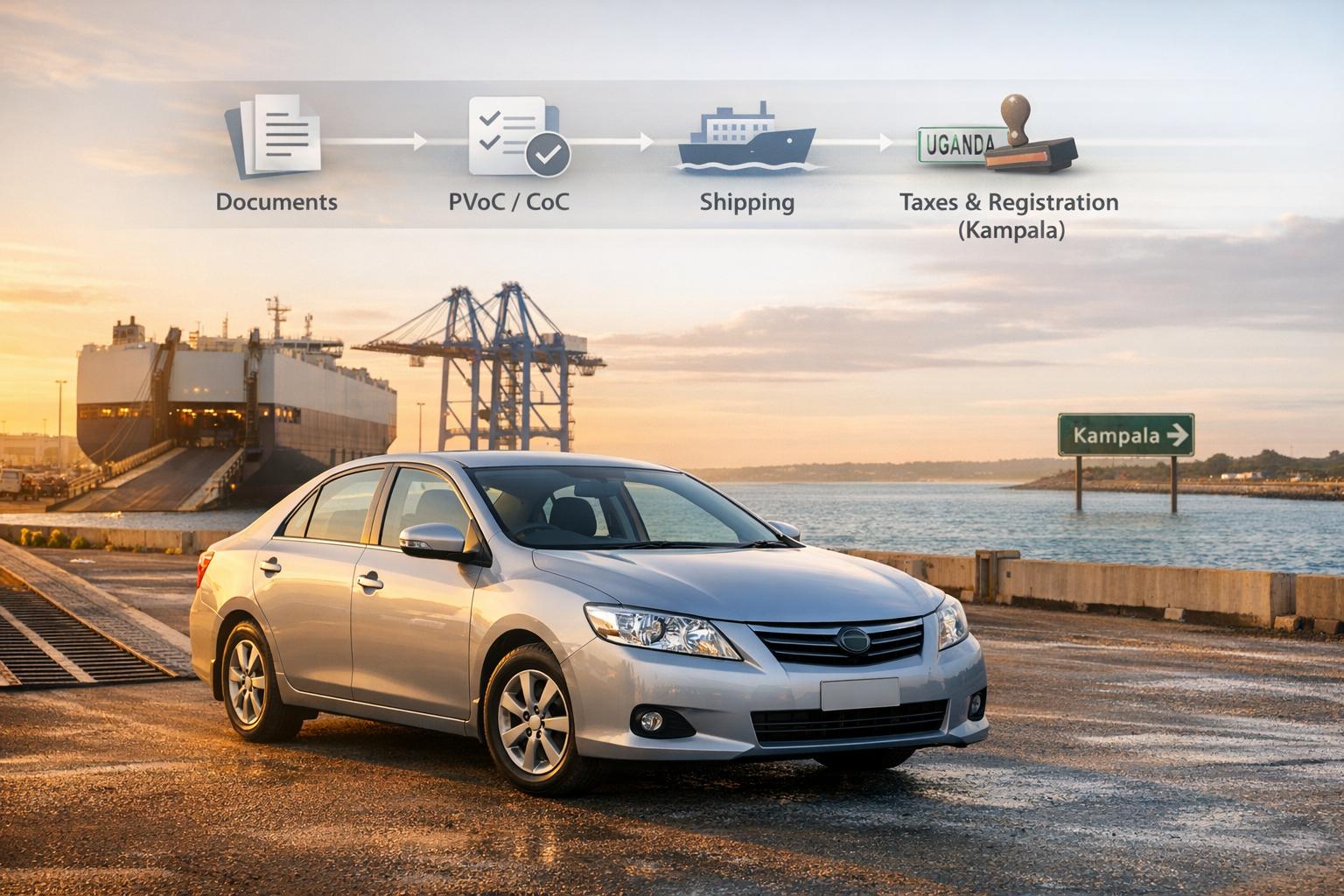
Thinking of importing a car from South Africa to Kampala? Here’s what you need to know:
- Key Requirements: Uganda enforces a 15-year age limit on imported cars (based on manufacturing date) and mandates all vehicles to be Right-Hand Drive (RHD). A Pre-Export Verification of Conformity (PVoC) inspection is also required before shipping.
- Essential Documents: You’ll need a Commercial Invoice, Bill of Lading, original logbook, Certificate of Conformity (CoC), Import Declaration Form (IDF), Tax Identification Number (TIN), and a packing list.
- Shipping Options: Choose between Roll-on/Roll-off (RoRo) for affordability (~$1,000–$1,200) or container shipping for added security (~$2,000–$2,450). Vehicles typically arrive at Mombasa or Dar es Salaam before being transported overland to Kampala.
- Costs and Taxes: Taxes include a 25% import duty, 18% VAT, 6–15% withholding tax, and an environmental levy (varies by age and engine size). Additional costs include inspection fees ($300–$325), clearing agent fees ($2,500–$3,500), and registration fees.
- Timeline: The entire process, from South Africa to Kampala, takes about 4–8 weeks.
Pro Tip: Work with licensed clearing agents to simplify customs clearance and avoid delays. Proper planning and accurate documentation ensure a smooth import process.
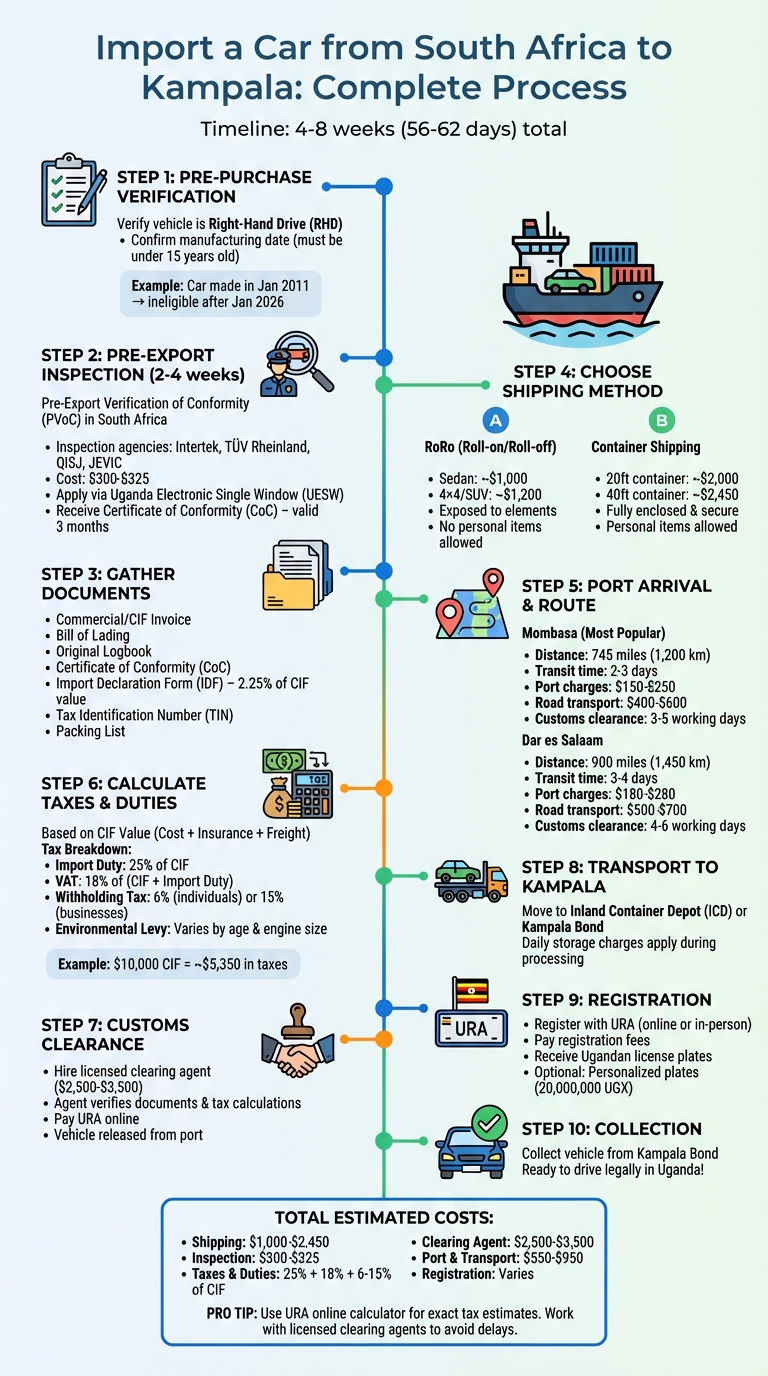
Complete Process for Importing a Car from South Africa to Kampala Uganda
Uganda’s Vehicle Import Regulations
Navigating Uganda’s vehicle import rules is crucial if you’re planning to buy a car from South Africa. The Uganda National Bureau of Standards (UNBS) ensures that only vehicles meeting safety and roadworthiness standards are allowed into the country. Failing to comply with these regulations can lead to penalties, shipment rejection, or even forced re-export. Let’s break down the key requirements.
Vehicle Age Limits and Drive Standards
Uganda imposes a strict 15-year age limit on imported vehicles, calculated from the manufacturing date – not the registration year. For example, a car manufactured in January 2011 becomes ineligible for import after January 2026. To avoid issues, confirm the manufacturing date on the compliance plate or in the vehicle’s documentation.
Additionally, all imported vehicles must be Right-Hand Drive (RHD), with exceptions for special-purpose vehicles like some construction or industrial equipment. Since South African vehicles are typically RHD, this requirement shouldn’t be a major hurdle.
Pre-Export Verification of Conformity (PVoC)
After meeting the age and drive requirements, vehicles must undergo the Pre-Export Verification of Conformity (PVoC) process. This mandatory inspection, enforced under the UNBS Act of 1983, ensures that vehicles comply with Uganda’s safety, health, and environmental standards. Inspection agencies such as Intertek or TÜV Rheinland perform these checks in South Africa before shipment. Applications are submitted via the Uganda Electronic Single Window (UESW) portal, and the process typically takes 2–4 weeks, depending on documentation and scheduling.
Successful inspections result in a Certificate of Conformity (CoC), which is valid for three months and applies to a single shipment. This certificate is essential for customs clearance. Vehicles arriving without a CoC risk being rejected, destroyed, or re-exported at the importer’s expense. Generally, the CoC requirement applies to shipments valued above $2,000.
| Regulation | Requirement Detail |
|---|---|
| Age Limit | 15 years maximum from the manufacturing date |
| Drive Standard | Right-Hand Drive (RHD) required (except special-use vehicles) |
| Mandatory Inspection | Pre-Export Verification of Conformity (PVoC) |
| Required Certificate | Certificate of Conformity (CoC), valid for 3 months |
| CoC Application | Uganda Electronic Single Window (UESW) portal |
sbb-itb-7bab64a
Required Import Documents
Getting the right paperwork in order is crucial when importing a vehicle to Uganda. Mistakes or missing documents can lead to delays, fines, or even rejection by authorities like the Uganda Revenue Authority (URA) and the Uganda National Bureau of Standards (UNBS). One critical detail to double-check is that all documents, especially those listing chassis numbers, match perfectly. As Everycar.jp highlights:
Missing documents can cause serious delays and extra costs. With the right documents, clearance becomes faster and stress-free.
Here’s a checklist to help you prepare everything you need.
Document Checklist
- Commercial or CIF Invoice: This document, provided by the seller in South Africa, should include the purchase price, a detailed vehicle description, and information about both the buyer and seller. Accurate details are essential since this invoice is used to calculate import duties and taxes.
- Bill of Lading (B/L): Issued by the shipping line after the vehicle is loaded, this document serves as proof of shipment and ownership. You’ll need it to release the vehicle at the port, so make sure to get scanned copies promptly to begin your Import Declaration Form.
- Original Logbook or Export Certificate: This proves legal ownership of the vehicle. The URA only accepts original documents – no photocopies allowed. Double-check that the chassis number matches across all documents to avoid complications.
- Certificate of Conformity (CoC): This certificate is issued after the Pre-Export Verification of Conformity inspection, conducted by UNBS-authorized agencies like QISJ or JEVIC. The CoC ensures the vehicle meets safety and age standards and is valid for three months. Importantly, you must secure this certificate before the vehicle leaves South Africa.
- Import Declaration Form (IDF): You or your licensed clearing agent must apply for this form through the Uganda Electronic Single Window system. The application incurs a fee of 2.25% of the CIF value, with a minimum cost of about $40–$50.
- Tax Identification Number (TIN): Issued by the URA, your TIN is required to facilitate tax payments during the import process.
- Packing List: This document, provided by the seller, outlines the vehicle’s contents and any included accessories.
| Document | Provided By | Purpose |
|---|---|---|
| Commercial/CIF Invoice | Seller/Exporter | Calculates import duties and taxes |
| Bill of Lading | Shipping Line | Proof of carriage and vehicle release |
| Original Logbook | Seller/Exporter | Proves legal ownership from South Africa |
| Certificate of Conformity | Inspection Agency (QISJ, JEVIC) | Confirms safety and age compliance |
| Import Declaration Form | Importer/Clearing Agent | Official import notification to URA |
| Packing List | Seller/Exporter | Details vehicle contents and accessories |
To simplify the process, consider hiring a licensed clearing agent. These professionals handle customs declarations and related paperwork. Their services typically cost between $2,500 and $3,500, excluding duty and registration fees. With all documents in hand and a qualified agent on board, you’ll be ready to move forward with shipping and customs clearance smoothly.
Shipping Methods and Routes
With your documents in order, the next step is figuring out how to transport your vehicle efficiently. Since Uganda doesn’t have a seaport, vehicles first arrive at Mombasa (Kenya) or Dar es Salaam (Tanzania) before continuing overland to Kampala. Choosing the right shipping method and route can help you balance costs, security, and delivery time.
RoRo vs. Container Shipping
When it comes to shipping methods, you’ll likely choose between Roll-on/Roll-off (RoRo) and container shipping.
Roll-on/Roll-off (RoRo) is often the more affordable choice. With this method, your vehicle is driven onto the ship’s deck and securely strapped down. Shipping a sedan to Mombasa costs about $1,000, while a 4×4 or SUV runs closer to $1,200. However, your car will be exposed to the elements during transit, and personal items cannot be shipped with it.
Container shipping, on the other hand, provides extra protection, making it ideal for luxury or classic cars. A 20-foot container (suitable for one car) costs around $2,000, while a 40-foot container (holding two or more cars) is priced at about $2,450. Containers shield vehicles from theft and weather damage, and you can include household goods or spare parts along with the car. Your choice will depend on factors like vehicle value, security concerns, and whether you need to transport additional items.
| Feature | RoRo Shipping | Container Shipping |
|---|---|---|
| Cost | Lower (sedan ~$1,000) | Higher (20ft container ~$2,000) |
| Security | Moderate (exposed on deck) | High (fully enclosed) |
| Personal Items | Not permitted | Allowed |
| Best For | Standard cars, SUVs, trucks | Luxury, classic, or multiple cars |
Routes to Kampala
Once your shipping method is decided, the next step is selecting an overland route. Mombasa is the most popular option due to its better infrastructure and shorter transit time. The port handles over 1.2 million twenty-foot equivalent units annually. The Mombasa route spans 745 miles (1,200 km) and typically takes 2–3 days. Port charges range from $150 to $250, while road transport costs fall between $400 and $600.
In comparison, the Dar es Salaam route covers 900 miles (1,450 km) and takes 3–4 days. Port fees are slightly higher at $180–$280, and road transport costs range from $500 to $700. Customs clearance in Mombasa generally takes 3 to 5 working days, while Dar es Salaam requires 4 to 6 working days.
Keep in mind that road conditions on the Dar es Salaam route can worsen during the rainy seasons (March–May and October–November), which may cause delays.
From start to finish, shipping from South Africa to Kampala typically takes 4 to 8 weeks, depending on your chosen method and route. The Mombasa route often saves 4 to 5 days compared to Dar es Salaam.
Import Costs and Taxes
When importing a vehicle, taxes and duties are based on the CIF (Cost, Insurance, and Freight) value. This figure includes the car’s purchase price, marine insurance, and shipping costs, making it a significant part of your total expenses.
Duties and Tax Calculations
Uganda’s tax system for vehicle imports involves several key components:
- Import Duty: Set at 25% of the CIF value.
- Value Added Tax (VAT): Calculated at 18% of the combined total of the CIF value and Import Duty.
- Withholding Tax: This is 6% for individuals or 15% for businesses, applied to the CIF value.
- Environmental Levy: Varies based on the vehicle’s age and engine size, especially for vehicles over 8 years old.
Here’s a quick example: If the CIF value of a sedan is $10,000, the Import Duty would be $2,500 (25%). VAT on this amount, plus the CIF, would total $2,250 (18% of $12,500). Adding a 6% Withholding Tax, approximately $600, brings the total tax-related costs to about $5,350 – excluding other fees.
For an exact calculation, you can use the Uganda Revenue Authority (URA) online calculator.
Other Expenses
Taxes aren’t the only costs to factor in. Several additional fees can significantly impact your budget:
- Import Declaration Fee: 2.25% of the CIF value, with a minimum charge of Ksh. 5,000.
- PVoC Inspection Fee: Ranges between £230 and £250.
- Professional Clearing Services: Typically costs between $2,500 and $3,500.
- URA Registration Fees: These vary depending on the vehicle.
- Personalized Number Plates: If desired, these cost 20,000,000 UGX.
Additionally, there are infrastructure levies and bond storage charges that may apply during the import process. All these elements combined can significantly increase the total cost of importing a vehicle.
Customs Clearance and Vehicle Transport
Customs Clearance Steps
When your vehicle arrives at the port, the first step is to hire a licensed clearing agent. Their job is to handle the customs process, which includes verifying tax calculations and ensuring all necessary documents are in order. These documents typically include the Bill of Lading (BOL), Import Declaration Form (IDF), Certificate of Conformity (COC/PVoC), purchase invoice, and the original logbook from South Africa.
The clearing agent will calculate the total duties and taxes owed. Once you have this information, you’ll need to pay the Uganda Revenue Authority (URA) directly through their online payment system. After completing these formalities, you can shift your focus to the transport and registration of your vehicle.
Transport and Registration
Once customs clearance is done, the vehicle needs to be transported from the port – most commonly Mombasa – to an Inland Container Depot (ICD) or a Kampala Bond. Depending on the arrangement, the vehicle can be moved using a car transporter or kept inside its shipping container. Keep in mind that daily storage charges apply while the vehicle remains in the bond during processing.
The next step is registering your vehicle with the URA, which can be done online or in person. This process will provide you with official Ugandan license plates. After paying the required fees and completing the registration, you can collect your vehicle from the Kampala Bond and start driving legally.
Conclusion
Bringing a car from South Africa to Kampala involves following Uganda’s import rules closely. First, make sure the vehicle complies with Uganda’s requirements for right-hand drive (RHD) and age limits. It’s also crucial to complete all necessary inspections before the car leaves South Africa. For instance, the PVoC inspection typically costs between $300 and $325 USD.
Careful financial planning is key to avoiding unexpected costs. Use the Uganda Revenue Authority’s online calculator to estimate your total tax obligations. These include a 25% import duty, 18% VAT, and extra charges based on the car’s age and engine size. Additionally, clearing and transport services usually range from $2,500 to $3,500. The entire process, from South Africa to Kampala, typically takes about 56 to 62 days.
Choosing the right professionals can make all the difference. Work with reliable exporters and licensed clearing agents to avoid scams and handle the complex documentation and URA system requirements. For more expensive vehicles, container shipping is often a safer option than RoRo, as it reduces the risk of damage or theft during transit.
To ensure your car is registered and road-ready in Uganda, keep all necessary paperwork organized. This includes the Bill of Lading, Certificate of Conformity, the original logbook, and the purchase invoice. By planning ahead and working with trusted professionals, you can navigate the import process smoothly and legally. Following these steps will help you get your vehicle on Ugandan roads without unnecessary complications.
FAQs
How do I confirm a car meets Uganda’s 15-year rule?
To ensure a car complies with Uganda’s 15-year rule, start by checking the manufacturing date. The vehicle must be less than 15 years old. You can find this information on the logbook, registration papers, or export documents.
Additionally, the car must undergo a Pre-Export Verification of Conformity (PVoC) or JEVIC inspection. These inspections confirm both the vehicle’s age and condition. Make sure all related documentation is accurate and current before proceeding.
What happens if my car arrives without a valid CoC?
If your car is shipped without a valid Certificate of Conformity (CoC), you might encounter customs delays and additional expenses. In Uganda, there’s a 15% surcharge applied to the Cost, Insurance, and Freight (CIF) value for vehicles that lack either a CoC or a Compliance Review Waiver (CRW). The CoC serves as proof that the vehicle complies with Uganda Standards. To steer clear of these issues, make sure the CoC is secured before shipping.
What’s the cheapest way to get the car from Mombasa to Kampala?
The cheapest option for transporting a car from Mombasa to Kampala is usually RoRo (roll-on/roll-off) shipping. This method involves driving the vehicle directly onto a specialized ship designed for cars, which makes it more economical compared to container shipping. RoRo typically comes with faster transit times and lower costs, making it an efficient choice for moving vehicles along this route.
Related Blog Posts
- How to Import a Car to Uganda: Complete Guide 2025
- How to register a used car in Uganda
- Importing a car to Uganda: taxes explained
- What You Need to Know Before Buying a Car in Uganda