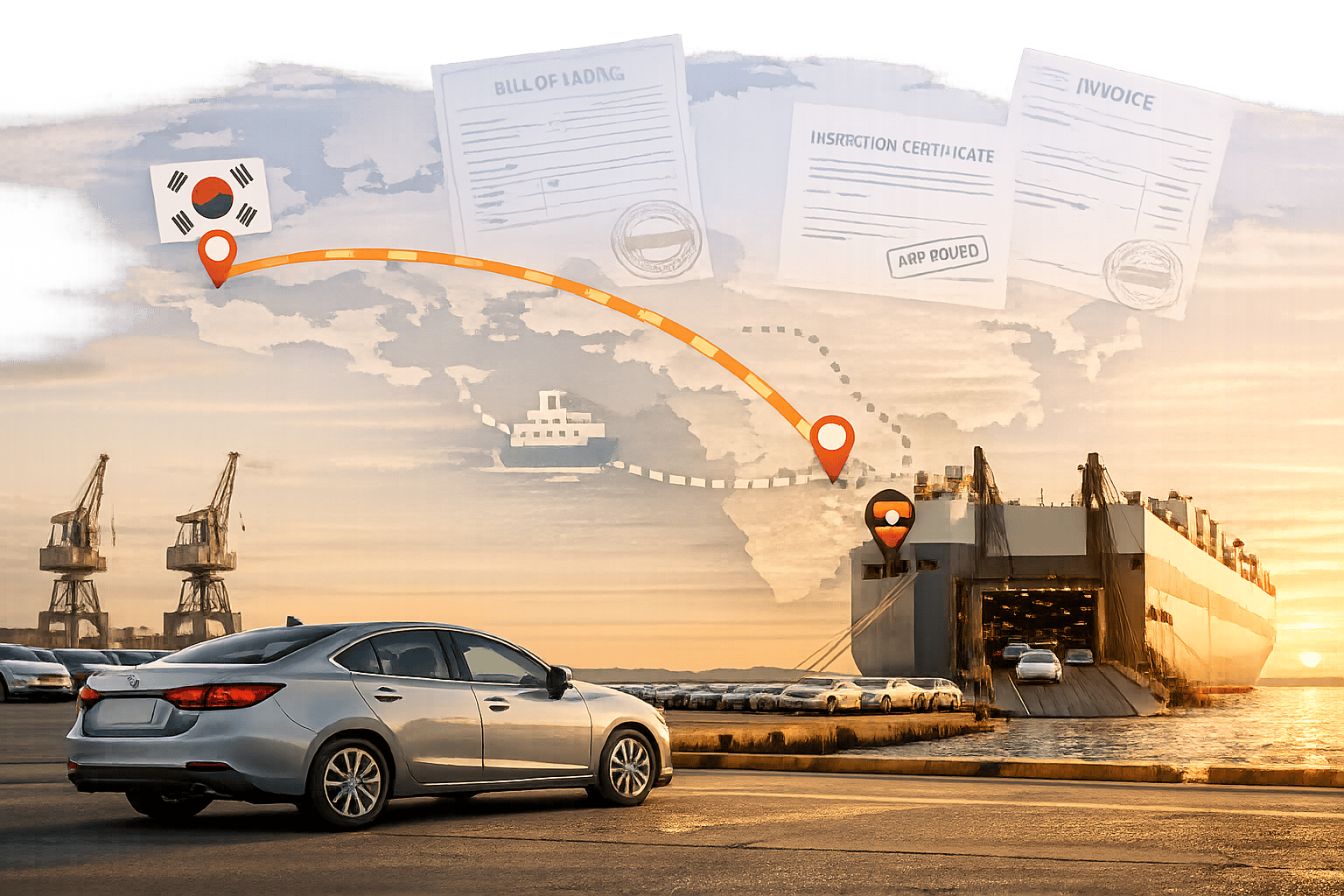
Looking to save money on your next car? Importing a vehicle from South Korea to Uganda can save you between UGX 4,000,000 and UGX 7,000,000 compared to buying locally. Here’s how you can do it:
- Eligibility: Uganda allows vehicles under 15 years old, with both left-hand and right-hand drive options. All cars must pass a JEVIC inspection for mileage and safety compliance.
- Taxes and Costs: Import duty is 25% of the car’s CIF (Cost, Insurance, Freight) value, plus 18% VAT and 6% withholding tax. Cars older than 9 years may incur a 50% levy.
- Shipping Options: Choose between RoRo (cheaper) or container shipping (secure). Use ports in Mombasa (faster) or Dar es Salaam (alternative).
- Documents Needed: Key paperwork includes a Proforma Invoice, Bill of Lading, Export Certificate, and Tax Identification Number (TIN).
- Save More: Buy during South Korea’s low-demand seasons (March-April) for discounts and consider bulk shipping to cut costs.
Takeaway: With proper planning, importing a car can be more affordable than buying locally. Follow these steps to avoid delays and extra fees.
[Interview] The best three ways to import used cars from Korea
sbb-itb-7bab64a
Step 1: Find Trustworthy South Korean Car Exporters
Working with a dependable exporter helps protect you from scams and undisclosed issues. South Korea offers several well-known platforms for sourcing vehicles, such as Encar, K Car, Autowini, and Hyundai Glovis. These platforms often feature verification systems to help you identify genuine sellers.
To ensure an exporter is legitimate, look for indicators like "Verified Seller" badges, ISO 9001:2015 certification, and a valid business license. Once you’ve shortlisted potential exporters, take the following steps to confirm their credentials.
How to Research and Check Exporter Credentials
Start by requesting a VIN-based Car History Report. This will reveal details about past accidents, flood damage, frame repairs, or airbag deployments. Next, cross-check the odometer readings with the Korean registration certificate. If an older car shows unusually low mileage, it might indicate tampering.
Ask for detailed photos of the engine room and underbody to check for rust or hidden damage. If the seller’s report raises concerns, consider hiring a third-party inspector for an unbiased assessment. Legitimate exporters should also provide essential documents like the Vehicle Registration Certificate (차량등록증), Bill of Sale, Export Declaration, and Bill of Lading.
Once you’re confident in the vehicle’s history and paperwork, maintain open and clear communication with the exporter.
Best Practices for Communicating with Exporters
Use the messaging system on the platform to keep a record of all your negotiations. If the exporter sends you a Proforma Invoice, act promptly – these invoices often expire within 48 hours, after which the vehicle may be relisted for sale.
For added security, work with exporters who offer escrow services. These services hold your payment until the shipment and documentation are verified. Most international transactions use Telegraphic Transfer (TT), so double-check that the name on the Bill of Lading matches your Ugandan Tax Identification Number (TIN). This will help you avoid delays during the customs clearance process.
Step 2: Learn Uganda’s Import Regulations and Required Documents
Once you’ve confirmed the exporter’s credentials, the next step is to familiarize yourself with Uganda’s specific import requirements. Having a clear understanding of these rules and gathering the necessary documents before your vehicle leaves South Korea is crucial. Customs and taxes are managed by the Uganda Revenue Authority (URA), while the Uganda National Bureau of Standards (UNBS) oversees safety standards. Missing even one required document could lead to shipment delays or penalty fees.
Required Documents for Car Imports
To successfully clear customs, you’ll need the following documents:
| Document | Purpose | Where to Obtain |
|---|---|---|
| Commercial/Proforma Invoice | Details the purchase price and transaction information for tax calculations | South Korean car exporter |
| Bill of Lading (B/L) | Serves as proof of ownership and includes shipping details | Shipping line or carrier |
| Export Certificate | Confirms the vehicle has been deregistered in South Korea | South Korean Ministry of Land, Infrastructure and Transport |
| Certificate of Conformity (CoC/CRW) | Ensures the vehicle meets Uganda’s safety and roadworthiness standards | UNBS-authorized inspection agents |
| Import Declaration Form (IDF) | Required for customs clearance | Uganda Revenue Authority or a licensed clearing agent |
| Tax Identification Number (TIN) | Necessary for all tax-related transactions | Uganda Revenue Authority |
Double-check that all document details match the vehicle’s specifics to avoid delays. Pay special attention to the VIN and chassis numbers across all documents. To streamline the process, you can submit inspection requests online via the UNBS E-Portal (eportal.unbs.go.ug).
It’s a good idea to arrange for a pre-shipment roadworthiness inspection in South Korea. If you skip this step and opt for an inspection at the destination port, you may face a penalty fee of 15% of the vehicle’s CIF (Cost, Insurance, and Freight) value.
Uganda’s Vehicle Age and Emissions Requirements
Uganda enforces strict rules on vehicle age and emissions. Vehicles older than 15 years are not allowed for import. This regulation, implemented on October 1, 2018, applies to all cars entering through the ports of Mombasa or Dar es Salaam.
As Commissioner for Customs at URA, Dickson Kateshumba, clarified:
"No motor vehicle aged 15 years and above shall be allowed into the country as of Oct. 1 [undefined]."
Additionally, all vehicles must comply with Euro 4 emission standards as part of the mandatory roadworthiness inspection. Both right-hand drive (RHD) and left-hand drive (LHD) vehicles are permitted. Verify the manufacture date to ensure the vehicle is under 15 years old at the time of arrival. However, specialized vehicles like agricultural tractors, armored vehicles, and heavy-duty machinery such as crane lorries and forklifts are exempt from this age restriction.
Step 3: Calculate Import Duties, Taxes, and Total Costs
Uganda Car Import Tax Calculator: Complete Cost Breakdown and Fees
Once you’ve sorted out your vehicle’s documentation and confirmed the exporter’s credentials, it’s time to figure out the full cost of importing the vehicle. Knowing the tax structure ahead of time helps you avoid budget shocks and ensures the car fits within your financial plan. The starting point for all these calculations is the CIF value – this includes the purchase price, shipping fees, and insurance costs.
Uganda’s Import Taxes and Duties Breakdown
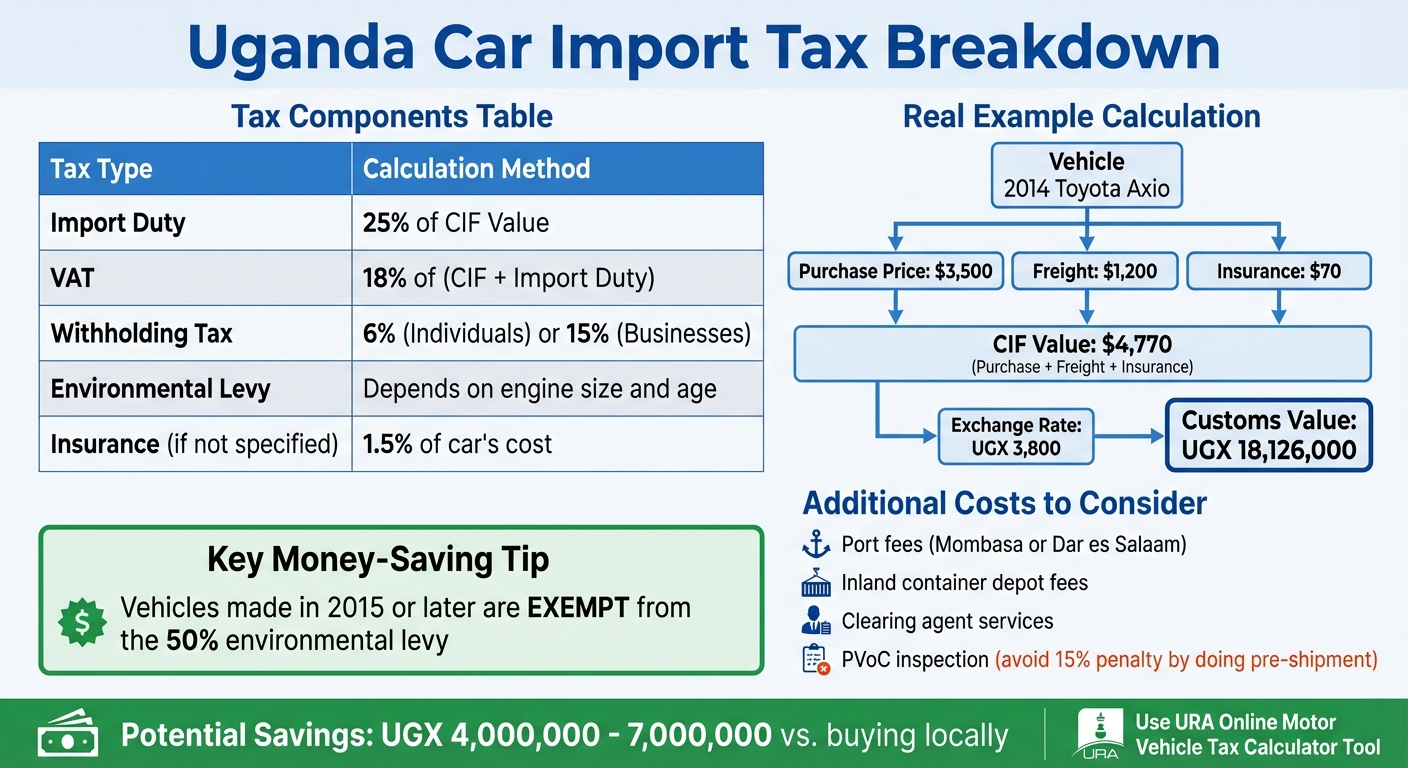
Uganda’s tax system for vehicle imports involves several components, all based on the CIF value. The Uganda Revenue Authority (URA) calculates these as follows:
| Tax Component | Rate / Basis |
|---|---|
| Import Duty | 25% of CIF Value |
| VAT | 18% of (CIF + Import Duty) |
| Withholding Tax | 6% (Individuals) or 15% (Businesses) |
| Environmental Levy | Depends on engine size and age |
The URA uses a benchmark valuation database to determine the vehicle’s value. If the price on your purchase invoice is lower than their benchmark, taxes will be calculated using the higher benchmark value.
For example, consider a 2014 Toyota Axio purchased for $3,500, with $1,200 in freight costs and $70 for insurance. This gives it a CIF value of $4,770. Using an exchange rate of UGX 3,800, the customs value comes to UGX 18,126,000. All taxes are calculated from this value. Keep in mind that the URA sets a fixed monthly exchange rate for tax purposes, which is often higher than the standard market rate.
To simplify the process, the URA offers an online Motor Vehicle Tax Calculator. By entering details like the vehicle’s year of manufacture (up to 2026), condition (new or used), and type, you can get a detailed tax breakdown. This tool is an excellent way to avoid surprises and ensure your budget aligns with the expected fees.
Avoiding Extra Costs
Taxes aren’t the only expenses you’ll face. Additional charges like port fees at Mombasa or Dar es Salaam, inland container depot fees, and clearing agent services can quickly add up. To avoid delays and extra costs, ensure the vehicle undergoes the mandatory PVoC inspection in South Korea before shipment.
Insurance is another factor to consider. If no specific insurance fee is provided, the URA applies a standard rate of 1.5% of the car’s cost. To avoid disputes during customs clearance, always request itemized quotes from your exporter. These should clearly separate the FOB (Free On Board) price, freight, and insurance, ensuring the CIF value is accurate and transparent.
Step 4: Select Shipping Methods and Ports to Reduce Costs
The shipping method and port you choose can have a big impact on your overall import expenses. For Uganda, a landlocked country, vehicles are shipped to either Mombasa (Kenya) or Dar es Salaam (Tanzania), and then transported inland.
RoRo vs. Container Shipping: Cost and Security Comparison
Roll-on/Roll-off (RoRo) is the cheaper option if you’re shipping a standard, operable vehicle. Vehicles are driven directly onto the ship and off at the destination. However, this method leaves the car exposed to elements and limits your ability to include extra items in the shipment.
Container shipping, on the other hand, places your vehicle in a secure, enclosed container – either 20-foot or 40-foot. This option is better for protecting against weather, theft, and salt damage, making it ideal for high-value or vintage vehicles. It also allows you to ship additional items, like spare parts, but comes with a higher price tag.
Once you’ve decided on a shipping method, the next step is choosing the most suitable port.
Mombasa vs. Dar es Salaam: Which Port to Use
After selecting a shipping method, you’ll need to evaluate which port best meets your needs.
- Mombasa: This port handles about 75% of Uganda’s vehicle imports and is often the preferred choice. It offers faster transit times, frequent sailings, and better road infrastructure along the Northern Corridor. The overland distance from Mombasa to Kampala is about 1,200 km (745 miles), typically taking 2–3 days. Customs clearance generally takes 3–5 working days. Costs for shipping through Mombasa range between $1,350 and $2,050, which includes:
- Ocean freight: $800–$1,200
- Port handling: $150–$250
- Road transport: $400–$600.
- Dar es Salaam: This port is a solid alternative, especially during peak seasons (December–February and June–August) when Mombasa can experience congestion. The overall transit time via Dar es Salaam is longer – around 22–26 days. The overland journey spans 1,450 km (900 miles), taking 3–4 days, with customs clearance requiring 4–6 working days. Shipping costs range from $1,430 to $2,080, broken down as:
- Ocean freight: $750–$1,100
- Port handling: $180–$280
- Road transport: $500–$700.
While ocean freight via Dar es Salaam may sometimes be slightly cheaper, the higher inland transport costs usually cancel out this advantage.
For faster and more reliable shipping, Mombasa is often the better option. However, during peak seasons or when competitive rates are available, Dar es Salaam could be worth considering. Keep in mind that heavy rains from March to May and October to November can impact road conditions, making Mombasa the more dependable route during those months.
Step 5: Use Money-Saving Strategies to Get Better Deals
After deciding on your shipping method and port, the next step is finding ways to save money without sacrificing quality. Building on the choices you made in Step 4, here are some practical strategies to help you lower costs even further. Let’s dive into how bundling shipments and timing your purchases wisely can make a big difference.
Bulk Shipping vs. Single Vehicle Shipping
Shipping multiple vehicles together can cut costs significantly compared to importing just one car at a time. For example, using a shared 40-foot container for several vehicles allows you to split freight costs, reduce administrative fees by working with one clearing agent, and negotiate better deals, such as extended warranties or favorable return policies. Plus, you can include spare parts or accessories in the same shipment without adding extra freight charges.
Bulk shipping also simplifies the process. Clearing multiple vehicles at once is typically quicker, which can lower port storage fees and help you avoid penalties. If you’re importing high-value vehicles for resale in Uganda, this method also offers added security for your investment.
How to Use Seasonal Discounts and Negotiate Prices
Timing your purchase strategically is another way to save big. By purchasing during the right season, you can reduce vehicle costs by 10% to 20%. For instance, March through April is an ideal time because South Korean businesses close their financial year and often sell older inventory at discounted rates. During this period, auction volumes can reach the low 40,000s daily, increasing supply and reducing competition. Additionally, many owners sell vehicles before May tax deadlines, further boosting inventory.
On the flip side, avoid buying or shipping during major holidays like Golden Week (late April to early May), O-bon (mid-August), and the New Year period (late December to early January). During these times, auctions, shipping companies, and customs agents often shut down or operate with limited staff, which can delay your shipment and increase costs.
When negotiating with exporters, always confirm whether quotes are FOB (Free on Board) or CIF (Cost, Insurance, and Freight). Sometimes, paying a slightly higher all-inclusive price is better than choosing a low base price with hidden fees. Start negotiations below your target price, using vehicle condition data and comparable prices to back up your offer. If the exporter won’t lower the price, ask for extras like minor repairs, detailing, faster processing, or priority loading instead.
Timing matters here, too. Exporters are often more willing to negotiate at the end of the month or quarter when they’re trying to meet sales goals. Keep in mind that South Korean business culture values respect and patience over aggressive bargaining. A polite and measured approach will go a long way in securing the best deal while complementing your earlier efforts to optimize shipping and port strategies.
Summary
Bringing a car from South Korea to Uganda can be a rewarding process if done with the right approach. By partnering with reliable exporters who provide complete documentation and the essential Pre-Export Verification of Conformity (PVoC) certification, you not only safeguard against fraud but also ensure the vehicle complies with Uganda’s strict import standards. Careful planning at every step is key to avoiding unnecessary delays and extra costs.
Understanding Uganda’s import regulations is equally important. Make sure to verify all required documentation and calculate the full cost of importing your car. This includes the 25% import duty, 18% VAT, and any other applicable fees. Keep in mind that vehicles made in 2015 or later are exempt from the 50% environmental levy. To avoid incurring port storage fees, begin the registration process with the Uganda Revenue Authority (URA) as soon as your documents are available.
The financial upside is clear: importing directly can save you between UGX 4 million and UGX 7 million compared to purchasing locally from a bond. By combining trusted exporters, regulatory adherence, and smart strategies – such as buying during low-demand periods and negotiating well – you can successfully import a high-quality car while keeping costs low. Follow these steps carefully to ensure a seamless and cost-effective import experience.
FAQs
How long does the full import process take?
The entire process of bringing a car from South Korea to Uganda, including shipping, clearing customs, and registering the vehicle, generally takes around 2 to 3 months. Shipping itself usually lasts about 25 to 28 days, depending on the chosen route. In total, the process typically takes between 56 and 62 days, though this timeframe can shift slightly depending on specific factors.
What extra fees should I budget for beyond URA taxes?
In addition to URA taxes, you’ll need to plan for registration fees, which depend on the type of vehicle, and mandatory insurance, a requirement for all imported cars. There may also be inspection fees to cover the roadworthiness certification needed before registration. Partnering with a licensed customs or clearing agent can simplify the process, ensuring all expenses are accounted for and compliance with local regulations is maintained.
How can I avoid scams when paying a South Korean exporter?
To steer clear of scams, it’s best to deal with verified exporters who hold proper licenses and have a history of positive reviews. Take the time to compare at least three quotes – this can help you identify unusually low offers that might be fraudulent. Always use secure payment methods that include buyer protection, and steer clear of untraceable options like wire transfers.
Before making any payment, double-check the exporter’s credentials and thoroughly review the terms of the deal. For extra security, consider using trusted platforms or escrow services. These services can hold your funds safely until the car is shipped, giving you added peace of mind.
Related Blog Posts
- How to Import a Car to Uganda: Complete Guide 2025
- How to register a used car in Uganda
- Importing a car to Uganda: taxes explained
- What You Need to Know Before Buying a Car in Uganda