
To import a car from the UK to Kampala, Uganda, you’ll need to follow a detailed process while navigating taxes, regulations, and logistics. Here’s a quick breakdown:
- Why Import from the UK? Cars from the UK are right-hand drive (required in Uganda), often cheaper, and come with reliable documentation like service histories and V5 logbooks. For instance, a 2010 Toyota Rumion can cost UGX 5 million less when imported directly instead of buying locally.
- Key Steps:
- Choose a Car: Must be less than 15 years old and right-hand drive. Check for VAT-qualifying vehicles to save costs.
- Prepare for Export: Gather documents like the V5 logbook, CIF invoice, and Bill of Lading. Pre-shipment inspections are no longer required as of late 2024; inspections now happen locally.
- Shipping: Decide between RoRo (cheaper) or container shipping (more secure). Shipping to Mombasa takes 25–40 days.
- Customs Clearance: Pay taxes (import duty, VAT, excise duty) based on the CIF value. Hire a trusted clearing agent to handle the process.
- Transport to Kampala: Use professional transporters for safety, especially for high-value vehicles.
- Register in Uganda: Complete registration with the Uganda Revenue Authority (URA), pay fees, and secure road permits and insurance.
- Costs to Expect:
- Shipping: $795–$1,400 (RoRo) or $1,560–$1,950 (container).
- Customs and transport: $2,500–$3,500.
- Taxes: Import duty (25%), excise duty (20%), VAT (16%), and other fees.
- Common Mistakes to Avoid:
- Importing cars older than 15 years or left-hand drive vehicles.
- Overlooking hidden costs like environmental levies or inspection fees.
- Falling for scams – always verify sellers and use secure payment methods.
Importing a car takes 56–62 days on average and requires careful planning to avoid costly errors. Hiring reliable agents and double-checking all regulations can make the process smoother.
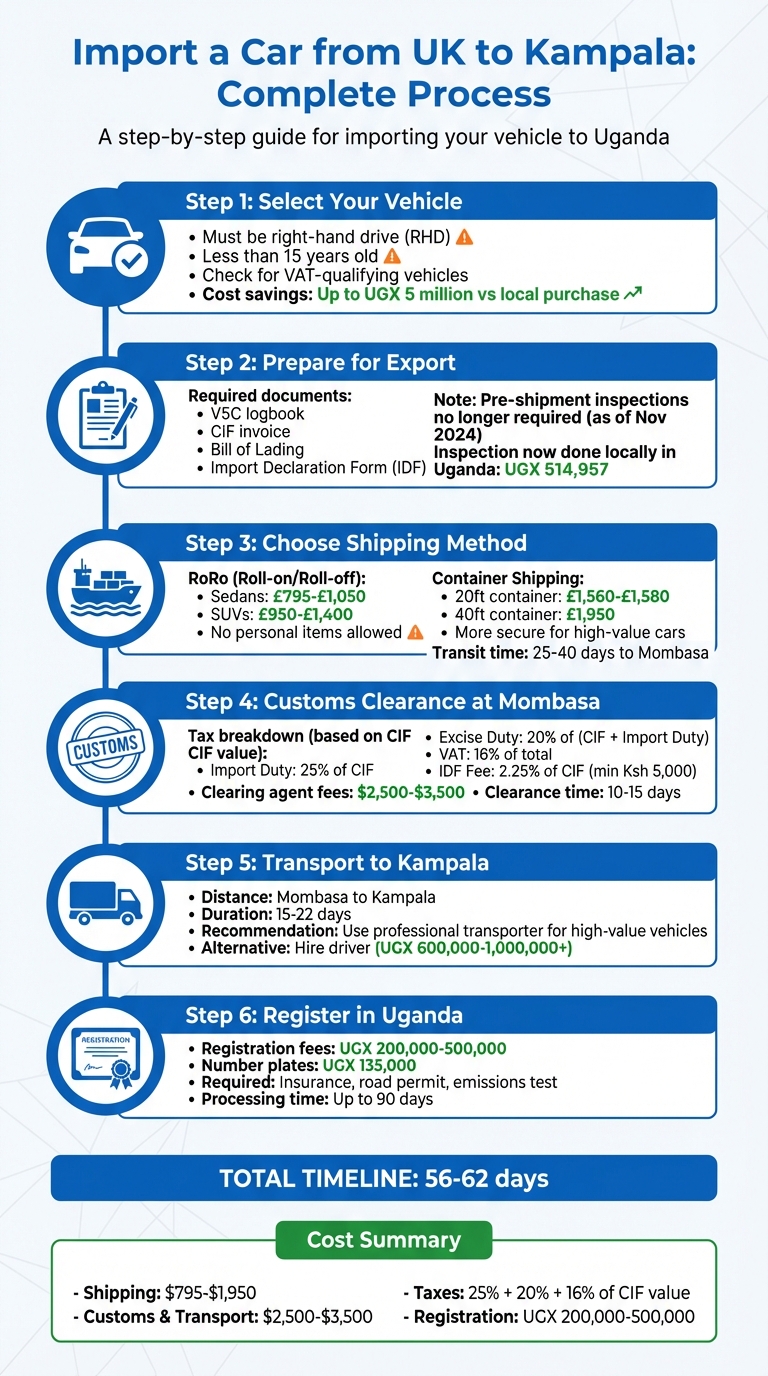
How to Import a Car from UK to Kampala: 6-Step Process with Costs and Timeline
Step 1: Selecting a Vehicle That Meets Uganda’s Requirements
Know Uganda’s Import Rules
Uganda has specific regulations for vehicle imports. First, all imported cars must be right-hand drive (RHD) – left-hand drive vehicles are not allowed unless they serve specialized purposes, like ambulances. Additionally, vehicles older than 15 years from their first registration date are not permitted, as customs enforces a strict 15-year age limit. Imported vehicles also need to meet the Uganda Standard KS 1515:2000, which outlines safety, emissions, and roadworthiness criteria.
Before shipping, the vehicle must pass a pre-export roadworthiness inspection conducted by an approved organization, such as the Uganda National Bureau of Standards (UNBS) or Quality Inspection Services Japan (QISJ). This inspection costs $230 at the inspection site or $250 if the inspector travels. Skipping this step could lead to rejection at the port, resulting in extra costs and delays. By carefully selecting a compliant vehicle, you can avoid unnecessary risks and expenses.
Research Vehicle Models and Prices
After familiarizing yourself with Uganda’s rules, compare vehicle models while keeping costs in mind. Remember, the total cost goes beyond the purchase price. You’ll need to account for shipping fees – around $795 for a saloon car or $950 for an SUV from the UK to Mombasa – plus taxes. Import duty is 25% of the CIF (Cost, Insurance, and Freight) value, excise duty adds 20% of CIF plus duty, and VAT is 16% of the total. Vehicles older than 8 years are also subject to an additional Environmental Levy.
To save on costs, look for "VAT qualifying" cars in the UK. These allow exporters to reclaim the UK’s 20% VAT, which reduces the purchase price. Use the Uganda Revenue Authority (URA) online portal to estimate your total tax liability before finalizing your decision. Also, consider fuel efficiency and maintenance costs, as repair expenses and parts availability vary depending on the model.
Check Vehicle Condition and History
To avoid surprises, always request a detailed vehicle history report. This ensures the car hasn’t been stolen, written off in a major accident, or tied to any outstanding loans. In the UK, an HPI check can provide this information. The original V5C logbook confirms legal ownership and technical details, while the MOT certificate history helps verify mileage and highlights any recurring mechanical problems.
"All used vehicles imported into Uganda shall be inspected for Road Worthiness, safety and other requirements." – Car Exporters UK
Make sure the inspection agency compares the odometer reading with registration documents to detect tampering. If you’re buying remotely, investing in a pre-purchase inspection can help you avoid costly issues once the car arrives in Kampala. For secure payments, use escrow services or direct bank transfers.
Once the vehicle’s compliance and condition are confirmed, you’re ready to move forward with the export process confidently.
sbb-itb-7bab64a
Step 2: Getting the Car Ready for Export from the UK
Schedule the Required Pre-Shipment Inspection
Here’s an important update: As of November 22, 2024, the Uganda National Bureau of Standards (UNBS) no longer requires pre-shipment roadworthiness inspections in source countries like the UK. Instead, all imported used vehicles are inspected after they arrive in Uganda. The local inspection fee for this process is UGX 514,957 (about £140).
"This change will help improve the standards of vehicles entering Uganda’s market. The new system aims to ensure more thorough local oversight of vehicle quality." – James Kakooza, Executive Director, UNBS
That said, some exporters and clearing agents may still refer to the older Pre-Export Verification of Conformity (PVoC) program. To avoid unnecessary costs, double-check with your clearing agent whether any pre-export certification is still required. Since inspections now happen locally, plan for extra time once the vehicle reaches Uganda, as this step will take place after shipping rather than before.
Once the inspection requirements are clear, the next step is gathering all the necessary export documents.
Collect All Required Documents
To export a car from the UK, you’ll need to assemble several key documents:
- Original V5C logbook: This document, issued by the UK’s Driver and Vehicle Licensing Agency (DVLA), serves as proof of ownership and contains the vehicle’s history.
- CIF invoice: The Cost, Insurance, and Freight (CIF) invoice is crucial for Ugandan customs to determine import duties and taxes. Request this from your seller or exporter, ensuring it reflects the vehicle’s purchase price, shipping costs, and insurance.
- Bill of Lading (BOL): Provided by the shipping line, this document confirms the contract of carriage and acts as a receipt for the shipped goods.
- Import Declaration Form (IDF): This form is issued by the Uganda Revenue Authority (URA). Your clearing agent can assist with obtaining it. The IDF fee amounts to 2.25% of the CIF value, with a minimum charge of approximately Ksh 5,000. Be sure to apply for the IDF before the vehicle arrives at the port to avoid delays.
Keep both digital and physical copies of these documents, as they’ll be needed at various stages of customs clearance and vehicle registration.
Step 3: Shipping Your Vehicle to Uganda
Pick Between RoRo and Container Shipping
When shipping your vehicle to Uganda, you’ll need to decide between RoRo (Roll-on/Roll-off) and container shipping. Each option has its own perks based on your vehicle type and budget.
RoRo is the go-to method for many importing used cars. It involves driving your vehicle directly onto the ship, where it’s secured for the journey. Costs typically range from £795–£1,050 for sedans and £950–£1,400 for SUVs and 4x4s. However, there’s a catch – you can’t store any personal belongings in the car; it must be completely empty.
"RoRo is short for ‘Roll on Roll off’ and is the simplest, cheapest, and most popular method of shipping." – Car Exporters UK
Container shipping, on the other hand, offers more security and flexibility but comes at a higher price. A 20-foot container, which fits one car, costs around £1,560–£1,580, while a 40-foot container, capable of holding two cars, is priced at approximately £1,950. This method keeps your vehicle locked inside a steel container, protecting it from weather and sea air. Plus, you can ship additional items like spare parts or household goods along with your car.
"Container shipping… is a popular choice for high value cars as it is the most secure." – MHH International
If you’re looking for a cost-effective solution for a standard vehicle, RoRo is your best bet. For luxury or high-value cars – or if you need to ship extra items – container shipping is the better choice.
Understand the Route and Timeline
Once you’ve chosen your shipping method, your vehicle will depart from UK ports such as Southampton, Tilbury, or Sheerness and head to Mombasa Port in Kenya. From there, it will be transported overland to Kampala. The entire process – from UK collection to final delivery in Kampala – takes about 56–62 days.
Here’s a breakdown of the timeline:
- 1–8 days: Vehicle collection and delivery to the UK port
- 4–5 days: Loading and ship departure
- 25–40 days: Sea transit to Mombasa
- 10–15 days: Clearance at Mombasa Port
- 7–10 days: Overland transport to Kampala and registration
For the Mombasa-to-Kampala leg, you can either hire a driver (a cheaper but riskier option) or use a professional car transporter, which is strongly recommended for luxury or high-value vehicles. If you’re shipping via RoRo, make sure your vehicle’s battery is fully charged before it reaches the UK port – cars need to be driven on and off the ship during the journey.
Lastly, consider the cost of professional clearing services, which typically range from $2,500–$3,500. These fees include Mombasa port charges and transport to Kampala, so be sure to account for this in your budget. Next up: clearing customs and getting your vehicle on the road in Kampala.
Step 4: Clearing Customs and Moving the Car to Kampala
Calculate and Pay Import Duties and Taxes
When your car arrives at Mombasa Port, the first step is to calculate and pay the required import duties and taxes. These are based on the CIF value, which includes the car’s purchase price, marine insurance, and shipping costs. Here’s how the charges are calculated:
- Import Duty: 25% of the CIF value
- Excise Duty: 20% of the combined CIF value and Import Duty
- VAT: 16% of the total of CIF value, Import Duty, and Excise Duty
- Import Declaration Fee (IDF): 2.25% of the CIF invoice, with a minimum of Ksh. 5,000
| Tax Component | Rate / Calculation |
|---|---|
| Import Duty | 25% of CIF value |
| Excise Duty | 20% of (CIF + Import Duty) |
| VAT | 16% of (CIF + Import Duty + Excise Duty) |
| IDF Fee | 2.25% of CIF (Min Ksh. 5,000) |
Payments should be made directly to the Uganda Revenue Authority (URA) via their official website (www.ura.go.ug). Your clearing agent will confirm the calculations and provide a secure payment link. It’s crucial to ensure payments go directly to URA and not to the agent themselves.
Hire a Clearing Agent at Mombasa Port
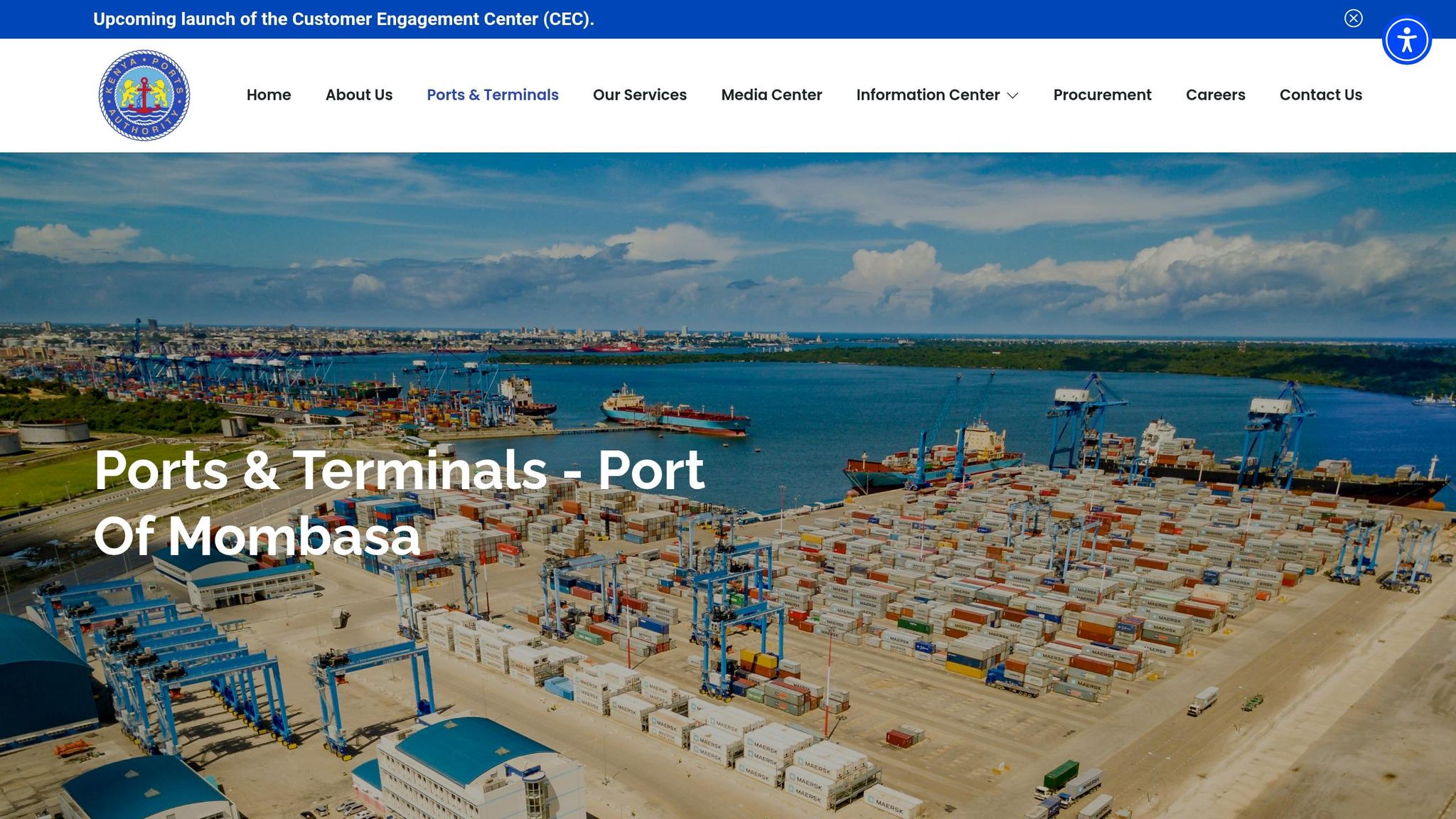
Customs clearance can be complex, so hiring a professional clearing agent is essential. They will handle the customs entry process using the Simba 2005 system, verify the duty calculations, and manage port charges. Trusted agents like Upstream or Mitchell Cotts are familiar with URA procedures and can streamline the process.
To proceed, you’ll need to provide the agent with these documents:
- Original CIF invoice
- Original Bill of Lading
- Import Declaration Form (IDF) issued by Ugandan Customs
- Original UK logbook
Additionally, the agent will confirm that your vehicle complies with Ugandan import regulations, including the requirement that it must be less than 15 years old from the date of registration.
"Our clearing agent will set up the customs clearance on your behalf and check the calculation for you. Once they are happy, they send the link to you for payment for you to make directly to URA." – Alistair Benn, MHH International
The cost for professional clearing services, including port charges and transport to Kampala, generally ranges between $2,500 and $3,500. Once customs clearance is complete, the next step is arranging overland transport to Kampala.
Arrange Transport from Mombasa to Kampala
After clearing customs, your car will be transported to a bonded warehouse in Kampala. This journey typically takes 15 to 22 days. For high-value or luxury vehicles, shipping containers are recommended to ensure security and prevent damage during transit.
"We are very careful not to have our cars driven by a hired driver." – MHH International
Using a professional car transporter guarantees secure handling throughout the trip. Once the vehicle reaches the Kampala Bond, you can proceed with the final stages of registration and inspection.
Step 5: Registering Your Vehicle in Uganda
Register the Vehicle
Once your car has cleared customs and reached Kampala, it’s time to handle the final legal requirements. At the Kampala Bond, you’ll need to complete the Uganda Revenue Authority (URA) registration using their online customs management system. Make sure you have all the necessary documents, including the Bill of Lading (BOL), Import Declaration Form (IDF), Certificate of Conformity (COC), purchase invoice, original UK logbook or export certificate, passport, and your URA Tax Identification Number (TIN) card.
You’ll also need to fill out and submit several forms, such as the Allocation of Registration Number of New Vehicle Form, Auto Vehicle License Form, and Form B. A police officer will physically inspect your vehicle to confirm it hasn’t been stolen and meets all legal standards. The officer will then sign the allocation form. Registration fees depend on your vehicle’s engine capacity and type, ranging from UGX 200,000 to UGX 500,000 (about $53 to $133). Standard number plates cost an additional UGX 135,000 (around $36). If you want personalized plates, you’ll need to complete a special request form and pay extra fees at designated banks.
Keep in mind, the registration process can take up to 90 days in some cases, so plan ahead. Before you finalize registration, double-check that the chassis number on the vehicle matches all the provided documentation. Any discrepancies could lead to delays or even seizure of the vehicle. After completing registration, you’ll need to secure road permits and insurance to legally drive in Uganda.
Get Road Permits and Insurance
Registering your vehicle doesn’t automatically make it road-legal. To drive on Ugandan roads, you’ll need vehicle insurance and a road permit from the Transport Licensing Board. Since the insurance certificate is required for the final registration step, it’s best to arrange this as soon as your car clears customs.
Additionally, your vehicle must pass an inspection that includes emission testing. Uganda is now aligning with Euro 4 emissions standards for imported vehicles. Before hitting the road, take care of basic maintenance tasks like changing all fluids (oil, coolant, and transmission), inspecting tire conditions, and replacing the battery if needed. Once you’ve secured insurance, obtained your road permit, and have a clean inspection report, your vehicle is officially ready to drive in Uganda.
How to Import a Car to Uganda
Common Mistakes and How to Avoid Them
Navigating the import process can be tricky, and being aware of common pitfalls can save you from costly mistakes. From choosing the right vehicle to managing costs and avoiding fraud, here’s what you need to know.
Buying Vehicles That Don’t Meet Requirements
One of the biggest errors buyers make is purchasing cars that don’t meet Uganda’s regulations. For instance, Uganda prohibits vehicles older than 15 years (calculated from the manufacture date, not the registration date). Many people mistakenly check only the registration year, which can result in their car being seized at customs. As Jeff from Ttunda Classifieds warns:
"As a rule, avoid cars older than 15 years… if you purchase such a car, it will be held at customs without you being able to get it plus your money that you invested".
Another frequent mistake is purchasing left-hand drive vehicles. Uganda only permits right-hand drive (RHD) cars, except for rare cases involving special-purpose vehicles. Always check the manufacture date on the vehicle identification plate and confirm the car is RHD.
Before shipping, ensure you obtain a Pre-Export Verification of Conformity (PVoC) inspection certificate from UNBS or QISJ. This inspection, which costs around £230 at the provider’s site or £250 at your chosen location, is mandatory. Skipping this step can lead to major delays or clearance issues at the port.
Unexpected Costs and Wrong Calculations
Another common mistake is underestimating the total cost of importing. Many buyers focus solely on the purchase price, forgetting to account for taxes, port charges, and other fees. Taxes are calculated based on the CIF (Cost, Insurance, and Freight) value, so using the URA online calculator can help you get an accurate estimate .
On top of that, budget an extra $2,500–$3,500 for port charges, transport, and other fees. Registration and IDF fees add smaller amounts, but vehicles manufactured in 2014 or earlier are subject to an environmental levy of 50% of the car’s price, including shipping . If you’re importing without a middleman, you might save UGX 4 million to UGX 7 million, but be prepared to handle the process yourself.
Careful calculations and planning ahead can help you avoid unpleasant financial surprises.
Avoiding Scams and Unreliable Agents
Fraud is a real risk in the import process, so it’s crucial to work with reputable exporters and clearing agents. David Okech from Automag Uganda advises:
"Work with registered and well-reviewed car exporters. Avoid deals that sound too good to be true".
Before committing to a purchase, verify the vehicle’s history using its chassis number . Use secure payment methods like escrow services or direct bank transfers to protect your money – steer clear of untraceable options. To ensure the car’s condition matches the seller’s claims, hire an independent mechanic to review inspection sheets and photos, rather than relying solely on dealer-provided images.
If you’re hiring a driver to transport the car from Mombasa to Kampala (a service that typically costs UGX 600,000 to UGX 1,000,000+), choose someone with verified referrals. Regularly track your vehicle’s shipping progress to avoid demurrage fines or falling victim to cargo scams. Additionally, start the URA registration process as soon as you receive the original documents via a reliable courier, rather than waiting for the vehicle to arrive at the port.
Taking these precautions can help protect your investment and ensure a smoother import experience.
Conclusion: Completing Your Import Successfully
Bringing a car from the UK to Kampala involves careful planning and strict adherence to regulations. From selecting a right-hand drive (RHD) vehicle that’s less than 15 years old to arranging mandatory inspections, every step requires close attention to detail. Skipping any part of the process or missing documentation can lead to costly delays – or worse, outright rejection.
To avoid issues, make sure you calculate taxes accurately using the URA online portal. Hiring a trustworthy clearing agent is equally important, as they’ll help ensure all paperwork is in order. Import duties, VAT, excise duties, and environmental levies can add up quickly, so it’s wise to budget an extra $2,500–$3,500 to cover port charges and transport expenses.
To steer clear of common mistakes, double-check vehicle details, use secure payment methods, and work with reliable agents. Proper documentation and timely registration with the URA are essential to avoid unnecessary delays and extra costs.
For more updates on automotive trends and regulations in Uganda, check out AutoMag.ug.
FAQs
What’s the real total cost to land a UK car in Kampala?
When importing a car, the total cost goes beyond just the car’s CIF value (Cost, Insurance, and Freight). You’ll need to factor in several taxes and fees, including 15% import duty, 17% VAT, 2% import commission, and 6% withholding tax. On top of that, additional expenses like shipping, insurance, and registration can pile up, making the overall cost much higher. It’s crucial to consider all these elements when planning your budget for the import process.
Which documents are most likely to delay customs clearance?
Delays in customs clearance frequently happen when key original documents, like the logbook or bill of lading, are missing. These are crucial for verification purposes. Problems also arise from incomplete or incorrect paperwork, such as the vehicle invoice, Certificate of Conformity (COC), or inspection certificates like JEVIC. To prevent setbacks, double-check that all documents are complete, accurate, and include the required originals.
How do I verify a UK seller and avoid import scams?
To ensure you’re dealing with a trustworthy UK seller and to avoid potential scams, start by checking their reputation and customer reviews, especially if they operate as a dealer or broker. Always request essential documents such as the vehicle logbook, bill of lading, and inspection certificates. Verify that the seller provides a valid inspection certificate, such as a JEVIC certificate, to confirm the vehicle’s condition. It’s also wise to work with established agents and opt for secure payment methods or escrow services to safeguard your transactions against fraud.
Related Blog Posts
- How to Import a Car to Uganda: Complete Guide 2025
- How to register a used car in Uganda
- Importing a car to Uganda: taxes explained
- What You Need to Know Before Buying a Car in Uganda