Uganda is not an easy country to own a car in — and that is said with great affection. Between Kampala’s relentless stop-start traffic, the red-dirt murram roads stretching across rural districts, the equatorial heat and humidity, the sudden downpours that turn tracks into rivers, and the occasional pothole that seems to have been designed by someone who genuinely dislikes vehicles, Uganda puts cars through a level of daily punishment that most manufacturers never test for.
The result is predictable: vehicles that are not properly maintained deteriorate faster here than they would in the temperate, smooth-road conditions of Japan or Europe where many of them were built. The good news is that Uganda also has a strong culture of practical mechanical knowledge, and a well-maintained car — even a high-mileage imported second-hand vehicle — can serve its owner reliably for many years if given the right attention at the right intervals.
This guide is your complete, Uganda-specific car maintenance checklist. It covers everything you need to keep your vehicle running well: from weekly checks you can do in your driveway to annual inspections that require a qualified mechanic. Whether you drive a Toyota Corolla through Kampala every day, a Land Cruiser on Uganda’s rougher roads, or a pickup on a farm in western Uganda, this checklist applies to you.
For the latest car care guides, maintenance advice, and driving tips tailored specifically for Ugandan roads, visit AutoMag.ug — your go-to resource for everything automotive in Uganda.
1. Understanding Uganda’s Unique Challenges for Your Car
Before diving into the checklist, it helps to understand why Uganda specifically demands more from your vehicle — and therefore more from your maintenance routine. Uganda’s conditions attack vehicles from multiple directions simultaneously.
Heat and Humidity
Uganda sits on the equator. Daytime temperatures in Kampala and low-altitude areas regularly reach 28–34°C, and in the Rift Valley floor areas they can exceed 38°C. This sustained heat accelerates the degradation of rubber components — hoses, seals, belts, and tyres all deteriorate faster in tropical heat than in cooler climates. Engine cooling systems work harder. Coolant degradation is faster. Fluid evaporation is more significant.
Humidity compounds the problem. Uganda’s Lake Victoria basin and forested areas experience high humidity year-round. Humidity accelerates corrosion of metal components, particularly in wheel arches, underbody panels, brake components, and electrical connectors. Vehicles that were rust-free in Japan can develop surface rust within a year of operating in Uganda’s humid conditions if underbody protection is neglected.
Dust
Outside Uganda’s major towns, dust is a constant reality. Murram roads in dry conditions produce thick clouds of fine red laterite dust that penetrates air filters, settles in brake systems, coats electrical connections, and works its way into every crevice of a vehicle’s interior and exterior. Dust-related air filter clogging is one of the most common causes of reduced engine performance in Uganda — and one of the most easily prevented.
Road Conditions
Uganda’s road quality spans a vast range. The new expressways and major highways are excellent by any standard. Secondary tarmac roads are generally adequate. But rural and district roads — which millions of Ugandan vehicle owners use regularly — can be severely potholed, deeply rutted in wet season, and rocky in highland areas. These conditions destroy suspension components, tyres, wheels, and underbody protection at a rate that would shock drivers accustomed only to smooth roads.
Stop-Start Urban Traffic
Kampala’s traffic is legendary. The city’s combination of high vehicle density, inadequate road capacity, and unpredictable driving patterns means that many urban drivers spend large portions of their driving time in slow-moving or stationary traffic. This stop-start pattern is particularly hard on automatic transmissions, cooling systems, clutches (manual vehicles), and brakes. It also reduces fuel efficiency significantly compared to highway driving.
| The Core Principle of Uganda Car Maintenance: Uganda’s conditions shorten the effective life of many vehicle components compared to manufacturers’ standard service intervals. What works as a 10,000 km oil change interval in Japan may need to be 7,500 km in Uganda’s dusty, hot conditions. Apply the principle: when in doubt, service earlier — not later. |
2. The Complete Uganda Car Maintenance Checklist
This checklist is organised by frequency — from checks you should do every week to those needed annually. Print it, save it on your phone, or share it with your mechanic. Consistent use of this list is the most straightforward path to a reliable, long-lasting vehicle in Uganda.
3. Weekly Checks: Five Minutes That Can Save You Thousands
These checks take less than five minutes in total and should become as automatic as checking your fuel gauge. Many breakdowns and costly repairs are caused by issues that were visible — and fixable — days or weeks before they became serious.
Engine Oil Level
Pop the bonnet and check the engine oil dipstick every week, especially if your vehicle has higher mileage. The dipstick has a MIN and MAX marker — the oil level should sit between the two, ideally closer to MAX. Low oil is the number one cause of avoidable engine damage in Uganda. If you are regularly topping up between services, this signals a leak or internal oil consumption that needs investigation.
What to look for beyond level: the oil’s colour and texture. Fresh oil is golden-amber. Healthy older oil is dark brown. Milky, creamy, or frothy oil indicates water contamination — likely a coolant leak into the engine, which is a serious problem requiring immediate attention. Gritty oil with metal particles signals internal engine wear.
Coolant Level
The coolant reservoir is typically a semi-transparent plastic tank near the radiator with MIN and MAX markings. Check the level weekly, particularly in Uganda’s heat. Never open the radiator cap when the engine is hot — the system is pressurised and hot coolant can cause severe burns. If coolant level drops consistently without visible leaks, this points to an internal leak that requires urgent diagnosis.
Brake Fluid Level
The brake fluid reservoir is usually a small translucent plastic container on the brake master cylinder under the bonnet. The level should sit between MIN and MAX. A gradual drop in brake fluid level over time is normal as brake pads wear down — pad wear causes pistons to extend further, which draws fluid from the reservoir. A sudden drop, however, indicates a leak in the brake system and requires immediate investigation before driving further.
Tyre Pressure and Visual Condition
Check tyre pressure weekly, preferably when the tyres are cold (before the vehicle has been driven). Uganda’s varying temperatures and road conditions cause pressure fluctuations. Under-inflated tyres wear unevenly, consume more fuel, handle poorly, and are far more susceptible to punctures on rocky or potholed roads. Over-inflated tyres reduce grip and ride comfort.
Standard pressure recommendations are found on the tyre placard inside the driver’s door jamb or in the owner’s manual. As a general guide, passenger cars typically run 28–35 PSI; SUVs and pickups 32–40 PSI depending on load and tyre size. While checking pressure, visually inspect the sidewalls for cuts, bulges, or embedded objects — all of these signal a tyre that needs immediate attention.
Windscreen Washer Fluid
This seems minor but becomes critical on Uganda’s dusty roads. A dirty windscreen that you cannot clean while driving is a genuine safety hazard. Keep the washer reservoir full — in dusty conditions it depletes faster than you expect. Use a proper washer fluid or clean water with a small amount of washing liquid. Do not use engine coolant, which contains chemicals that can damage the paint and windscreen.
Lights
Walk around the vehicle once a week and verify that all lights are functioning: headlights (both high and low beam), brake lights, indicators, reverse lights, and hazard lights. In Uganda, a non-functioning brake light is both a safety hazard and a traffic police violation. Replacing a bulb takes minutes and costs almost nothing compared to the consequences of being rear-ended.
4. Monthly Checks: Keeping Ahead of Uganda’s Conditions
Monthly checks go deeper than the weekly routine and catch developing issues before they become expensive failures. Many Ugandan drivers skip these — the ones who do them consistently spend significantly less on emergency repairs over time.
Air Filter Inspection
Uganda’s dusty roads make the air filter one of the most maintenance-intensive components on any vehicle. A clogged air filter restricts airflow to the engine, reducing power, increasing fuel consumption, and — in severe cases — allowing fine dust particles to bypass the filter and reach engine internals where they act as an abrasive.
Remove the air filter and inspect it monthly if you regularly drive on dusty murram roads. Hold it up to the light — if you cannot see light through it, it needs cleaning or replacement. Most paper air filters can be gently tapped to dislodge loose dust but should not be washed. Replace the filter every 15,000–20,000 km in normal conditions; every 10,000 km or sooner if you frequently drive on dusty roads.
Battery Terminals and Charge
Uganda’s heat and humidity are particularly hard on lead-acid batteries. Heat accelerates internal battery degradation, and humidity promotes corrosion on terminals. Monthly, check the battery terminals for white or blue-green corrosion — clean them with a terminal brush or a cloth dampened with a solution of baking soda and water. Ensure the terminal clamps are tight. A loose terminal is a common cause of intermittent starting problems that are frustrating to diagnose and trivial to prevent.
If your vehicle struggles to start in the morning, takes multiple cranks, or the dashboard lights dim noticeably when starting, these are signs of a weakening battery. Uganda’s heat means batteries often fail suddenly rather than giving the gradual warning signs seen in cooler climates — have it load-tested annually and replace proactively if it is over three years old.
Brake Pad Thickness
If your vehicle has alloy wheels with open spokes, you can often visually estimate brake pad thickness by looking through the wheel at the calliper. The pad material visible against the rotor should be at least 3–4mm thick. Less than 2mm is the replacement threshold. Kampala’s stop-start traffic and Uganda’s hilly terrain in areas like Kabale and Kisoro consume brake pads significantly faster than flat-road highway driving.
Listen for squealing when braking — most modern brake pads have a wear indicator that produces a high-pitched squeal when pads reach their wear limit. This squeal is not a failure; it is a designed warning. Grinding, however, means the pad material is gone and metal is contacting the rotor — this damages the rotor and is a safety emergency.
Windscreen and Wiper Blades
Wiper blades deteriorate quickly in Uganda’s UV-intense equatorial sun and should be inspected monthly. Streaking, squeaking, or lifting at speed indicates worn blades. Uganda’s heavy rainstorms make working wiper blades critically important — replacing blades every 6–12 months in tropical conditions is a reasonable standard. Also check for windscreen chips and cracks monthly; Uganda’s roads throw up stones regularly, and a small chip repaired early is far cheaper than a full windscreen replacement once a crack spreads.
Power Steering Fluid
If your vehicle has hydraulic power steering (most older vehicles do; newer ones have electric steering and no fluid to check), inspect the reservoir monthly. Low power steering fluid causes a whining noise when turning and eventually can damage the power steering pump — an expensive component to replace. Top up with the manufacturer-specified fluid only; mixing fluid types can damage seals.
Clutch (Manual Vehicles)
For manual transmission vehicles — still very common in Uganda — pay attention to clutch behaviour monthly. The biting point should be consistent from day to day. A biting point that has gradually moved lower or higher, a clutch that slips under load (engine revs increase without corresponding vehicle acceleration), or a clutch pedal that feels spongy or uncharacteristically heavy are all signs of developing clutch or hydraulic issues. Addressing these early avoids the significantly higher cost of a complete clutch replacement under emergency conditions.
5. Every 5,000 km: High-Mileage Uganda-Specific Intervals
Standard manufacturer service intervals are designed for temperate climates, smooth roads, and often relatively new vehicles. In Uganda’s heat, dust, and demanding road conditions, many experienced mechanics recommend shortening several key intervals. The 5,000 km check is particularly relevant for high-mileage vehicles, those driven regularly on murram roads, or vehicles used in heavy stop-start urban traffic.
Engine Oil Top-Up or Change Assessment
At every 5,000 km, check the oil level and assess its condition. If your vehicle is consuming oil between changes (level dropping significantly between checks), investigate the cause rather than simply topping up. Sustained oil consumption indicates worn piston rings, valve seals, or other internal issues that worsen over time. A full oil change at 5,000 km rather than 10,000 km is advisable for older vehicles (above 150,000 km) operating in Uganda’s conditions.
Wheel Rotation
Rotating wheels — moving front tyres to the rear and vice versa, following the pattern in your owner’s manual — equalises wear across all four tyres. Uganda’s roads cause uneven wear patterns, particularly on vehicles with worn suspension components that cause misalignment. Rotating every 5,000 km significantly extends tyre life and improves safety.
Underbody Visual Inspection
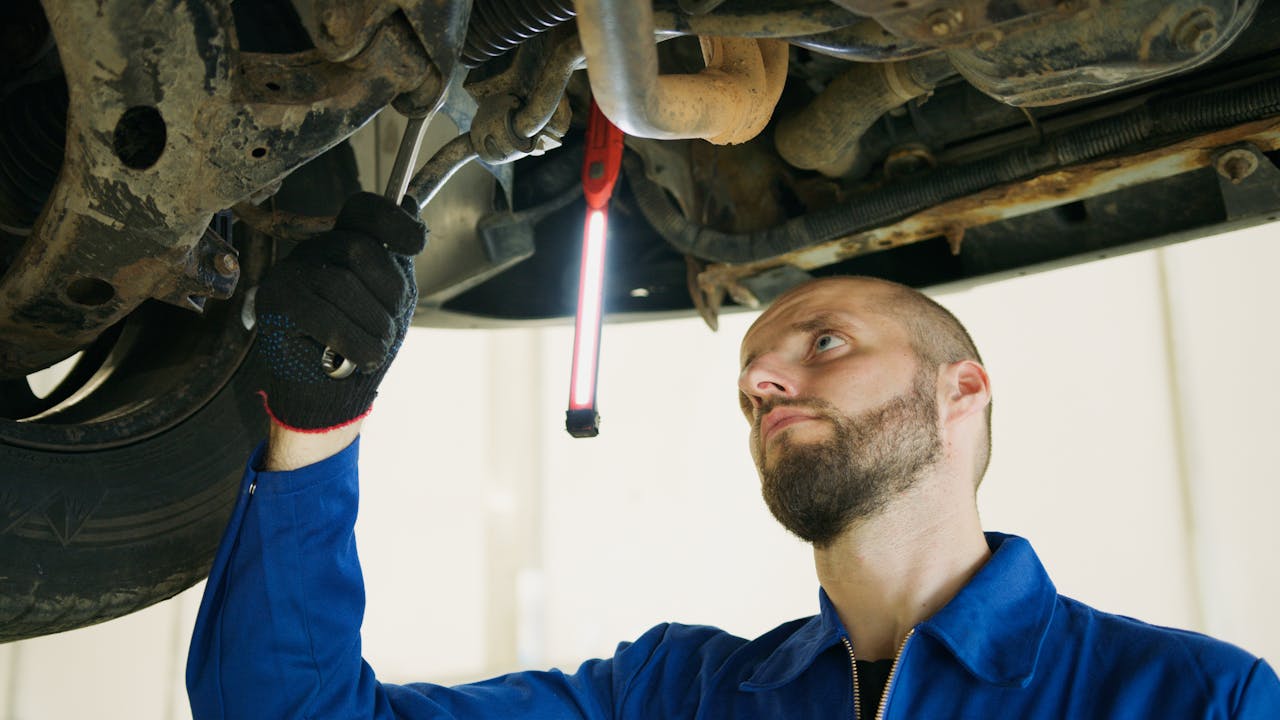
Every 5,000 km, have the vehicle put on a ramp or use a creeper to inspect the underbody. Look for: fluid leaks (oil, coolant, or brake fluid drips), damaged or loose exhaust components, rust formation on structural members or brake lines, and any suspension or steering components showing wear, cracks, or damage. Uganda’s potholes and off-road use frequently cause underbody damage that is invisible from above the vehicle.
6. Every 10,000 km: The Core Service Interval
The 10,000 km service is the foundation of Uganda vehicle maintenance. This is the service interval that most reputable Ugandan mechanics and manufacturer guidelines converge on for local conditions.
Engine Oil and Filter Change
This is non-negotiable. Engine oil breaks down over time and kilometres, losing its viscosity, detergent properties, and ability to protect engine components from metal-to-metal contact. In Uganda’s heat, oil degrades faster than in cooler climates. Use the viscosity grade specified for your vehicle — for most petrol and diesel engines operating in Uganda’s tropical climate, 10W-40 or 5W-30 are common specifications, but always check your owner’s manual.
The oil filter must be changed with every oil change — a new oil through a clogged old filter defeats the purpose. Use quality oil and filters: genuine Toyota, Bosch, Denso, or equivalent quality brands are worth the small premium over cheap unbranded alternatives. Poor-quality oil and filters are a false economy.
Air Filter Replacement or Cleaning
If the monthly inspection has not already prompted a replacement, the 10,000 km service is the latest you should go before at minimum cleaning and inspecting the air filter thoroughly. On dusty road routes, replace at this interval regardless of visual appearance — fine particles invisible to the eye can still clog the filter’s pores and reduce airflow.
Fuel Filter Inspection
Uganda’s fuel quality can vary, particularly outside major towns where fuel storage infrastructure may be less controlled. Sediment and water contamination in fuel are more common in Uganda than in developed markets. A clogged fuel filter causes hard starting, rough idling, hesitation under acceleration, and eventual engine stalling. Replace the fuel filter every 20,000–30,000 km or at first sign of symptoms; inspect for sediment build-up at each 10,000 km service.
Spark Plugs (Petrol Engines)
Standard copper spark plugs should be inspected at 10,000 km and replaced every 20,000–30,000 km. Iridium or platinum plugs last longer — up to 60,000–100,000 km — but still benefit from inspection. In Uganda’s conditions, dirty or worn plugs cause rough idling, increased fuel consumption, and difficult cold starting. When removing plugs, inspect the electrode condition and gap — burned or fouled plugs indicate running problems beyond just age.
Tyre Rotation and Pressure Reset
Confirm tyres are rotated and pressures are set correctly. If you have not been rotating at 5,000 km intervals, the 10,000 km service is the minimum rotation frequency. At this service, also check wheel balance — vibrations through the steering wheel or seat at highway speeds indicate wheel imbalance, which accelerates tyre wear and stresses wheel bearings.
7. Every 20,000 km: Deeper System Checks
Gearbox and Differential Oils
Manual gearbox oil, automatic transmission fluid (ATF), front and rear differential oils, and transfer case oil (on 4×4 vehicles) all require periodic changes. Uganda’s demanding conditions — particularly for 4×4 vehicles that regularly engage low range on rough terrain — accelerate the degradation of these fluids. Manual gearbox oil: change every 40,000–60,000 km. ATF: inspect at 20,000 km; change every 40,000–60,000 km (earlier if fluid is dark or burnt-smelling). Differential and transfer case oils: change every 40,000–60,000 km.
Brake Fluid Flush
Brake fluid is hygroscopic — it absorbs moisture from the atmosphere over time. As moisture content increases, the fluid’s boiling point drops. In Uganda’s hilly terrain (particularly around Kabale, Mbale, and the Rwenzori foothills), repeated heavy braking on descents can cause brake fluid to boil in extreme cases, resulting in sudden loss of braking power — a frightening and dangerous event called brake fade. Flush and replace brake fluid every two years or every 40,000 km, whichever comes first.
Power Steering Fluid Flush
Replace hydraulic power steering fluid every 40,000–60,000 km. Old power steering fluid darkens and loses its lubricating and protective properties, leading to accelerated wear of the power steering pump and rack. On vehicles where the power steering feels heavy or produces a persistent whine on full lock, a fluid flush often resolves the issue without the need for component replacement.
Coolant Flush and Refill
Engine coolant should be fully flushed and replaced every two years or every 40,000 km. Old coolant loses its anti-corrosion properties and becomes acidic, attacking aluminium engine components and causing corrosion in the cooling system. In Uganda’s heat, coolant is working at its limits — keeping it fresh and at the correct concentration (typically 50% coolant, 50% distilled water) protects the engine, radiator, and water pump effectively.
Suspension and Steering Inspection
Uganda’s potholes and rough roads are the leading cause of suspension-related failures. At every 20,000 km, have the full suspension system inspected by a qualified mechanic: ball joints, tie rod ends, shock absorbers, control arm bushings, and anti-roll bar links. Worn suspension components cause poor handling, uneven tyre wear, and — in the case of ball joint failure — sudden loss of vehicle control.
Signs to watch for between services: knocking sounds over bumps, the vehicle pulling to one side, steering wheel vibration, the car sitting unevenly (one corner lower than others), or tyres showing unusual wear patterns.
8. Every 40,000 km: Major System Services
Timing Belt Replacement
This is one of the most critical and most neglected maintenance items in Uganda. Many common engines in the Ugandan vehicle fleet — including the Toyota 2.4L GD-6 diesel, the 1ZZ, 1NZ-FE petrol engines, and others — have rubber timing belts that must be replaced at manufacturer-specified intervals (typically 60,000–100,000 km, but often shortened for Uganda’s conditions). Ignoring the timing belt is a gamble with catastrophic consequences: when a timing belt snaps, it causes immediate and severe engine damage, typically bending valves and destroying the engine in seconds.
Check your vehicle’s specific timing belt interval in the owner’s manual and treat it as an absolute deadline. If you do not know the vehicle’s service history (common with imported second-hand vehicles), replace the timing belt regardless of apparent condition — a belt that looks fine can still fail without warning. While the timing belt is being replaced, also replace the water pump, tensioner, and idler pulleys — these are driven by the same belt and replacing them at the same time costs relatively little extra versus the labour of replacing them separately later.
Spark Plugs (Full Replacement — Petrol Engines)
Standard copper spark plugs should be fully replaced at 40,000 km if not already done earlier. Even iridium plugs benefit from inspection at this interval. Misfiring, rough idle, or increased fuel consumption that has not responded to basic maintenance often resolves with a fresh set of plugs and leads (or coil checks on direct ignition systems).
Brake Callipers and Wheel Bearings
At 40,000 km, have brake callipers inspected for seized pistons — a common problem in Uganda’s humid conditions where callipers are exposed to both dust and moisture. A partially seized calliper causes uneven braking, accelerated pad and rotor wear on one side, and in severe cases brake dragging that causes premature overheating. Wheel bearings should also be checked for play and wear — a humming noise that changes pitch when you sway the steering wheel while driving at speed is a classic wheel bearing warning sign.
PCV Valve Cleaning or Replacement
The Positive Crankcase Ventilation (PCV) valve recirculates crankcase gases back into the intake for combustion. A blocked PCV valve causes oil leaks, increased oil consumption, rough idle, and in extreme cases, engine damage from pressurised crankcase gases. Cleaning or replacing the PCV valve at 40,000 km is a simple, inexpensive preventative measure.
9. Annual Inspections: Your Comprehensive Vehicle Health Review
Once a year — ideally at the start of either dry season when roads are more accessible — schedule a comprehensive vehicle inspection that covers systems not addressed in routine interval services.
Full Brake System Overhaul Assessment
Annually, have all brake components comprehensively assessed: pad and shoe thickness, rotor and drum thickness and surface condition, hydraulic line condition, calliper and wheel cylinder function, and parking brake cable tension. Uganda’s hilly terrain in many parts of the country places high demands on braking systems, and a comprehensive annual check catches developing issues before they become failures.
Exhaust System Inspection
Uganda’s rough roads and the corrosive environment created by humidity and dust attack exhaust components continuously. Annual inspection should cover the complete exhaust system from the manifold to the tailpipe: check for rust-through holes (often audible as a ticking or roaring noise), loose clamps or hangers, damage to the catalytic converter, and condition of the lambda sensor wiring. A holed exhaust is a safety issue — carbon monoxide can enter the cabin.
Air Conditioning Service
Uganda’s heat makes air conditioning not a luxury but a necessity for many drivers. Annual air conditioning service includes: checking refrigerant gas level and recharging if low, cleaning the cabin air filter (often overlooked but critical for air quality), inspecting drive belt condition, and checking compressor clutch engagement. A system that is low on refrigerant before service costs less to recharge than one that has been run on low charge for a full year, which can damage the compressor.
Wheel Alignment
Uganda’s roads knock wheel alignment out over time — it cannot be avoided. Annual wheel alignment (and more frequently if you regularly drive on rough roads) ensures your tyres wear evenly, your vehicle tracks straight, and your fuel consumption is not penalised by rolling resistance from misaligned wheels. Signs you need alignment before your annual service: the vehicle pulling to one side, the steering wheel not centred when driving straight, or unusual tyre wear patterns.
Fuel Injector Cleaning
Carbon deposits accumulate on fuel injectors over time, degrading the spray pattern and fuel atomisation. Annual or biannual injector cleaning — either via professional ultrasonic cleaning or a quality fuel system cleaner additive — restores injector performance, improves fuel economy, and reduces harmful emissions. This is particularly beneficial for high-mileage imported vehicles where injector maintenance history is unknown.
Comprehensive Electrical Inspection
Annually, have an auto electrician inspect all wiring harnesses for chafing, rodent damage (a common and underappreciated issue in Uganda where vehicles parked in gardens attract rats that chew wiring), and corrosion at connectors. Check all fuses, relays, and the alternator output. Electrical faults are among the most time-consuming and expensive to diagnose once they become serious — annual checks catch degrading wiring before it becomes a full-scale electrical failure.
10. Uganda Car Maintenance Quick Reference Table
Use this table as a quick reference for your maintenance schedule. Print it and keep it in your vehicle or share it with your mechanic.
| Task | Frequency | Uganda Priority |
| Check engine oil level | Weekly | CRITICAL |
| Check coolant level | Weekly | CRITICAL |
| Check tyre pressure | Weekly | CRITICAL |
| Check brake fluid level | Weekly | HIGH |
| Check all lights | Weekly | HIGH |
| Inspect air filter | Monthly | CRITICAL (dusty roads) |
| Check battery terminals | Monthly | HIGH |
| Inspect brake pads | Monthly | HIGH |
| Check wiper blades | Monthly | MEDIUM |
| Wheel rotation | Every 5,000 km | HIGH |
| Underbody visual check | Every 5,000 km | HIGH |
| Engine oil and filter change | Every 7,500–10,000 km | CRITICAL |
| Air filter replacement | Every 10,000 km (dusty) / 15,000 km (normal) | CRITICAL |
| Fuel filter inspection | Every 10,000 km | HIGH |
| Spark plug inspection (petrol) | Every 10,000 km | HIGH |
| Brake fluid flush | Every 2 years / 40,000 km | HIGH |
| Coolant flush | Every 2 years / 40,000 km | CRITICAL |
| Suspension full inspection | Every 20,000 km | CRITICAL |
| Gearbox / diff oils | Every 40,000–60,000 km | HIGH |
| Timing belt replacement | Per manufacturer spec — never exceed | CRITICAL |
| Wheel alignment | Annual minimum | HIGH |
| AC service | Annual | HIGH |
| Full electrical inspection | Annual | MEDIUM |
11. Seasonal Maintenance: Before and After Uganda’s Rainy Seasons
Uganda experiences two rainy seasons annually: the long rains from March to May and the shorter rains from October to November. These seasonal transitions are the ideal time for targeted maintenance that addresses the specific demands each season places on your vehicle.
Before the Rainy Season
- Inspect all door seals and windscreen seals for cracks or gaps — water ingress during heavy rain causes interior flooding and mould, and can damage electrical components under seats and carpets
- Replace wiper blades if they show any signs of streaking or skipping — you need them to perform perfectly in Uganda’s heavy rain events
- Check that all drainage channels around the windscreen and sunroof (if fitted) are clear of debris
- Inspect the underbody drain holes to ensure they are not blocked — pooled water accelerates corrosion
- Apply a fresh coat of underbody sealant if possible — muddy, wet roads are the fastest route to underbody rust
- Ensure headlights and tail lights are fully functional — visibility is significantly reduced in heavy rain
After the Rainy Season
- High-pressure wash the underside of the vehicle to remove accumulated mud — mud traps moisture against metal surfaces and accelerates corrosion
- Inspect brake components for rust caused by sustained exposure to wet and muddy conditions
- Check that air vents and drainage holes have not become blocked by debris washed in during the rains
- Inspect the suspension for any new play or damage caused by deep puddles, flooded roads, or hidden potholes
- Clean and dry the interior thoroughly — damp carpets and seat foam breed mould quickly in Uganda’s humidity
12. Choosing a Vehicle That Is Easier to Maintain in Uganda
The best maintenance strategy begins before you even buy a vehicle. Some vehicles are significantly easier and more affordable to maintain in Uganda than others — primarily because of spare parts availability, the depth of local mechanical knowledge, and the vehicle’s inherent reliability track record.
Toyota models dominate Uganda’s roads for excellent reasons: the widest spare parts availability in the country, the greatest depth of mechanical expertise among local workshops, and a proven reliability track record in East African conditions. If you are buying a used vehicle and want the easiest maintenance experience, a Toyota Corolla, Fielder, Harrier, Land Cruiser, or Hilux gives you the most accessible and affordable maintenance ecosystem in Uganda. Browse current Toyota and other quality used vehicle listings on auto24.ug — the platform lists certified used vehicles including Toyota Harriers, RAV4s, Subaru Foresters, Nissan X-Trails, and Honda Fits, all of which have reasonable spare parts availability in Uganda.
For broader vehicle research, comparisons, and maintenance guides, carkibanda.com offers a comprehensive resource for Ugandan drivers — from buying guides to technical articles on maintaining specific models in Uganda’s conditions.
13. A Note on Maintaining Electric Vehicles in Uganda
Electric vehicles present a fundamentally different maintenance picture from conventional petrol and diesel cars. There are no oil changes, no spark plugs, no timing belt, no exhaust system, and significantly fewer brake service requirements (regenerative braking reduces pad wear dramatically). For drivers interested in exploring EV ownership in Uganda, EV24.africa offers import options and guidance on electric vehicles suited to the Ugandan market.
That said, EVs in Uganda require their own maintenance attention: battery thermal management in Uganda’s heat (keeping the battery cool significantly extends its lifespan), tyre maintenance (EVs are heavier than equivalent petrol vehicles, increasing tyre wear), and finding qualified EV technicians for any electrical system work. As Uganda’s EV market develops and certified service providers grow in number, the maintenance landscape for electric vehicles will continue to improve.
14. Finding and Working with a Good Mechanic in Uganda
Your maintenance checklist is only as good as the mechanic who executes it. Uganda has thousands of roadside mechanics who can handle basic servicing, but finding one who is technically skilled, honest, and equipped with quality parts is worth the investment of time and, sometimes, a slightly higher service cost.
What to Look For
- A clean, organised workshop — this reflects how the mechanic approaches their work
- The ability to explain what they are doing and why — good mechanics communicate clearly
- Transparency on parts used — they should tell you the brand and origin of parts being fitted
- A willingness to show you the old parts after they are removed — particularly relevant for oil filters, brake pads, and air filters
- Proper tools — specifically a torque wrench for wheel nuts and engine components, and a code reader for checking dashboard warning lights
What to Avoid
- Mechanics who quote a price and then add unexpected charges after the work is done
- Workshops that refuse to show you what parts they are fitting or where they source them
- Any mechanic who advises you to ignore a dashboard warning light without diagnosis
- Mechanics who perform work not requested without consultation — always get a quote and approval before any non-emergency work begins
Frequently Asked Questions (FAQs)
Q1: How often should I change my engine oil in Uganda?
For most vehicles operating in Uganda’s conditions, change engine oil every 7,500–10,000 km or every six months, whichever comes first. For older vehicles (above 150,000 km), high-mileage driving on dusty roads, or vehicles with turbocharged engines, 5,000–7,500 km intervals are advisable. Uganda’s heat and dust degrade oil faster than standard manufacturer intervals assume.
Q2: Why does my car overheat more in Uganda than it did in the country I bought it from?
Uganda’s equatorial heat is the primary reason. Your cooling system is working significantly harder here than in Japan, Europe, or the UAE where your vehicle was likely manufactured and first used. Common causes of overheating in Uganda: low coolant level, degraded coolant that has lost its anti-boil properties, a clogged or damaged radiator, a failing thermostat, a worn water pump, or a blocked air intake reducing engine airflow. Start with a coolant flush and refill — this resolves overheating in a surprising proportion of cases. If the problem persists, have the full cooling system inspected.
Q3: My tyres keep getting punctures on Uganda’s roads. What can I do?
Frequent punctures on Uganda’s roads are common and usually preventable. First, ensure your tyres are inflated to the correct pressure — both over and under-inflation increase puncture risk. Second, check tyre tread depth — worn tyres are far more susceptible to penetration by road debris. Third, inspect tyre sidewalls for age cracks or damage that makes them vulnerable. For drivers who frequently use murram or rocky roads, fitting quality all-terrain (AT) tyres with tougher sidewalls significantly reduces puncture frequency compared to standard road tyres. Always carry a properly inflated spare and a working jack.
Q4: How do I know if my shock absorbers need replacing?
Warning signs of worn shock absorbers in Uganda: excessive body movement over bumps (the car bounces more than once after hitting a pothole), nose-diving under braking, squatting at the rear under acceleration, the car rolling excessively in corners, or tyre wear that shows scalloped or cupped patterns on the tread. A simple test: push down hard on each corner of the vehicle and release — it should bounce up and settle immediately. If it continues to bounce, the shock absorber on that corner is likely worn. Uganda’s roads consume shock absorbers faster than any manufacturer’s service recommendation anticipates.
Q5: Is it worth getting a comprehensive service plan for a used imported car in Uganda?
For most used imported vehicles in Uganda, a formal dealer service plan is not available. Instead, build your own by finding a trusted mechanic and scheduling services proactively according to the intervals in this guide. The key is consistency — irregular maintenance that responds only to breakdowns costs far more over time than proactive scheduled servicing. Keep a simple log of every service in a notebook in the vehicle, recording date, mileage, what was done, and what parts were used. This history is also valuable when you eventually sell the vehicle.
Q6: How do I protect my car from rust in Uganda’s humidity?
Rust protection in Uganda requires a multi-layered approach. Wash the underside of the vehicle regularly, especially after driving on muddy or wet roads. Apply underbody sealant or wax annually. Ensure all drainage channels remain clear so water does not pool in body cavities. Touch up paint chips promptly — bare metal rusts quickly in humid conditions. Treat door hinge and bonnet hinge areas with penetrating oil to prevent corrosion-related seized hinges. Wax or sealant the exterior paintwork every 3–6 months to protect against UV degradation and surface rust.
Q7: My dashboard warning light has come on. What should I do?
Never ignore a dashboard warning light. Some lights — like the oil pressure warning (often a red oil can symbol) or the temperature warning — require you to stop the vehicle immediately to prevent serious damage. Others — like the check engine light, battery warning, or traction control warning — allow you to continue driving but require diagnosis as soon as possible. A good mechanic with an OBD2 code reader can diagnose most warning lights within minutes. The code reader is inexpensive and is standard equipment for any workshop worth using in Uganda.
Q8: How can I improve my car’s fuel economy in Uganda?
The most effective steps to improve fuel economy in Uganda: keep tyres inflated to the correct pressure (under-inflated tyres can increase fuel consumption by 5–10%); maintain a clean air filter; use the correct engine oil viscosity; have wheel alignment checked regularly; avoid prolonged idling in Kampala traffic (switch off rather than idle for more than 2 minutes); drive smoothly and avoid hard acceleration from stops. A vehicle that has received all maintenance at the correct intervals will consistently achieve better fuel economy than one that has been neglected — fuel savings from proper maintenance often offset service costs over time.
Final Thoughts: Maintenance Is an Investment, Not a Cost
A well-maintained car in Uganda is not just more reliable — it is safer, cheaper to run, more fuel-efficient, and worth significantly more when you eventually sell it. The hours and shillings invested in proactive maintenance return themselves many times over in avoided breakdowns, extended vehicle life, and stronger resale value.
Uganda’s roads and climate are demanding. But they are not incompatible with vehicle longevity. Thousands of Ugandan drivers run high-mileage vehicles for decades with minimal major failures — the common thread is consistent, scheduled attention to the fundamentals. Use this checklist, find a mechanic you trust, and treat your vehicle as the significant investment it is.
For more in-depth maintenance guides, car reviews, and Uganda driving advice, visit AutoMag.ug. If you are in the market for a reliable used vehicle that starts its Uganda life in good mechanical condition, browse certified listings at auto24.ug. And for vehicle comparisons, buying guides, and the broader Uganda automotive community, explore carkibanda.com.