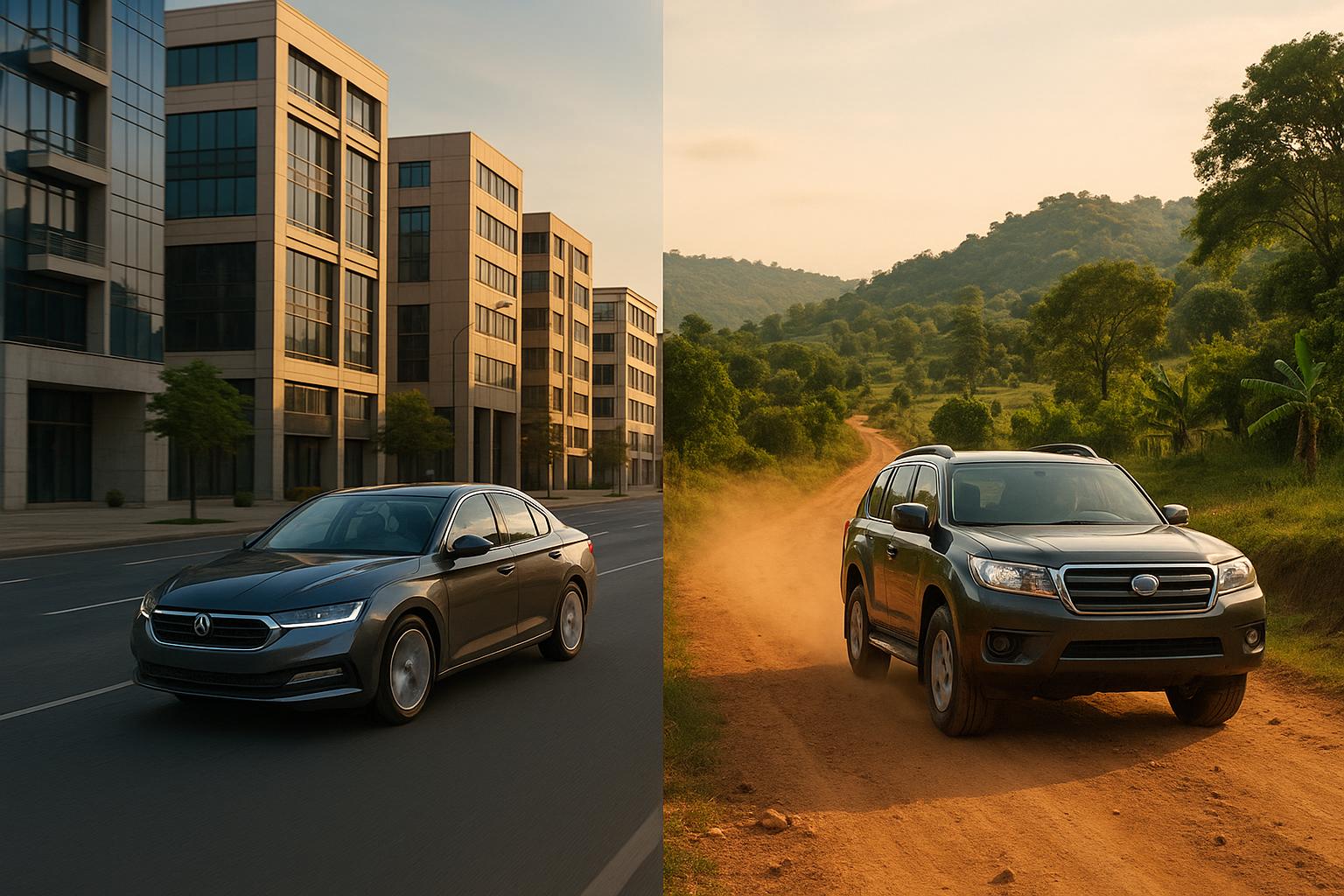
Choosing between an SUV and a sedan in Uganda depends heavily on your driving environment, budget, and personal needs. Here’s a quick breakdown to help you decide:
- Sedans are ideal for city driving, offering better fuel efficiency, lower costs, and easier handling on paved roads. They’re perfect for urban areas like Kampala and major highways.
- SUVs are better suited for rough terrain, rural areas, and Uganda’s rainy season. They provide higher ground clearance, better traction, and more space for passengers and cargo but come with higher fuel consumption and maintenance costs.
Quick Overview:
- Sedans: Cost-efficient, fuel-saving, and best for city roads.
- SUVs: Tougher, spacious, and reliable for unpaved or muddy roads.
Your choice should reflect your typical driving conditions, passenger needs, and budget. If you mostly drive on smooth roads, a sedan is a smart pick. For rural travel or challenging weather, an SUV offers the durability you need.
How to Choose Between a Sedan, SUV, or Hatchback
Driving Conditions in Uganda
Uganda’s diverse road conditions play a big role in deciding whether an SUV or a sedan is the better fit for your needs. Understanding the daily driving environment is key to making an informed choice.
Road Types and Terrain
In Kampala and other major cities, roads are generally paved and maintained, making them suitable for sedans. However, you’ll still encounter the occasional pothole or speed bump, so careful driving is necessary.
Highways in Uganda provide smoother driving conditions, but heavy rains can lead to potholes and water damage. Sedans manage well on these roads with cautious navigation.
Rural roads, often made of murram (compacted dirt), can be a mixed bag. During dry spells, they’re dusty but manageable, while the rainy season turns them into muddy, uneven paths. Low-clearance sedans may struggle with rocks and ruts, whereas SUVs, with their higher ground clearance, handle such obstacles with ease. Uganda’s varying climate makes these terrain challenges even more pronounced.
Climate and Seasonal Challenges
Uganda’s tropical weather can quickly transform dirt roads into slippery, muddy tracks, especially during the rainy season. Heavy rains often lead to flooding in low-lying areas, and vehicles with higher ground clearance are better equipped to handle shallow floods safely.
Rainy conditions also demand better traction, which SUVs often provide through features like all-wheel drive or four-wheel drive. Their specialized tires offer improved grip, making them more dependable on wet and muddy surfaces.
In contrast, the dry season brings its own challenge: dust. Unpaved roads kick up fine particles that can infiltrate your vehicle’s engine and reduce interior comfort. While both sedans and SUVs are affected, SUVs sometimes have better sealing and filtration systems to combat dust. Regardless of the vehicle type, regular maintenance is crucial to keep it in top condition.
Fuel Prices and Availability
Fuel costs in Uganda are high, making fuel economy an important consideration. Sedans, with their lighter build and smaller engines, typically offer better mileage, saving money on both city commutes and highway drives.
SUVs, on the other hand, consume more fuel due to their larger engines and heavier frames. Even with advancements in engine efficiency, they generally can’t match a sedan’s fuel economy, especially in stop-and-go traffic or on long trips.
Urban areas have plenty of fuel stations, but rural regions may experience shortages. For SUVs, which use more fuel, this means planning ahead is critical – sometimes even carrying extra fuel for longer journeys.
If your driving is mostly on well-maintained city roads, a sedan’s fuel efficiency is hard to beat. However, if your routes frequently involve rugged terrain, the added capabilities of an SUV could outweigh its higher fuel consumption.
When to Choose a Sedan
For drivers in Uganda who stick to paved roads and want to keep expenses low, sedans are a smart choice. Let’s break down what makes sedans a practical option for those navigating Uganda’s urban and highway settings.
Why Sedans Stand Out
Sedans come with a three-box design that lowers their center of gravity, which improves stability and handling on smooth, paved roads. This design makes them a great option for city driving and highway cruising.
One of their biggest advantages is fuel efficiency. Sedans are lighter and often equipped with smaller engines, which means they consume less fuel compared to larger vehicles. In Uganda, where fuel prices can be steep, this translates to noticeable savings over time.
Another plus? Sedans tend to be more budget-friendly overall. They’re generally cheaper to buy than SUVs, and their simpler mechanics mean lower costs for maintenance, repairs, and even insurance.
Comfort is another area where sedans shine. Designed for paved roads, they offer a smooth ride with minimal noise and body roll. Many modern sedans also come with advanced safety features, contributing to strong crash-test ratings and peace of mind for drivers.
Best Places for Sedans
Sedans are ideal for Uganda’s urban areas, like Kampala and other major cities, where roads are well-paved. Their compact size and tight turning radius make them easy to park and maneuver in heavy traffic.
They’re also well-suited for Uganda’s main highways, which are mostly smooth asphalt. On longer trips, drivers can enjoy the sedan’s superior handling and fuel efficiency.
Sedans work best for professionals, couples, and small families who primarily drive on smooth roads. However, if your routes include unpaved or rough terrain – common in rural areas or when heading to remote lodges – a sedan’s low ground clearance might not be up to the task.
Cost-Effective and Easy to Maintain
One of the biggest selling points for sedans in Uganda is their economical operation. With their excellent fuel efficiency and simpler mechanics, sedans offer long-term savings. Models like the Toyota Corolla, Honda Civic, and Nissan Sunny are particularly popular because they have widely available and affordable parts, making them a great choice for budget-conscious buyers or first-time car owners.
If your driving is mostly on paved urban roads or highways, a sedan provides an efficient and cost-effective solution – without the added expense of off-road capabilities you might never need.
sbb-itb-7bab64a
When to Choose an SUV
If a sedan’s efficiency doesn’t quite cut it on tougher terrains, an SUV might be the better choice. While sedans thrive in city environments, SUVs shine when the journey takes you beyond urban areas or onto unpredictable roads.
What SUVs Offer
SUVs, short for Sport Utility Vehicles, are designed with features that set them apart from sedans. One key advantage is their higher ground clearance, which helps them navigate potholes, speed bumps, and uneven terrain without damaging the undercarriage – essential for handling Uganda’s rural and poorly maintained roads. Additionally, many SUVs come equipped with All-Wheel Drive (AWD) or Four-Wheel Drive (4WD) systems. These features distribute power to all four wheels, offering better traction and control on muddy, slippery, or uneven roads, especially during heavy rains.
Another standout feature is the spacious interior. SUVs offer more room for passengers, luggage, and cargo, making them ideal for families or anyone who frequently transports goods. The elevated seating position also provides better visibility, which is particularly useful in heavy traffic or on unfamiliar routes.
However, these benefits come with some drawbacks. SUVs tend to consume more fuel due to their larger engines and heavier build. With fuel prices in Uganda reaching UGX 5,500 per liter in 2025, annual fuel costs for SUVs covering 12,427 miles (20,000 km) can range from UGX 8,460,000 to 11,000,000, depending on the vehicle’s fuel efficiency. Additionally, SUVs are typically more expensive to purchase, insure, and maintain compared to sedans.
Where SUVs Work Best
SUVs are particularly well-suited for Uganda’s rural and challenging terrains. If your regular routes include upcountry trips to visit family, access farmland, or reach remote business locations, an SUV’s higher ground clearance makes it easier to handle potholes, humps, and rough rural trails – challenges that could damage a sedan.
They also excel on steep hills and mountainous terrain. The combination of powerful engines and AWD/4WD systems ensures the traction needed to climb inclines safely, even on wet or loose surfaces.
For those living in or frequently traveling to areas with unpaved or poorly maintained roads, an SUV is often the most practical option. While Uganda’s major highways and city streets are generally smooth, many secondary roads and rural areas lack proper surfacing.
SUVs also perform well in Uganda’s varying weather conditions. With temperatures ranging from 75°F to 91°F (24°C to 33°C) and peaks of up to 104°F (40°C) in the north during January and February, along with frequent thunderstorms and rain showers, having a vehicle that can handle wet and slippery conditions is a significant advantage.
Space and Family Requirements
For families or anyone who regularly transports multiple passengers, SUVs offer a level of space that sedans simply can’t match. Most SUVs comfortably seat five to seven people and provide ample cargo space for groceries, equipment, or luggage. This makes them perfect for family outings to national parks or trips to visit relatives in rural areas.
The added cargo capacity is also a plus for those who use their vehicle for both personal and business needs. Whether you’re transporting inventory, equipment, or supplies, SUVs offer the flexibility to carry cargo and passengers without needing a separate commercial vehicle.
Popular Japanese SUVs like the Toyota Hilux (priced between UGX 55 million and 80 million for used models) and Subaru Forester (UGX 35 million to 55 million for used models) dominate Uganda’s market. These vehicles are favored for their lower maintenance costs – about 20% less than their European counterparts – and the availability of spare parts. For instance, genuine Toyota parts are widely accessible in markets like Kawempe, often priced 15% below retail. This availability helps keep long-term ownership costs manageable, even with a higher initial investment.
When planning to buy an SUV, it’s essential to consider the total cost of ownership. Beyond the purchase price, factor in import duties (roughly 25% on used vehicles), shipping costs from Japan (UGX 2 million to 4 million), and local taxes and duties, which can increase final expenses by 30% to 40%. On the bright side, SUVs tend to retain higher resale values due to their versatility, which can help offset some of these costs when it’s time to sell.
For those who frequently travel off-road, need extra space for family or business, or face harsh weather conditions, an SUV is often worth the higher costs. On the other hand, if your driving is mostly confined to urban areas with paved roads, the added capabilities of an SUV might not justify the expense.
How to Make Your Decision
Choosing between a sedan and an SUV comes down to understanding your own needs and how each vehicle’s features align with them. By weighing your lifestyle, driving habits, and budget, you can make a choice that works for you.
Rate Your Needs
Start by thinking about where and how you drive. Do you stick to paved city streets, or do you venture onto rugged, unpaved roads? If your daily routes are smooth and predictable, a sedan might be the perfect fit. But if your travels take you through rough terrain or rural areas, an SUV’s higher ground clearance and off-road readiness could make a big difference.
Next, consider how many passengers and how much cargo you typically carry. Sedans are great for individuals or small groups, offering just enough space for everyday needs. On the other hand, if you’re regularly transporting bulky items or a larger group of people, an SUV provides the extra room you need.
Think about the conditions you face on the road. Are you dealing with steep hills, potholes, or even flooded roads during rainy seasons? An SUV’s durability and features like all-wheel drive can handle those challenges with ease. But if your obstacles are minor, a sedan will handle them just fine.
Lastly, don’t forget your budget – not just the purchase price, but the ongoing costs as well. Sedans generally cost less to fuel, maintain, and insure, while SUVs come with higher expenses in these areas. Balancing these factors with your financial situation will help you make a smart decision.
Here’s a quick comparison to help you match your priorities with what each vehicle offers.
Sedan vs SUV Comparison
| Factor | Sedan | SUV |
|---|---|---|
| Fuel Economy | More efficient | Less efficient |
| Fuel Cost | Lower | Higher |
| Ground Clearance | Lower, ideal for city roads | Higher, handles rough terrain |
| Purchase Price | More affordable | Higher upfront cost |
| Seating Capacity | Usually up to 5 passengers | Often seats 5 to 7 passengers |
| Cargo Space | Limited trunk space | Larger cargo area |
| City Driving | Easier to park and maneuver | Harder to handle in tight spaces |
| Rural Roads | Less suited for rugged conditions | Better equipped for off-road driving |
| Maintenance Costs | Lower | Higher |
| Resale Value | Moderate resale potential | Higher resale potential |
| Parking Ease | Easier in tight spaces | More challenging in urban areas |
This table gives a clear picture: sedans shine in efficiency and affordability, while SUVs excel in versatility and handling tougher conditions. Your driving habits and priorities will steer you toward the right choice.
Buyer Profiles
Here are a few examples of who might benefit from each type of vehicle:
- City commuters in Kampala or Entebbe: If your life revolves around work commutes, errands, and short trips, a sedan’s fuel efficiency and ease of parking make it a practical choice.
- Families with young children: For smaller families, a sedan is often enough for school runs and weekend outings. Larger families or those traveling to rural areas may prefer an SUV for its extra space and adaptability.
- Small business owners and contractors: If you need a vehicle for both personal and work use, an SUV offers the cargo space to transport tools, supplies, or inventory without requiring a separate commercial vehicle.
- Upcountry travelers: For those navigating unpaved roads, river crossings, or steep hills, an SUV provides the ground clearance and durability to handle these challenges safely.
- Budget-conscious first-time buyers: Sedans are a great entry point, offering lower costs and reliable performance. As your needs grow, upgrading to a larger vehicle later is always an option.
- Retirees and empty nesters: If your driving is mostly local and you don’t need extra seating or cargo space, a sedan delivers all the comfort and functionality without the higher costs of an SUV.
Ultimately, the best vehicle for you is one that fits your everyday needs, not just what’s popular. A car that aligns with your lifestyle and driving conditions will serve you well for years to come.
Conclusion
When deciding between an SUV or a sedan, think about what you actually need for your daily life. Both vehicle types are well-suited for Uganda, but they shine in different scenarios. Sedans are more fuel-efficient, cost less to buy, and come with lower maintenance expenses, making them a smart choice for city dwellers and anyone focused on saving money while driving on paved roads. On the other hand, SUVs provide higher ground clearance, extra cargo space, and the toughness to handle rough terrain, making them ideal for rural travel or challenging road conditions.
Your driving environment should guide your decision. If most of your trips are within Kampala, along the Entebbe highway, or other smooth tarmac routes, a sedan’s fuel efficiency and ease of parking will meet your needs. However, if your journeys often take you onto unpaved roads, through potholes, or across muddy paths – especially during Uganda’s rainy season – an SUV’s rugged design and capabilities will be worth the extra cost. Also, think about how many passengers or how much cargo you’ll typically carry. Sedans are great for small groups and lighter loads, while SUVs are better suited for larger families or transporting bulky items like business equipment.
Don’t forget to consider the total cost of ownership. This includes fuel, maintenance, and insurance over the years you plan to own the vehicle. Sedans are generally cheaper in all these areas, making them a practical option for first-time buyers or anyone on a tight budget. If you can afford higher running costs and genuinely need the added benefits of an SUV, the investment could be worthwhile. The decision ultimately comes down to finding the right balance between cost and performance.
Both sedans and SUVs have their strengths, depending on where and how you drive. Sedans excel in urban efficiency, while SUVs are built for versatility on rougher roads. Choose the option that keeps you safe, comfortable, and within your budget for the long haul.
For in-depth reviews of popular models like the Toyota Corolla, Honda Accord, Toyota RAV4, and Nissan X-Trail, head over to AutoMag.ug. There, you’ll find detailed insights on fuel economy, maintenance costs, and reliability tailored to Ugandan driving conditions. When you’re ready to make a decision, AutoMag.ug also offers comparison guides, ownership cost estimates, and real experiences from other Ugandan drivers. With that knowledge and a clear sense of your own needs, you’ll be well-prepared to pick the vehicle that fits your lifestyle perfectly.
FAQs
How do I choose between an SUV and a sedan for driving in Uganda?
When deciding between an SUV and a sedan in Uganda, a few important factors come into play. Start with the road conditions you’ll face. SUVs are built to handle rough terrain and unpaved roads, which are common in many parts of Uganda. Sedans, however, are better suited for smoother, urban roads.
Next, think about fuel efficiency. Sedans typically consume less fuel, making them a more economical choice for daily commutes or city driving. SUVs, while versatile, generally use more fuel, which could add up over time.
Your budget and lifestyle are also crucial. SUVs often come with a higher price tag and increased maintenance costs, but they provide more space and flexibility, making them a great option for families or outdoor enthusiasts. Sedans, on the other hand, are usually more affordable, easier to maintain, and perfect for individuals or smaller families.
Lastly, consider the resale value. In Uganda, SUVs often retain their value better due to their popularity and ability to handle diverse driving conditions, which makes them a sought-after choice in the used car market.
By carefully evaluating these aspects, you can make an informed decision that aligns with your needs and driving habits.
How do fuel prices and availability in Uganda influence the choice between an SUV and a sedan?
Fuel prices in Uganda tend to fluctuate, so fuel efficiency is an important factor to think about when picking a vehicle. If saving on fuel is a priority, sedans are often the better choice. They typically consume less fuel, making them easier on your wallet for both daily commutes and long-distance trips.
On the other hand, if your driving often involves rough or unpaved roads, an SUV might be more suitable. SUVs usually come with more powerful engines and are better equipped to handle challenging terrain. Weigh your usual driving conditions and fuel budget carefully to decide which option fits your lifestyle best.
What are the long-term costs of owning a sedan compared to an SUV in Uganda?
In Uganda, sedans are an appealing option for those looking to keep long-term expenses manageable. They tend to use less fuel, come with lower maintenance costs, and are easier to maneuver through crowded city streets. These qualities make sedans a smart pick for daily commutes and urban driving.
SUVs, on the other hand, typically come with higher running costs. They consume more fuel, repairs can be pricier, and insurance rates are often steeper. That said, SUVs shine when it comes to handling rough roads and challenging terrains. Plus, they often hold their value well, making them a practical choice for drivers who frequently venture off the beaten path.
Related Blog Posts
- SUV vs Sedan: Best Choice for Ugandan Roads
- Most popular cars in Uganda
- SUV sales trends in Uganda
- Top 5 sedans for Ugandan roads: Affordable and reliable options